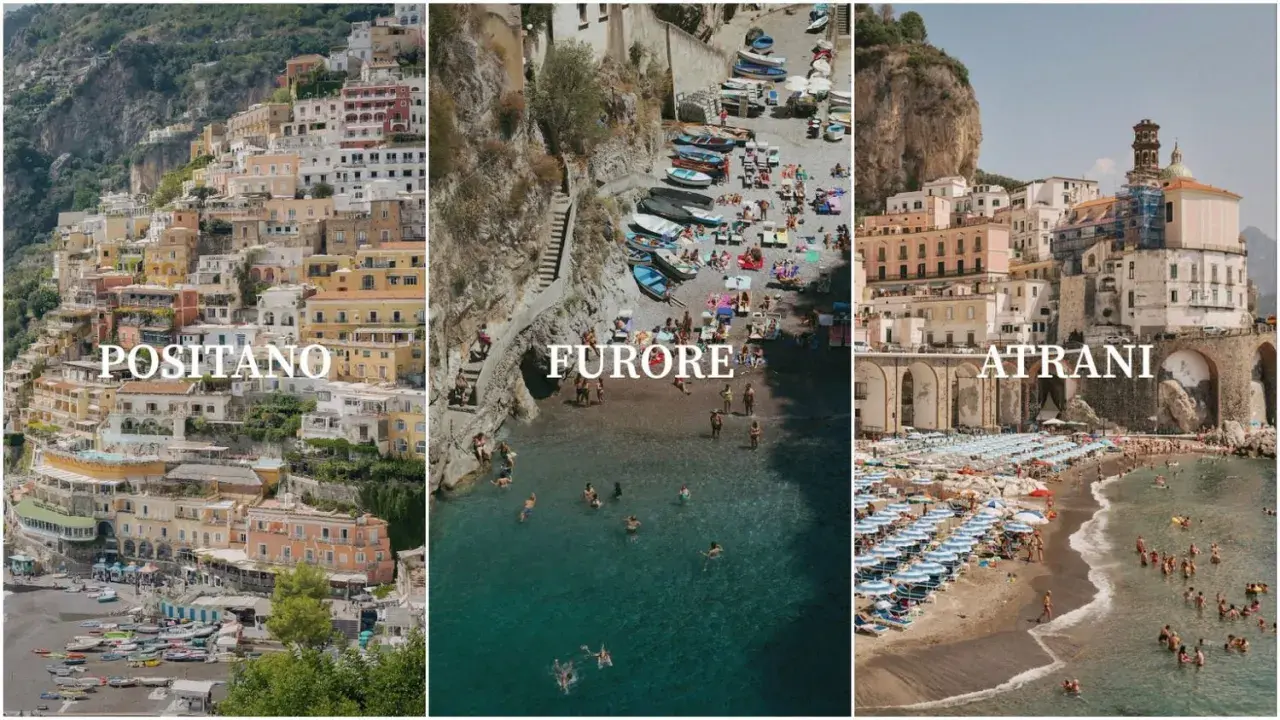
The Amalfi Coast is not one single town but a chain of municipalities, each with a different rhythm, landscape, and reason to stop. The question of what towns make up the Amalfi Coast has a clean answer once you separate the postcard shoreline from the broader UNESCO landscape. In practice, that means knowing which places are the classic seaside stops, which ones sit higher in the hills, and which names travelers often mix up with the coast even though they are technically something else.
The coast is best read as 15 municipalities, not one town
- The Amalfi Coast UNESCO landscape is made up of 15 municipalities, not just the famous strip of cliffside villages.
- The best-known seaside names are Positano, Amalfi, Ravello, Praiano, Maiori, Minori, Atrani, Cetara, Vietri sul Mare, Conca dei Marini, and Furore.
- Tramonti, Scala, Corbara, and Sant'Egidio del Monte Albino are part of the wider coastal territory even though they feel more inland or uphill.
- Some names people associate with the coast, such as Nocelle or Pogerola, are hamlets inside municipalities, not separate municipalities.
- For trip planning, it helps to think in clusters instead of trying to treat the coast like one continuous resort town.
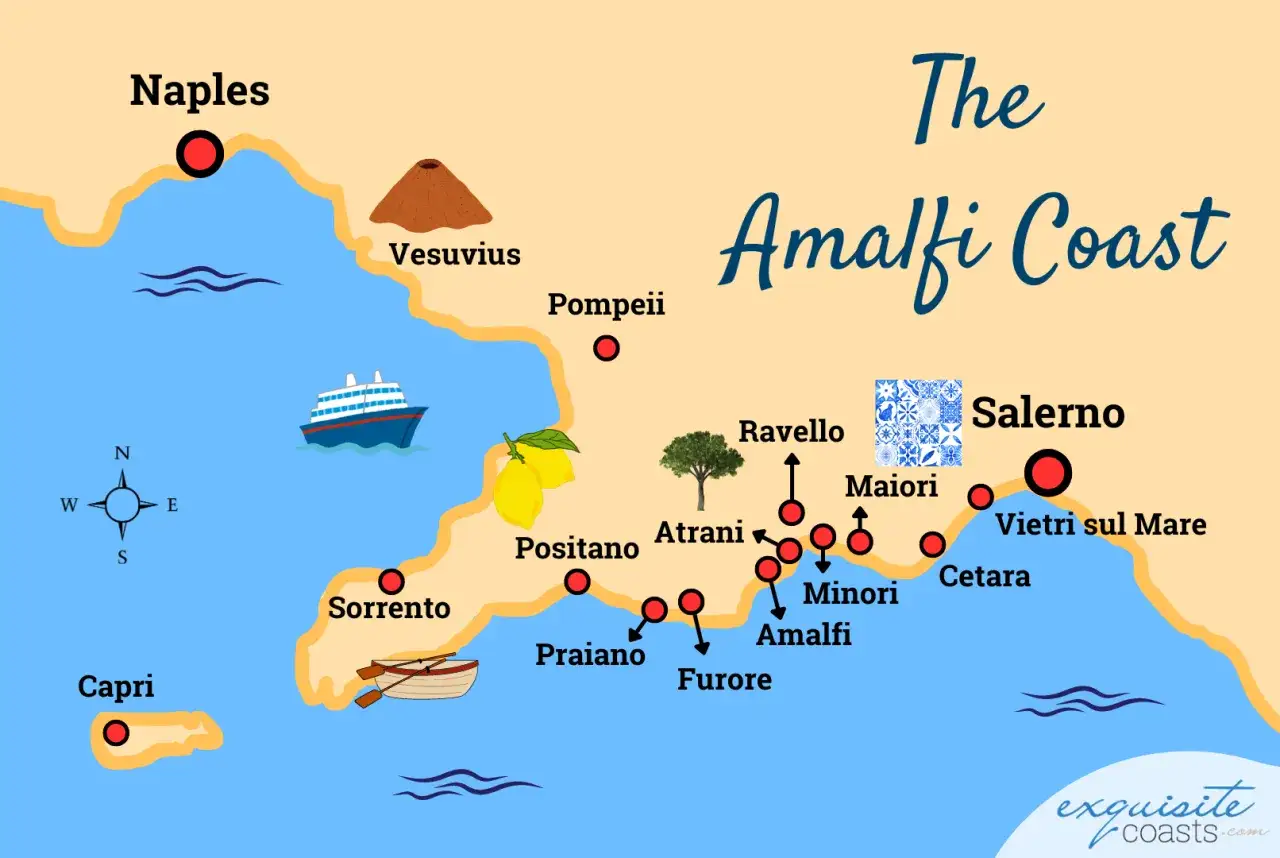
The official list runs to 15 municipalities
In Italian terms, the Amalfi Coast is a territorial landscape made up of comuni, which are municipalities. That matters because a comune can be a beachfront town, a hill village, or an inland settlement that still belongs to the protected coastal zone. The UNESCO view of the coast is broader than the visitor's view, and that is where most confusion begins.
If you want the full list, these are the municipalities that make up the Amalfi Coast landscape:
| Municipality | Where it sits | Why it matters |
|---|---|---|
| Vietri sul Mare | Eastern gateway | The usual first stop coming from Salerno, known for ceramics and an easy introduction to the coast. |
| Cetara | Eastern shoreline | A working fishing town with a strong food identity, especially anchovies and colatura di alici. |
| Maiori | Central shoreline | Valuable for its wider beach, simpler logistics, and more resort-like feel. |
| Minori | Central shoreline | Quieter than Maiori, with Roman heritage and a more relaxed pace. |
| Atrani | Next to Amalfi | Small, dense, and walkable, with a strong old-village character. |
| Amalfi | Central hub | The historic heart of the coast and one of the easiest bases for first-time visitors. |
| Conca dei Marini | Between Amalfi and Furore | Known for quieter scenery, the bay setting, and access to the Emerald Grotto area. |
| Furore | Cliff and fjord landscape | One of the coast's most dramatic landforms, especially for travelers who like scenery over beaches. |
| Praiano | Mid-coast | A calmer alternative to Positano, with good sunset views and strong walking access. |
| Positano | Western end of the classic strip | The most iconic vertical town on the coast and the one most travelers picture first. |
| Ravello | Hilltop above the coast | Best for views, gardens, and culture rather than beach time. |
| Scala | Above Amalfi | A quieter mountain town with trail access and a strong historic feel. |
| Tramonti | Inland valley belt | Important for agriculture, local food, and a less compressed version of the coast. |
| Corbara | Inland edge | Shows the agricultural backbone of the landscape rather than the tourist shoreline. |
| Sant'Egidio del Monte Albino | Inland foothills | Part of the wider UNESCO territory and useful for understanding the coast beyond the sea. |
Shorter lists usually stop at the better-known seaside names and leave out the inland communes. That is fine if you are planning a beach holiday, but it is not the full answer. Once that distinction is clear, the next useful step is separating the towns that feel like classic Amalfi Coast postcards from the ones that work better as quiet bases.
The towns most visitors picture first
If I were answering this for a traveler with limited time, I would focus on the towns that shape the coast's identity in practice. These are the places that most often appear in hotel searches, ferry plans, and day-trip itineraries, and they are also the ones where the trade-offs become obvious very quickly.
| Town | Best known for | Main trade-off |
|---|---|---|
| Positano | Iconic views, designer boutiques, and the classic stacked-houses look | Expensive, steep, and heavily visited |
| Amalfi | Historic center, cathedral, ferry access, and central location | Busy, especially in peak season |
| Ravello | Villas, gardens, and some of the best views on the coast | No real beach at town level |
| Praiano | Quieter atmosphere and a strong sunset reputation | Less obvious nightlife and a smaller center |
| Maiori | The broadest beach and a more straightforward seaside stay | Less dramatic than the cliff towns |
| Minori | Food, Roman remains, and a gentler scale | Smaller and quieter than the headline names |
| Atrani | A tiny, old-world center just next to Amalfi | Very limited space and fewer facilities |
| Cetara | Fishing culture and local seafood traditions | More local than luxurious |
| Vietri sul Mare | Ceramics and an easy arrival point from Salerno | Feels more like a gateway than a showpiece |
Atrani is the one I think many travelers underrate. It sits so close to Amalfi that people often treat it as an add-on, but the compact scale makes it feel more intimate than most of the coast. If you prefer a place that feels lived-in rather than staged, that matters a lot. Those headline towns are the easiest to recognize, but they are still only part of the picture.
The inland municipalities that change the picture
The coast makes more sense once you look away from the sea for a moment. The inland and hill municipalities explain why this stretch of Campania feels like a landscape with layers rather than a simple row of beach towns. They also show why the area is better understood as a cultural route than as a line of hotel stops.
Tramonti
Tramonti is the strongest reminder that the Amalfi Coast is also an agricultural zone. It spreads across a valley rather than clinging to a sheer shoreline, and that gives it a wider, greener feel. I would choose it for walking, local food, and a slower pace, not for a beach-centered stay.
Ravello and Scala
Ravello is the polished hill town, famous for its views, villas, and cultural atmosphere. Scala is quieter and rougher around the edges, which is exactly why it appeals to people who want trail access and less crowd pressure. Together they show how quickly the coast rises upward from the sea.
Read Also: REI Magma 15 Weight - Is It Right For Your Pack?
Corbara and Sant'Egidio del Monte Albino
These municipalities are easy to skip if you only follow the obvious tourist route, but they are part of the real answer. They sit on the inland edge of the Amalfi landscape and help explain the farming terraces, residential pockets, and historic settlements that support the more famous coastal strip. Without them, the geography looks flatter than it really is.
That inland layer changes the way I read the coast, and it also changes how I would choose a place to sleep. The next decision is not just which town looks prettiest, but which cluster actually fits the trip.
How I would group them for a trip
I rarely recommend trying to move base every night on the Amalfi Coast. The towns are close on a map, but the road network, seasonal traffic, and ferry connections mean that distance is not the same as convenience. A better approach is to pick one or two clusters and let the coast work around them.
| Trip goal | Best towns to base in | Why I would choose them |
|---|---|---|
| First-time postcard trip | Amalfi or Positano | They are the classic names, easiest to picture, and simple to combine with ferries or short excursions. |
| Quieter scenic stay | Praiano or Ravello | Both give strong scenery without the same level of pressure that Positano and Amalfi can carry. |
| Beach-first holiday | Maiori or Vietri sul Mare | They are more practical if you care about sand, access, and a less vertical day-to-day routine. |
| Food and local atmosphere | Cetara, Minori, or Tramonti | These places feel more rooted in local life and less shaped by the luxury market. |
| Walking and views | Scala, Furore, or Praiano | They connect well with the coast's trail network and give you stronger landscape drama. |
One practical note: many visitors use Sorrento as a base, but I would not count it as one of the Amalfi Coast municipalities. It sits nearby and works well for transport, yet it belongs to a different stretch of coastline. Once you keep that boundary clear, the itinerary becomes easier to trust and much harder to overcomplicate. Seen that way, the geography starts to do useful work instead of just adding names to a list.
The simplest way to remember the Amalfi Coast towns
The easiest mental model is simple: the Amalfi Coast has a famous seaside core, a hill-town layer, and an inland agricultural layer. UNESCO treats it as a cultural landscape for that reason, because the terraces, paths, and working villages are part of the same place as the sea. That is the part many quick guides miss, and it is why the coast feels richer than a string of beach towns.
- Classic shoreline names: Amalfi, Atrani, Cetara, Conca dei Marini, Furore, Maiori, Minori, Positano, Praiano, and Vietri sul Mare.
- Hill and view-focused names: Ravello and Scala.
- Inland names that still belong to the wider UNESCO landscape: Tramonti, Corbara, and Sant'Egidio del Monte Albino.
- Hamlets such as Nocelle and Pogerola belong inside municipalities, so they are part of the experience without being separate towns.
If I had to reduce the answer to one line, I would say this: the Amalfi Coast is a chain of distinct municipalities, and the trip gets better as soon as you stop thinking of it as one town.