Sicily works best when the airport matches the part of the island you plan to explore. The practical question behind international airports in Sicily is less about labels and more about fit: east coast, west coast, long-haul access, and how much time you want to spend on the road after landing. In this guide I break down the airports that matter in 2026, what kind of international service they handle, and how to choose the arrival point that saves the most time.
What matters most before you book
- Catania is the strongest all-around gateway for east and southeast Sicily, with broad European service and a Montreal link in 2026.
- Palermo is the better choice for the west, with a deep European network and seasonal New York service in 2026.
- Trapani and Comiso can be excellent for the right itinerary, but both are more seasonal and route-dependent.
- For Sicily, the airport decision usually matters more than shaving a few dollars off the fare.
- If you are coming from the US, the best nonstop option is the one that matches your final base, not just the cheapest headline price.
The four Sicilian airports that actually shape most trips
I treat Sicily’s air network as two major gateways and two specialist airports. That is the cleanest way to think about it, because not every airport with international traffic plays the same role for visitors. Catania and Palermo are the main workhorses, while Trapani and Comiso are useful when your trip lines up with their location and schedule.
| Airport | IATA | International profile in 2026 | Best use case |
|---|---|---|---|
| Catania Fontanarossa | CTA | Broadest network on the island, strong European coverage, plus Montreal in 2026 | East coast, Mount Etna, Taormina, Syracuse, Noto |
| Palermo Falcone Borsellino | PMO | Wide European network and seasonal New York-JFK and Newark service in 2026 | Palermo, Cefalu, Monreale, west and northwest Sicily |
| Trapani Birgi | TPS | Smaller, more seasonal, but very useful European links in summer | Trapani, Erice, Marsala, San Vito Lo Capo, Egadi Islands |
| Comiso | CIY | Niche seasonal network with a smaller route list | Ragusa, Modica, Scicli, and the southeast Baroque towns |
The key point is simple: the word international does not automatically mean a huge year-round network. In Sicily, it often means Europe first, then a handful of North African or long-haul services, usually concentrated in peak season. That distinction matters a lot once you start planning where to land.
Which airport fits which part of the island
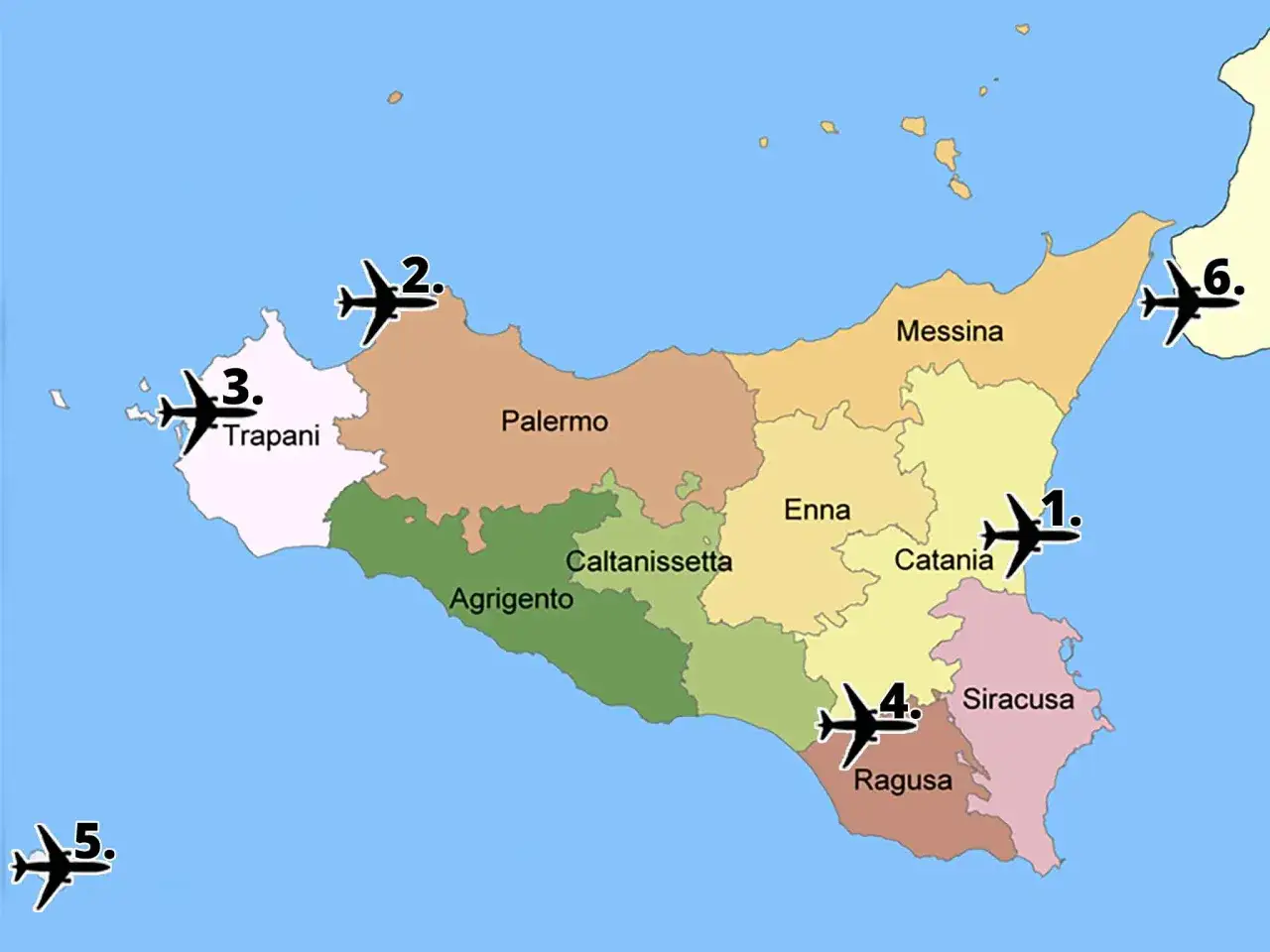
The fastest way to choose is to start with the destination on the island, not the airfare. If you already know where you will sleep, eat, and drive from, the airport choice becomes obvious very quickly.
| If you are heading to | My airport pick | Why it works |
|---|---|---|
| Etna, Taormina, Syracuse, Noto, the east coast | Catania | Shortest and simplest arrival for the eastern half of the island |
| Palermo, Monreale, Cefalu, northwest beaches | Palermo | Best match for the capital and the surrounding coast |
| Trapani, Erice, Marsala, San Vito Lo Capo, Egadi Islands | Trapani | Most direct fit when your base is in the far west |
| Ragusa, Modica, Scicli, the southeast Baroque towns | Comiso | Closest airport to the southern Baroque triangle |
| Agrigento and the southwest | Palermo, sometimes Trapani | Usually the least awkward overall, depending on your exact route |
As a rule of thumb, Catania to Taormina is roughly an hour by car, Palermo to the city center is about 35 to 45 minutes, Trapani to Trapani town is around 20 minutes, and Comiso to Ragusa is usually about 25 to 30 minutes. Those transfer times can look small on paper, but they change the feel of a trip more than most people expect. A slightly higher fare into the right airport often beats a bargain flight that forces a long cross-island drive.
If I am planning a coastal or road-trip itinerary, I think in terms of arrival geometry. The right airport removes friction, and the wrong one adds it before the holiday has even started. That becomes even more important once you look at how the route network behaves in 2026.
What international flying looks like in Sicily in 2026
In 2026, Sicily’s international flying is still heavily European, with a few important long-haul exceptions. Palermo Airport’s current route board includes New York-JFK and Newark, while Catania Airport has added Montreal for the 2026 season. Those are the kinds of routes that matter to US travelers because they reduce the need for a mainland connection in Italy.
Trapani and Comiso are more seasonal and more schedule-sensitive. Trapani’s summer network includes destinations such as Brussels-Charleroi, Düsseldorf-Weeze, Karlsruhe/Baden, Katowice, London Stansted, Manchester, Malta, Porto and Seville. Comiso’s current timetable is narrower, with seasonal routes that include Tirana, Katowice, Lille and Pisa. That does not make them weak airports; it just means they are better as precise tools than as all-purpose gateways.
Two terms are worth keeping straight. Seasonal routes operate only for part of the year, usually the summer schedule. Low-cost carriers are budget airlines that keep headline fares low by charging separately for extras like checked bags and seat selection. In Sicily, those two factors can change the real cost of a trip more than people notice at first glance.
For visitors coming from the US, my practical advice is to compare the nonstop first, then compare the airport-to-hotel transfer. That order usually gives a more honest answer than chasing the lowest ticket price alone. It is especially true if you are landing in summer, when route frequency is strongest but still not evenly spread across the island.
How I would get from the airport to the right base
Once you land in Sicily, the airport transfer is often the part that reveals whether you made the right choice. I would not treat all four airports the same way, because the ground transport options are not equally convenient.
- Catania: best if you want a rental car and a clean start toward Taormina, Syracuse, and Mount Etna.
- Palermo: best if you want a city-first arrival and then a move toward Cefalu or the western coast.
- Trapani: best if you are going straight to the far west, but I would still prebook transport if arrival timing is tight.
- Comiso: best when your trip is already centered on Ragusa or Modica, because the airport is a practical fit rather than a broad hub.
For a rough sense of scale, Catania to the city center is usually about 15 to 20 minutes, Palermo to the city is around 35 to 45 minutes, Trapani to Trapani is about 20 minutes, and Comiso to Ragusa is often 25 to 30 minutes. Those are normal driving estimates, not guarantees, and summer traffic can stretch them. Still, they show why I favor the airport that shortens the first and last leg of the trip, even if the fare is not the absolute lowest.
If I land late in the day, I lean even more toward a simpler airport-to-base match. A 25-minute transfer feels very different from a 90-minute one after a long-haul flight, especially if the route includes narrow roads, check-in delays, or a car pickup that takes longer than expected. This is where many Sicily itineraries quietly lose an hour or two without any real benefit.
The booking mistakes I see most often
The biggest mistake is treating the airport as an afterthought. I have seen too many trips become more tiring than they needed to be because the traveler booked the cheapest fare and then paid for the difference with time, transfers, and extra logistics.
- Choosing the cheapest fare, then discovering that the drive to the hotel eats up half the day.
- Assuming a summer route will still run in winter, even though the schedule is seasonal.
- Forgetting how quickly baggage and seat fees can change the total price on a low-cost carrier.
- Landing late at a smaller airport and expecting the same ground-transport frequency you would get at a major hub.
- Thinking “international” always means frequent long-haul service, which is not how Sicily works.
The first mistake is the one I would watch most carefully. On paper, a small fare difference can look clever, but once you add a rental car, a longer transfer, or a hotel night lost to travel fatigue, the savings disappear fast. In Sicily, route fit is the real economy.
The simplest way to choose without overthinking it
If I had to reduce the whole decision to a few lines, it would look like this.
- East coast, Etna, Taormina, Syracuse, or Noto: choose Catania.
- Palermo, Cefalu, Monreale, or the northwest: choose Palermo.
- Trapani, Erice, Marsala, or the Egadi Islands: choose Trapani if the route schedule works.
- Ragusa, Modica, or Scicli: check Comiso first.
- Coming from the US: compare the nonstop option first, then compare the transfer to your final base.
That is the framework I would use myself. It keeps the trip focused on where you are actually going, not just on the cheapest ticket in the search results. In Sicily, that one decision usually makes the entire journey feel calmer, shorter, and more intentional.