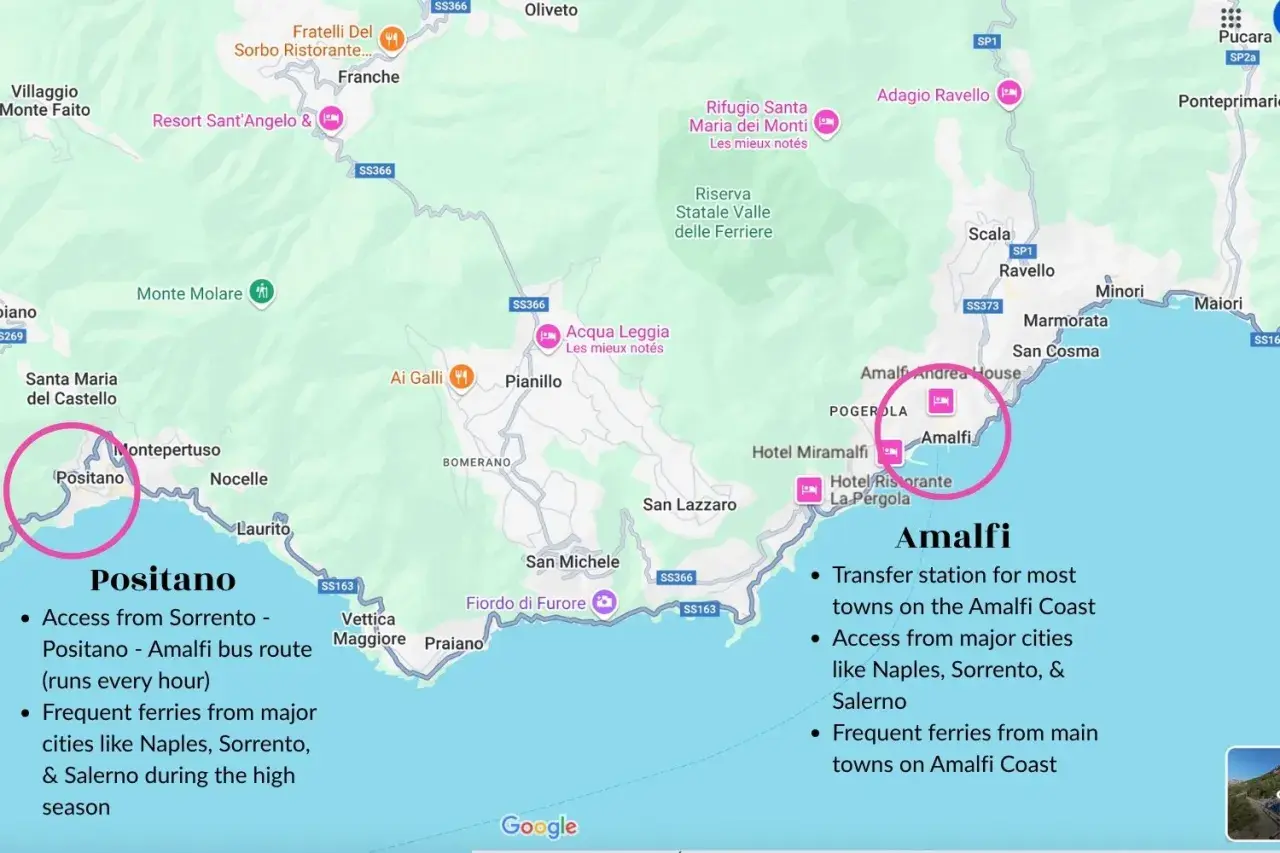
A clear Amalfi Coast towns map matters because this coastline looks compact on paper but behaves very differently once you are actually there. The road is narrow, the towns rise steeply above the sea, and the best base depends on whether you care most about ferries, views, beaches, or an easier pace. Here I break down the layout, the towns worth prioritizing, and the planning choices that make the trip smoother.
Key things to know before you plot the coast
- The Amalfi Coast is best planned as a chain of separate stops, not one continuous beach strip.
- Positano and Amalfi are the main anchors, while Ravello, Praiano, and Vietri sul Mare serve different travel styles.
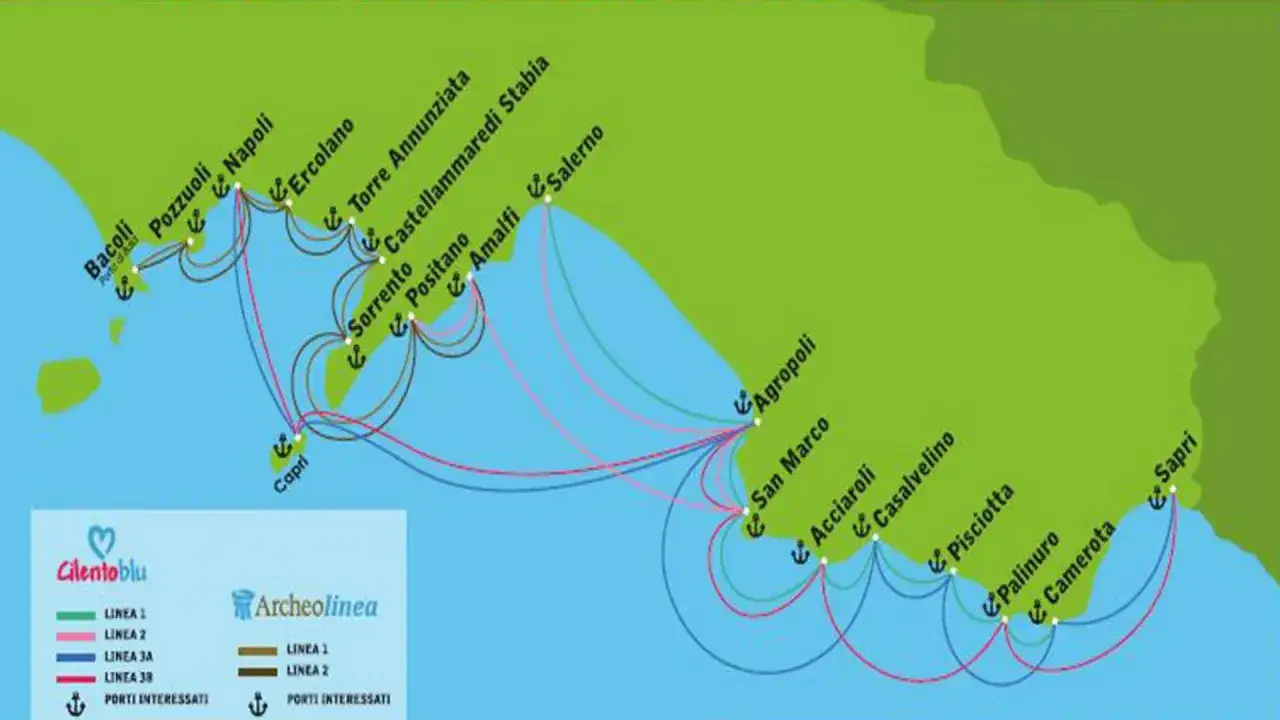
- Ferries are usually the fastest scenic link between the main coastal towns from spring through autumn.
- Driving is possible, but traffic, parking, and narrow roads make it a poor default choice for most visitors.
- For a short trip, I would focus on 3 to 5 towns rather than trying to see every village.
How to read the coastline from west to east
When I look at an Amalfi Coast towns map, I do not read it like a normal road trip map. I read it like a vertical landscape with a few coastal anchors, some cliffside villages, and a handful of inland towns that sit above the main road. That matters because a five-kilometer stretch can feel short on paper and surprisingly slow in real life.
The coastline is usually understood as a string of 13 towns: Positano, Praiano, Furore, Conca dei Marini, Amalfi, Atrani, Ravello, Scala, Minori, Tramonti, Maiori, Cetara, and Vietri sul Mare. Some travel guides also fold in nearby gateways like Sorrento and Salerno, but I treat those as access points rather than true Amalfi Coast towns.
The easiest way to think about the map is this:
- Western side has the postcard towns like Positano and Praiano.
- Middle section clusters around Amalfi, Atrani, and the scenic stops near Furore and Conca dei Marini.
- Eastern end opens up into Maiori, Minori, Cetara, and Vietri sul Mare, which feel flatter and less squeezed in.
- Inland high points like Ravello and Scala sit above the coast, not directly on the sea.
If I had to give one practical reading rule, it would be this: do not trust straight-line distance. On the coast, elevation, curves, and traffic change the real travel time far more than the map scale does. Once that clicks, the next step is deciding which towns deserve your limited time in the first place.
The towns I would prioritize on a first trip
I would not try to “collect” all 13 towns on a short trip. That usually turns into a lot of transit and not much actual time in each place. Instead, I would focus on a smaller group that gives you the best mix of scenery, transport, and atmosphere.
| Town | Why it matters | Best for | Watch-out |
|---|---|---|---|
| Positano | The most iconic cliffside town, with dramatic views and the strongest visual payoff. | First-timers, romance, photos, upscale stays. | It is steep, crowded, and not easy on the legs. |
| Amalfi | The transport hub and one of the most practical bases on the coast. | Ferries, buses, flexible day trips. | Busy in peak season and less intimate than smaller towns. |
| Ravello | Perched above the sea with a calmer, more refined feel. | Views, gardens, quieter evenings. | No direct beach access and you need to go down to the coast for the sea. |
| Praiano | A quieter stop between Positano and Amalfi with excellent sunset exposure. | Slower trips, couples, travelers who want less noise. | More spread out and less convenient for walking everywhere. |
| Maiori and Minori | The flattest and easiest shoreline towns, with better value and easier movement. | Families, longer stays, travelers who want fewer stairs. | Less dramatic than Positano or Ravello. |
| Vietri sul Mare | The eastern gateway, known for ceramics and easier access to Salerno. | Arrivals, practical overnights, lower-key stays. | Often overlooked by people chasing only the famous cliff towns. |
| Atrani | A tiny, elegant village right next to Amalfi. | Walkable side trip, low-key atmosphere. | Better as a stop than a base for most travelers. |
If you are building a short itinerary, I would start with Positano, Amalfi, and Ravello, then add Praiano or one of the flatter eastern towns if you have extra time. Furore and Conca dei Marini are often best treated as scenic stops rather than places to sleep. That distinction saves a lot of planning friction later, which is exactly why the next question should be where to base yourself.
Which base works best for the way you travel
Choosing a base is where many Amalfi Coast trips go wrong. People pick the prettiest town, then realize they actually wanted better ferry access, easier luggage handling, or shorter transfers. I prefer to choose the base first and the sightseeing pattern second.
| Base | Why I would choose it | Best for | Trade-off |
|---|---|---|---|
| Amalfi | Central location, strong ferry and bus connections, easy to branch in either direction. | First-time visitors who want flexibility. | Can feel busier than quieter towns. |
| Positano | The most famous views and the strongest “special trip” feeling. | Romantic trips and travelers who want a classic postcard stay. | Vertical layout means stairs, stairs, and more stairs. |
| Praiano | Quieter than Positano but still well placed for exploring the western coast. | Travelers who want beauty without as much chaos. | Less of a transport hub and more limited for spontaneous hopping. |
| Ravello | Peaceful, elegant, and rewarding if you value views over beach access. | Longer stays, slow travel, and garden lovers. | You have to travel down to the sea for swimming or ferries. |
| Maiori or Minori | Flatter streets, better practicality, and usually better value. | Families, budget-conscious travelers, and people who dislike steep climbs. | Less iconic than the headline towns. |
| Vietri sul Mare | A smart eastern-edge base with easier links toward Salerno. | Travelers arriving or departing by train from Salerno. | It is more functional than glamorous. |
My simple rule is this: if you want convenience, I would choose Amalfi; if you want the classic visual impact, I would choose Positano; if you want calm, I would look at Praiano or Ravello; if you want easier movement, I would lean toward Maiori, Minori, or Vietri sul Mare. Once that choice is made, the transport puzzle becomes much easier to solve.
How to move between towns without wasting a day
The coast looks compact, but movement is where trip planning gets real. The easiest way to get around is usually a mix of ferries, buses, and occasional walking between neighboring villages. Driving is possible, but I would not make it my default plan unless I had a specific reason and a guaranteed parking spot.
Ferries are the cleanest option for many coastal hops, especially between Amalfi, Positano, and Salerno from roughly April to October. They are scenic, they reduce motion sickness, and they usually save time. For example, a trip from Positano to Amalfi can take about 25 minutes by ferry versus around 50 minutes by car, depending on traffic. That difference adds up fast when you are crossing the coast more than once.
Buses run year-round, which makes them useful as a backup, but they get crowded and slow during peak travel times. I would use them for short inland links or when ferry schedules do not line up, not as my first choice for every transfer. Walking is excellent only for specific pairings like Amalfi and Atrani, or for people who are already comfortable with steep streets and stairs.
Driving sounds flexible until you hit the practical limits. The coastal road is narrow and winding, parking can run around €8 to €12 per hour, and spaces near the town centers are often scarce. In summer, that can turn a simple stop into a small logistics problem. If you do rent a car, I would only do it with a hotel that clearly confirms parking in advance.
For most visitors, my transport hierarchy is simple: ferry first, bus second, car only when there is no better option. That approach makes the coast feel scenic instead of stressful, and it opens the door to a smarter route order.
A route order that works for short trips
There is no single perfect itinerary, but there are definitely better and worse ways to string the towns together. I like to build a route around one central base, one scenic high point, and one quieter stretch that balances out the busy places.
- For 2 days, I would do Positano, Amalfi, and Atrani. That gives you the classic views without pretending you can see everything.
- For 3 days, I would add Ravello for a half-day or evening. It changes the rhythm of the trip because you move from shoreline energy to a quieter hilltop perspective.
- For 4 to 5 days, I would include Praiano plus one of the flatter eastern towns, usually Maiori or Minori, then finish with Vietri sul Mare if I wanted a less touristy edge.
- If you want scenic stops rather than extra overnights, I would use Furore and Conca dei Marini as pauses between the major towns, not as anchors.
The mistake I see most often is zig-zagging too much. Travelers bounce from one famous town to another without allowing for the real pace of the coast. I get better trips when I think in clusters: western glamour, central logistics, and eastern practicality. That keeps the days balanced and reduces the amount of backtracking.
Once your route has a shape, the remaining challenge is understanding what the map does not tell you until you arrive.
What the map hides until you arrive
A map can show you location, but it cannot show you how the coast feels on foot. That is where expectations often break down. Positano looks compact until you realize how vertical it is. Ravello looks close to Amalfi until you remember it sits high above the sea. Praiano looks simple until you notice how spread out it is along the road.
Here are the details I would not ignore:
- Vertical streets change everything. A hotel that looks close to the beach may still require a serious climb back up.
- Beach access is uneven. Maiori and Minori are much easier if you want flatter waterfronts and less stair traffic.
- Sun exposure matters. Praiano is especially good for sunset views, while some other towns lose direct light earlier in the day.
- Parking is not a normal convenience. In some places, the real challenge is not the room rate but the lack of usable parking.
- Some towns are better for walking than for sleeping. Atrani is a good example: lovely to visit, less essential as an overnight base for most travelers.
This is also why I like to treat the coast as a layered experience rather than a checklist. The best trip is not the one that covers the most names. It is the one that matches the terrain, the transport, and the amount of time you actually have.
The decisions that make the map useful in real life
If I were planning this trip from scratch, I would make four decisions first: choose one main base, decide whether I want ferry access or hilltop quiet, reserve a second stop only if the route truly benefits from it, and avoid assuming the car will save time. That simple framework usually turns a beautiful but confusing coastline into something manageable.
The smartest version of an Amalfi Coast trip is usually not the most ambitious one. It is the one where each town has a role. Positano gives you the drama, Amalfi gives you the connections, Ravello gives you the view from above, and the quieter villages give you breathing room. Once those roles are clear, the coast starts to feel less like a maze and more like a route you can actually enjoy.
For most travelers, that is the real value of a good map: not just seeing where the towns are, but knowing which ones deserve your time, your overnight stay, and your ferry ticket.