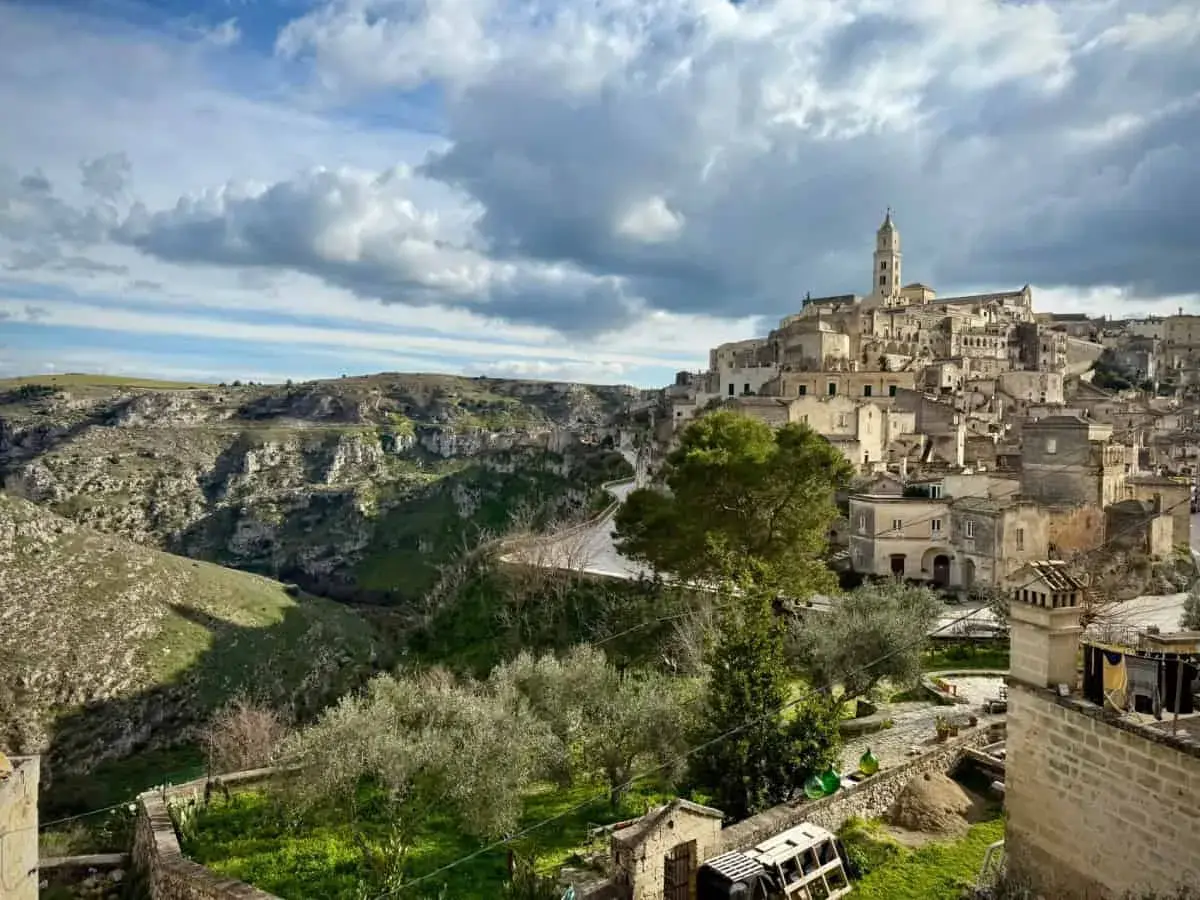
The city makes most sense when you visit it in layers
- Start in the Sassi so the layout of the city makes sense before you add museums and viewpoints.
- Choose at least one underground stop, because Matera’s cave interiors are part of the experience, not an add-on.
- Cross the ravine for the classic panorama from Murgia Timone and the surrounding park.
- Keep a little time for Piazza Duomo, the upper town, and a slower lunch or aperitivo.
- One day is enough for highlights, but an overnight stay makes the city feel far less rushed.
- Good walking shoes matter here more than in most Italian cities, because the streets are steep and uneven.
Start with the Sassi and let the city explain itself
The Sassi are the reason Matera feels so different from almost anywhere else in Italy. Sasso Caveoso and Sasso Barisano are not just old neighborhoods; they are the layered heart of the city, carved into the limestone ridge and stitched together by stairs, terraces, and hidden lanes. If I only had a few hours, I would spend most of them here first, because this is where Matera stops being a name on a map and starts making visual sense.
I would begin around the higher edge of the historic core, then drift downward rather than trying to force a strict loop. That approach lets you notice how much the city changes from one corner to the next: a narrow lane becomes a terrace, a terrace opens to a ravine, and a quiet doorway turns into a cave interior. The key is to walk slowly enough to notice the transitions. Matera rewards attention more than speed.
A good first stop is Casa Noha, which works as a compact introduction before you explore on your own. It gives the city’s backstory in about half an hour, so the streets that follow feel less abstract. From there, I like moving toward Piazza Duomo and then back into the Sassi at a pace that leaves room for detours. If you try to treat this area like a quick checklist, you miss the point. If you let it unfold, it becomes the strongest part of the trip.
That first layer sets the context for everything else, and once the layout makes sense, the underground sites stop feeling like add-ons and start feeling like the core of the visit.
Spend time underground where Matera makes the most sense
Matera is famous for its cave life, but the best underground stops do more than repeat the same idea in different rooms. They show water management, domestic life, art, and the practical reality of living in stone. If you want the city to feel real instead of theatrical, this is where I would focus.
| Stop | Why it is worth it | Typical time | Practical note |
|---|---|---|---|
| Casa Noha | A compact multimedia introduction to Matera’s history and the Sassi | 30 minutes | Adults are usually €6.50 and children €3; the schedule is seasonal and closed on Wednesdays |
| Palombaro Lungo | A vast underground cistern beneath Piazza Vittorio Veneto | 15 to 20 minutes | Adults are €3 and minors are free; it is a quick stop with a big payoff |
| Casa Grotta di Vico Solitario | A furnished cave home that shows how families actually lived in the 20th century | 30 to 45 minutes | Adults are usually €8 and reduced tickets €5; a strong choice if you want daily-life context |
| MUSMA | Contemporary sculpture set inside a cave palace | 60 to 90 minutes | Best if you want one cultural stop beyond the history-focused sites |
Palombaro Lungo is the easiest site to underestimate, and that is a mistake. It is not long, but it explains one of Matera’s biggest survival stories: water. The cistern is roughly 14 metres deep and 50 metres long, and the scale makes the engineering feel more impressive than any label could. Casa Grotta is the more emotional stop, because it shows how domestic space was actually arranged rather than simply described. If you only have room for two interior visits, I would choose Casa Noha and Casa Grotta, then add Palombaro Lungo if you still have energy.
That combination gives you history, infrastructure, and lived experience without turning the day into a museum crawl.
Cross the ravine for the view that finishes the story
Matera is most memorable when you see the Sassi from the opposite side of the gorge. Belvedere Murgia Timone is the classic place for that view, and I would not skip it unless the weather makes the walk unwise. The park around it is larger than the city-facing photos suggest, with rough paths, open rock, and a landscape that reminds you how old the settlement really is.
This is also where the visit becomes more than architecture. The Parco della Murgia Materana is full of ravines and rock churches, and you do not need to see every one of them to understand the point. One good viewpoint and one decent walk are enough to change the way you read the city. I usually recommend sunrise if you want cooler temperatures and fewer people, or sunset if you want the most dramatic light on the cave houses.
- Bring water, especially from late spring through early autumn, because the exposed ground heats up fast.
- Wear shoes with real grip; the paths are uneven and can be dusty or slippery in places.
- Allow at least 2 to 3 hours if you want the viewpoint plus a proper walk rather than a quick photo stop.
- Consider a guide if you want the rock churches and the landscape history to feel connected instead of random.
If you have only one outdoor experience in Matera, this should be it. The city looks complete only when the ravine is in the frame.
Slow down in the historic center above the caves
It is easy to get so focused on the cave districts that you miss the upper town, but that would leave out an important part of the city’s identity. Piazza Duomo, Piazza Pascoli, and the streets around Via Ridola give you the civic and cultural layer of Matera, which is quieter but no less useful for understanding the place. I like this part of the visit because it resets the pace after the steeper sections of the Sassi.
The Cathedral is worth a stop even if you do not plan a long church visit. The square around it is one of the most balanced viewpoints in the city, and it helps connect the medieval city with the cave neighborhoods below. Nearby, Palazzo Lanfranchi gives you a broader cultural anchor, and San Giovanni Battista is a strong example of the city’s Romanesque side. None of these need to be rushed. In fact, they work better when you treat them as pauses rather than objectives.
This is also the part of Matera where I would make time for a proper lunch or a long coffee break. The city has a lot of vertical movement, and a slow meal is not a luxury here. It is part of how you keep the day enjoyable rather than exhausting. Matera is strongest when it alternates effort and rest.
Once you start thinking that way, planning becomes much easier, because the next decision is not just what to see, but how much time the route should really take.
Plan your Matera visit around how much you actually have
Matera is compact enough for a short trip, but it is not a city I would try to rush. The stairs, the changes in level, and the amount of time you will naturally spend looking rather than moving all slow the day down. That is why the best plan depends less on the map and more on how long you want to stay.
| Time available | Best plan | What it suits best |
|---|---|---|
| Half day | Casa Noha, a Sassi walk, one underground site, and one viewpoint | Day trippers who want the core experience without trying to do everything |
| One full day | Add Casa Grotta, the Cathedral area, lunch, and Murgia at sunset | First-time visitors who want the strongest balance of history and scenery |
| Two days | Include MUSMA, a slower church and lane walk, and either sunrise or sunset on the ravine side | Travelers who like photography, deeper context, and fewer compromises |
If you stay overnight, I would choose lodging in the Sassi for atmosphere, the upper town if stairs are a concern, or the newer part of the city if you want easier parking and a simpler arrival. Matera is walkable, but it is not flat, so where you sleep changes the feel of the trip more than many people expect. If you are self-driving, park once and keep the car out of the equation as much as possible. Repeated short drives save less time than you think.
For most visitors, the ideal pace is one strong morning, one long scenic break, and one slower late-afternoon stretch. That rhythm is easier on the body and better for the city itself.
The first Matera route I would choose
If I were planning a first visit from scratch, I would keep the sequence simple: Casa Noha first, one cave interior next, the Sassi at unhurried pace after that, and Murgia Timone at the end of the day. That route gives you the city’s history, its lived environment, and its defining panorama without overloading the schedule.
- Use Casa Noha to understand the city before you start wandering.
- Pick either Palombaro Lungo or Casa Grotta if you want one strong underground stop.
- Save the opposite-side viewpoint for late afternoon or sunset.
- Leave enough space for Piazza Duomo or Piazza Pascoli as a calm reset between climbs.
That is the version of Matera I would recommend most often because it keeps the day balanced. You see the Sassi, you understand why people lived in the caves, and you end with the view that makes the whole city click into place. If you follow that order, Matera feels layered instead of crowded, and that is the difference between seeing the city and actually understanding it.