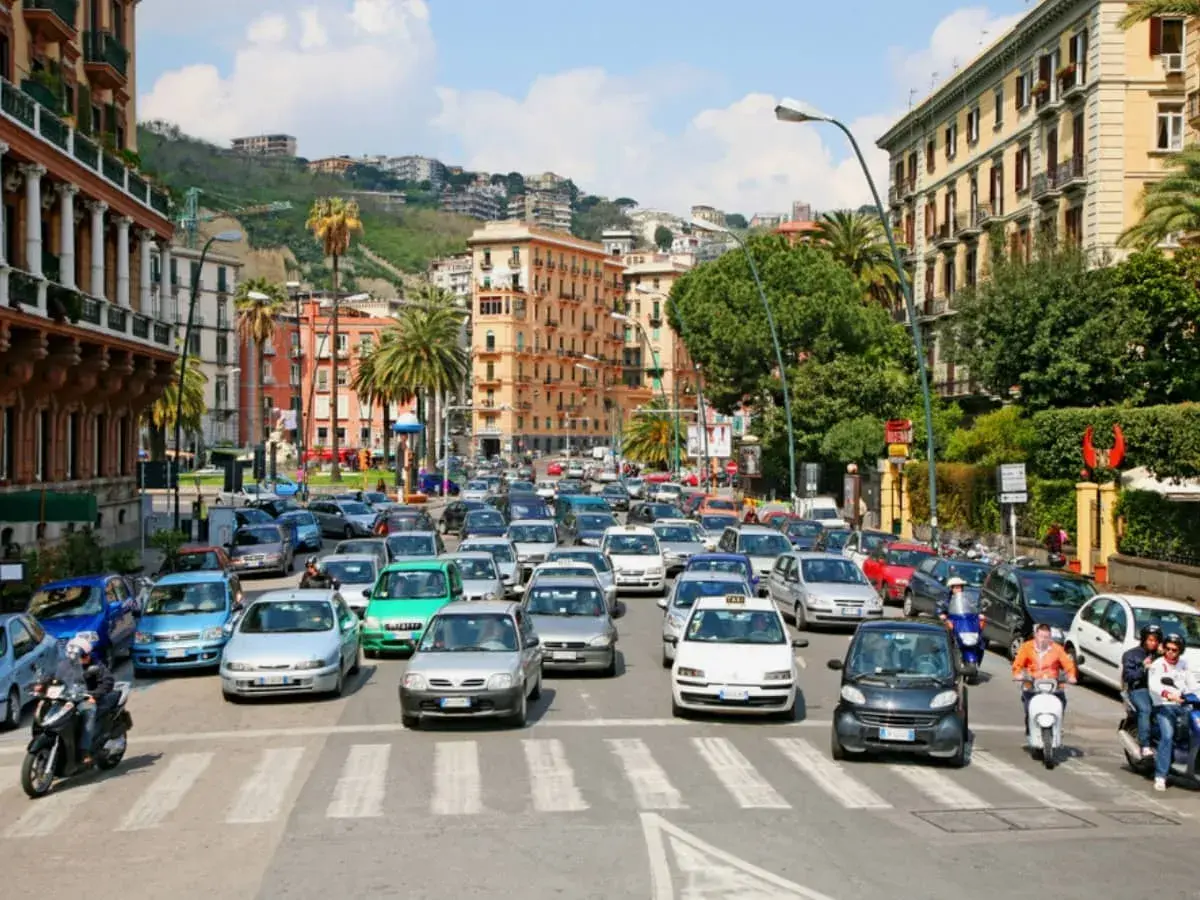
Driving in Naples, Italy, can be useful, but only if you treat it as a tool for the right parts of the trip. The city center is dense, parking is limited, and restricted traffic zones can turn a simple errand into an expensive mistake, while the wider Campania region opens up much better by car. In this guide, I focus on when to drive, what the local rules mean in practice, where people get fined, and when I would leave the keys with the hotel and use another option instead.
What matters before you put a car on Naples roads
- A car is usually a poor choice for central Naples, but a good one for wider Campania.
- ZTL restricted traffic zones are the main place visitors get fined.
- Paid parking uses blue lines; white lines are free; yellow lines are reserved.
- Rental companies commonly want a passport, a licence, an IDP or sworn translation, and a credit card.
- Urban speed limits are 50 km/h, while motorways allow 130 km/h in normal conditions.
- If your hotel is inside a ZTL, ask in advance whether they can register your plate.
Is a car actually useful in Naples
My rule is simple: the more your itinerary depends on the historic center, the less I want a car. Central Naples rewards walking, taxis, and public transport far more than it rewards patience behind the wheel. If you are staying near the old town, the waterfront, or the busiest inner districts, a car can become a liability the moment you start looking for a legal place to stop.
Where a car starts to make sense is outside the compact city core. That includes vineyard country, hillside viewpoints, some coastal day trips, and longer hops around Campania where you do not want to connect buses and trains all day. I would also consider a car if I were staying in a suburban hotel with easy parking and planning several out-of-town excursions. That split is the key to trip planning here, because Naples itself and the region around it behave like two different driving problems.
| Trip style | My take | Why it matters |
|---|---|---|
| Historic center stay | Skip the car | ZTLs, traffic, and parking fees outweigh the convenience. |
| Naples plus one or two countryside drives | Maybe rent | Useful if you have a base with parking and a clear route out of town. |
| Pompeii or Herculaneum focus | Often skip | Rail is usually easier, then you can use local taxis or walking once you arrive. |
| Vesuvius, inland wineries, or rural Campania | Car can help | Distances are less urban and transit can be thinner. |
| Amalfi Coast in peak season | Usually skip self-driving | Traffic and parking can eat the whole day. |
That distinction matters, because the legal rules and the city’s access controls are what make Naples feel complicated at first. Once you understand those, the decision becomes much easier.
The rules that matter before you leave the garage
If you are coming from the United States, I would not rely on your domestic licence alone. For a non-EU driver, rental desks commonly ask for an International Driving Permit or a sworn translation of your licence, along with a passport and a credit card in the driver’s name. Many companies also want the driver to be at least 21 or 23, and they usually expect the licence to have been held for at least a year.
The road rules themselves are straightforward, but they matter because Naples is not the place to improvise. Italy’s general limits are 50 km/h in built-up areas, 90 km/h on secondary and local roads, 110 km/h on main roads, and 130 km/h on motorways. The same rules also say that you drive on the right, use dipped beams as required, keep mobile phone use out of the equation, and wear seat belts. If you are driving with children under 1.50 metres tall, they need an approved child seat.
| Road type | Typical limit | What I would watch for |
|---|---|---|
| Built-up areas | 50 km/h | Frequent cameras, pedestrians, scooters, and sudden lane changes. |
| Secondary and local roads | 90 km/h | Sharp bends and local traffic that moves differently from highway traffic. |
| Main roads | 110 km/h | Keep an eye on signs, especially near urban approaches. |
| Motorways | 130 km/h | Toll tickets, lane discipline, and faster overtaking than you may expect. |
Alcohol limits also matter. The legal limit is 0.5 g/l, but it is zero for new drivers and professional drivers. I would keep the practical rule even simpler: if you plan to drive in and around Naples, do not build the evening around wine and then hope the legal margin will save you. That caution becomes even more important once you start dealing with the city’s restricted zones.
ZTL zones are the main trap
The biggest mistake visitors make is not “bad driving”; it is entering a restricted traffic zone without meaning to. Naples uses multiple ZTL areas, and they do not all run on the same schedule. Some zones are active only at certain hours or on certain days, while others are broader and easier to trigger by accident. The signs matter more than your navigation app, because maps do not always reflect temporary or street-level restrictions cleanly.
In practice, I tell travelers to treat every ZTL sign as a camera-backed warning, not a suggestion. If you are staying in a hotel inside a restricted area, ask the property before arrival whether they can register your plate. That small conversation can save a fine. If they cannot, I would usually park outside the zone and finish the trip on foot or by taxi.
| Sign or situation | What it means | My advice |
|---|---|---|
| ZTL sign | Restricted access, often camera enforced | Do not enter unless you are authorised. |
| Time window on the sign | Access is limited to specific hours or days | Check the exact schedule before you move the car. |
| Hotel permit | Your plate may be registered with the city | Confirm this before arrival, not after a fine appears. |
| Pedestrian area | No casual driving through | Assume you need a different route entirely. |
Once you are clear on access, the next challenge is parking, and that is where Naples starts taking real money if you are not careful.
Parking in Naples is where the budget disappears
Parking is the part of Naples driving that quietly changes a trip from convenient to annoying. Blue lines mean paid parking, white lines mean free parking, and yellow lines are reserved. That sounds simple, but in the central districts free spaces can be scarce, and the paid ones are often the least stressful option simply because they are legal and clearly marked.
ANM says it manages roughly 32,000 parking spaces across the city, which tells you two things at once: there are options, and there is still a lot of demand. One ANM-managed car park advertises day parking for cars from €5 at Via D’Aulisio, which is a useful baseline if you are trying to compare a garage against curb parking. I would rather pay for a straightforward space than circle the block while trying to decode local markings under pressure.
| Parking marking | Meaning | What I would do |
|---|---|---|
| Blue | Paid parking | Use the meter, app, or nearby ticket machine. |
| White | Free parking | Check the sign carefully; free spaces are less common where visitors need them most. |
| Yellow | Reserved parking | Do not use it unless the sign clearly says you may. |
My practical advice is to prefer a garage or an ANM lot if you plan to leave the car for more than a short stop. That is especially true near the center, where a cheap-looking curb space can become expensive the moment you misread the rules. And once you are parked, the way you actually drive through the city still matters.
How I would drive in the city itself
Naples traffic has a rhythm, and fighting it is usually the wrong instinct. I drive more defensively here than I would in a quieter Italian city: stay right, keep a real safety margin, and expect scooters, taxis, buses, and impatient local traffic to move more assertively than you might be used to. The goal is not to “win” the lane; it is to keep moving without making a wrong turn into a restricted street.
Navigation apps are useful, but they are not a substitute for reading signs with your own eyes. If the route starts pushing you into a narrow center street or toward a zone you do not understand, I would stop and re-route rather than commit. That small pause is usually cheaper than a fine, and far cheaper than an hour spent trying to escape a dead end with locals behind you. In Naples, calm is a practical skill.
- Keep your phone mounted and use hands-free directions only.
- Assume scooters may appear where you did not expect them.
- Do not reverse into a street just because the map says so.
- Carry the documents you may actually need: licence, IDP if applicable, passport, insurance papers, and a credit card.
- Keep a reflective vest and warning triangle in the car, because Italian road rules expect them.
That style of driving works best when the car is serving a clear purpose, which is why the final planning question is not “Can I drive?” but “Should I drive for this specific part of the trip?”
When a car helps and when another option is better
I would use a car for the wider region, not for the city center itself. That means rural Campania, winery visits, hillside stays, and itineraries where you are making several stops in one day and would otherwise waste time on transfers. It also means being honest about the trade-off: every time you add a car in Naples, you are also adding parking decisions, traffic exposure, and the possibility of a ZTL mistake.
For rail-friendly stops like central Pompeii or Herculaneum, I usually prefer train or a private transfer if I am only visiting the site and returning to Naples. For the Amalfi Coast, especially in busy months, I think self-driving is often a poor use of energy unless your accommodation includes confirmed parking and you already know the roads. On the other hand, if you are heading inland or trying to string together rural viewpoints and small towns, the car starts to earn its keep quickly.
| Route or plan | Best option | Why it works better |
|---|---|---|
| Naples city sightseeing | Walk, metro, taxi | You avoid ZTL stress and parking fees. |
| Pompeii or Herculaneum day trip | Train or transfer | Simple access and less time spent handling the car. |
| Vesuvius and inland Campania | Car | Flexibility matters more than in-city convenience. |
| Amalfi Coast in peak season | Usually not self-drive | Traffic, parking, and timing become the story of the day. |
| Multiple rural stops in one day | Car | It reduces transfer friction and gives you control over timing. |
The driving plan I would actually use in Naples
My practical Naples plan is uncomplicated: stay car-free if your trip is mostly urban, rent only if the car clearly unlocks parts of Campania you want to see, and never enter a restricted zone without knowing exactly why you are allowed in. If you need a hotel in the center, I would choose one with explicit parking instructions before I even compare room rates. That one decision shapes the whole experience more than most travelers expect.
- Book accommodation with confirmed parking if you plan to drive.
- Ask whether the hotel can register your plate for any ZTL access.
- Use garages or clearly marked paid spaces instead of guessing on the street.
- Keep your documents ready before you pick up the car.
- Drive into Naples only when the car is solving a real problem, not creating one.
In practice, Naples rewards selective drivers, not stubborn ones. If your trip is mostly about the old city, food, and the waterfront, leave the car out of the equation; if you are heading into the wider region, use one with a clear parking plan and a healthy respect for ZTL signs.