
Choosing the right Puglia airport can save an hour or more on the road and make the rest of the trip feel far simpler. In this guide, I break down the region’s main gateways, show which airport fits different parts of Apulia, and explain the transfer options that actually matter once you land. I also cover the smaller airports so you can tell when they are useful and when they are just a distraction.
The quickest way to choose the right arrival point
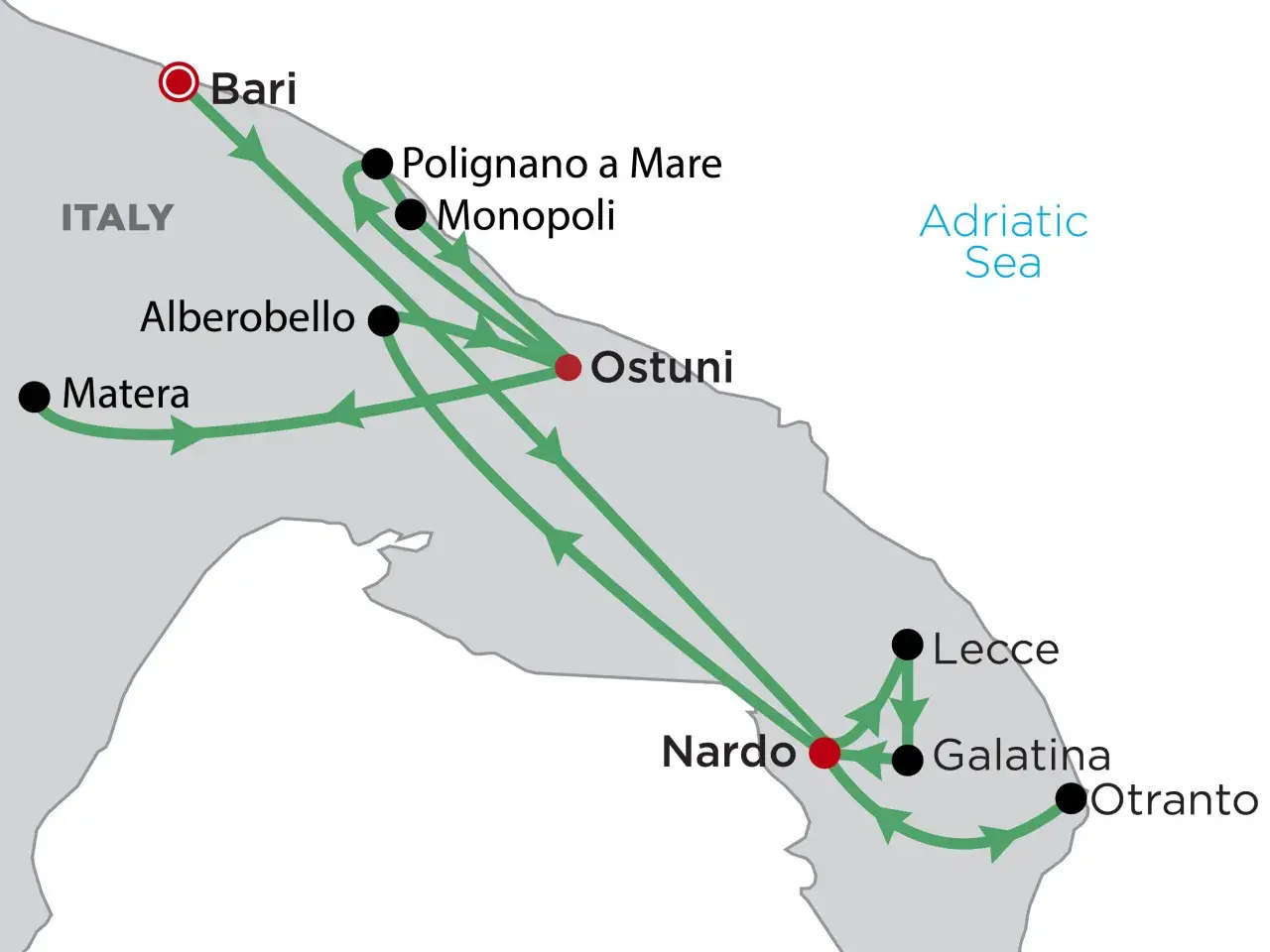
- Bari is usually the better all-round choice for central and northern Puglia, especially Bari, Polignano a Mare, Monopoli, Alberobello, and the Gargano side of the region.
- Brindisi is the cleaner pick for southern Puglia, including Lecce, Otranto, Gallipoli, and the Salento beaches.
- Foggia matters mainly for niche northern itineraries; most leisure trips still work better through Bari.
- Taranto-Grottaglie is part of the network, but it is not the default passenger airport for a typical holiday.
- A rental car is the easiest way to cover multiple bases; rail and airport buses work best if you are staying near a main city.
Where each airport makes sense for a real itinerary
According to Aeroporti di Puglia, the regional network covers Bari, Brindisi, Foggia, and Taranto Grottaglie. In practice, though, most visitors decide between Bari Karol Wojtyła and Brindisi Salento, because those two airports handle the clearest holiday routes and the most useful onward transfers.
| Trip base | Best airport | Why it works |
|---|---|---|
| Bari, Polignano a Mare, Monopoli | Bari | It keeps the first transfer short and gives you better access to the central coastline and the city rail hub. |
| Alberobello, Locorotondo, the Valle d’Itria | Either, with a slight edge to Bari | Both can work, but Bari usually feels more natural if you are starting in the north or planning to move around by train. |
| Ostuni, Lecce, Otranto, Salento beaches | Brindisi | It cuts the southbound drive and avoids the unnecessary backtrack that happens when you land too far north. |
| Gargano coast, Vieste, Peschici | Bari, or Foggia if the schedule fits | Bari usually offers the safer flight choice; Foggia only makes sense when it lines up cleanly with your route. |
| One-week loop across north and south | Whichever gives the best nonstop fare | For a car-based loop, the airport matters less than the pickup and drop-off terms on the rental. |
The two main airports are about 115 kilometres apart, so this is not a cosmetic decision. I treat it as a routing choice: if you land on the wrong side of the region, the first day often turns into a transfer day, and that is exactly how a relaxed trip starts to feel rushed. Once that is clear, the next question is how Bari and Brindisi differ in day-to-day use.
Bari and Brindisi compared for real trips
The gap between Bari and Brindisi is less about prestige and more about logistics. Bari tends to be the more flexible gateway, while Brindisi wins when your trip is centered farther south and you want to shave road time off the final approach.
| Factor | Bari | Brindisi |
|---|---|---|
| Best use case | Central and northern Puglia, city breaks, mixed itineraries | Salento, Lecce, Otranto, southern coast stays |
| Public transport feel | Stronger overall, with bus, rail, taxi, and rental options that make a car-free arrival easier | Good for simple point-to-point moves, especially if you are going straight to the south |
| Car-free strategy | Usually easier if you are staying in Bari or linking to the rail network | Works well if your first base is Lecce or somewhere deep in Salento |
| Road-trip advantage | Best if your route starts in the north or central coast | Best if you want to begin at the southern end and move north |
| My read | More forgiving for first-time visitors | More efficient if your itinerary is clearly south-heavy |
Bari also has the cleaner urban access pattern, which matters more than most travelers expect. Its airport links into the city by bus and rail, and that makes a late arrival much less stressful if you are spending your first night in Bari itself. Brindisi is simpler in a different way: it removes distance from the southern part of the region, which is exactly why it becomes the smarter choice for Salento-focused trips. The smaller airports only make sense in a few specific cases, which is where many travelers overthink the map.
When the smaller airports are worth considering
Foggia and Taranto-Grottaglie sit inside the same regional aviation system, but they are not interchangeable with Bari and Brindisi. Foggia can be useful if you are heading straight into the Gargano or you find a flight that matches your dates perfectly. Taranto-Grottaglie, by contrast, is not the default holiday airport at all; it is described as a European infrastructure for research and development of new aeronautical solutions, so I would only treat it as a special-use option, not a core tourist gateway.
Aeroporti di Puglia also runs Puglia Airbus, the shuttle network that links the main airports with key towns and destinations such as Bari, Brindisi, Foggia, Taranto, and Matera. That matters because a smaller airport becomes more viable when a shuttle can absorb part of the transfer, but I still would not build an itinerary around a niche airport unless the flight itself is clearly better. If the airport only works because of a long chain of connections, it is probably not the right arrival point for a relaxed trip. From there, the next practical issue is how you actually get off the plane and into your base without losing half a day.
How to get from the terminal into your base
For a Puglia trip, the airport transfer is not an afterthought. It is the first real test of whether your itinerary is designed well.
- Bari is the most forgiving airport if you are starting without a car. The airport has straightforward rail, bus, taxi, and rental options, so a city stay or a rail-based route works well here.
- Brindisi is the airport I would choose when the first nights are in Lecce or deep in Salento. The closer you are to the southern coast, the less time you waste getting into the trip proper.
- Cars change the equation. If your base is a masseria, a countryside villa, or a sequence of small towns, renting a car is usually the right call. Public transport in Puglia is useful, but it does not erase the geography.
- ZTLs matter. A ZTL is a restricted-traffic zone in historic centers, and it can turn a simple drive into a parking headache if you are not paying attention.
- Special assistance should be requested early. If you need reduced-mobility support, the airline usually needs notice at least 48 hours before departure, so do not leave that to the last minute.
My practical rule is simple: if you are staying in one major city, use the airport’s public transport and keep the trip light; if you are moving between beaches, hill towns, and countryside stays, rent the car and accept the extra planning. That decision then shapes the way I book the flight itself, which is where most avoidable mistakes happen.
The booking strategy I would use for a Puglia trip
When I book travel to Puglia, I do not start with the cheapest fare. I start with the route and ask what the arrival airport does to the first and last day of the trip. A flight that looks cheaper on paper can easily become more expensive once you add a long transfer, parking, or a one-way car rental.
- Pick the base first. If your first two nights are in Lecce, book Brindisi. If they are in Bari or Polignano, Bari is usually the cleaner choice.
- Price the transfer, not just the ticket. A slightly pricier flight can still be the better deal if it saves an hour of driving or a complicated bus change.
- Match arrival time to the ground plan. A late arrival into a rural stay is where trips get messy. In that case, I prefer a simple airport hotel, a pre-booked transfer, or an arrival before dark.
- Book the rental car early in summer. July and August are unforgiving months for last-minute car rentals in southern Italy, and the most convenient pickup slots go first.
- Consider an open-jaw itinerary. If you are driving one way through the region, flying into one airport and out of another can be smarter than forcing a loop back to the start.
That approach keeps the trip practical rather than theoretical. It also makes the final airport decision much easier, because once the itinerary is clear, the right arrival point usually becomes obvious. With that framework in place, the best choice for common Puglia itineraries is straightforward.
The airport choice I would make for common itineraries
- Long weekend in Bari and Polignano a Mare - I would fly into Bari and keep the first transfer short.
- Seven days in the Valle d’Itria - I would lean toward Bari if I am starting in the north, but I would not force it if Brindisi is significantly cheaper or the flight schedule is better.
- Lecce, Otranto, and the Salento coast - I would choose Brindisi without overthinking it.
- Gargano coast and beach towns in the north - I would start with Bari, then consider Foggia only if the route is unusually convenient.
- Mixed north-to-south road trip - I would book the best nonstop fare first, then solve the routing with a one-way rental rather than chasing a perfect airport match.
My default rule is simple: land as close as possible to the first place you will sleep and the last place you will leave from. In Puglia, that usually means Bari for the central and northern arc, Brindisi for Salento, and a deliberate transfer plan if you are trying to stitch both together. If you get that first decision right, the rest of the trip gets easier fast.