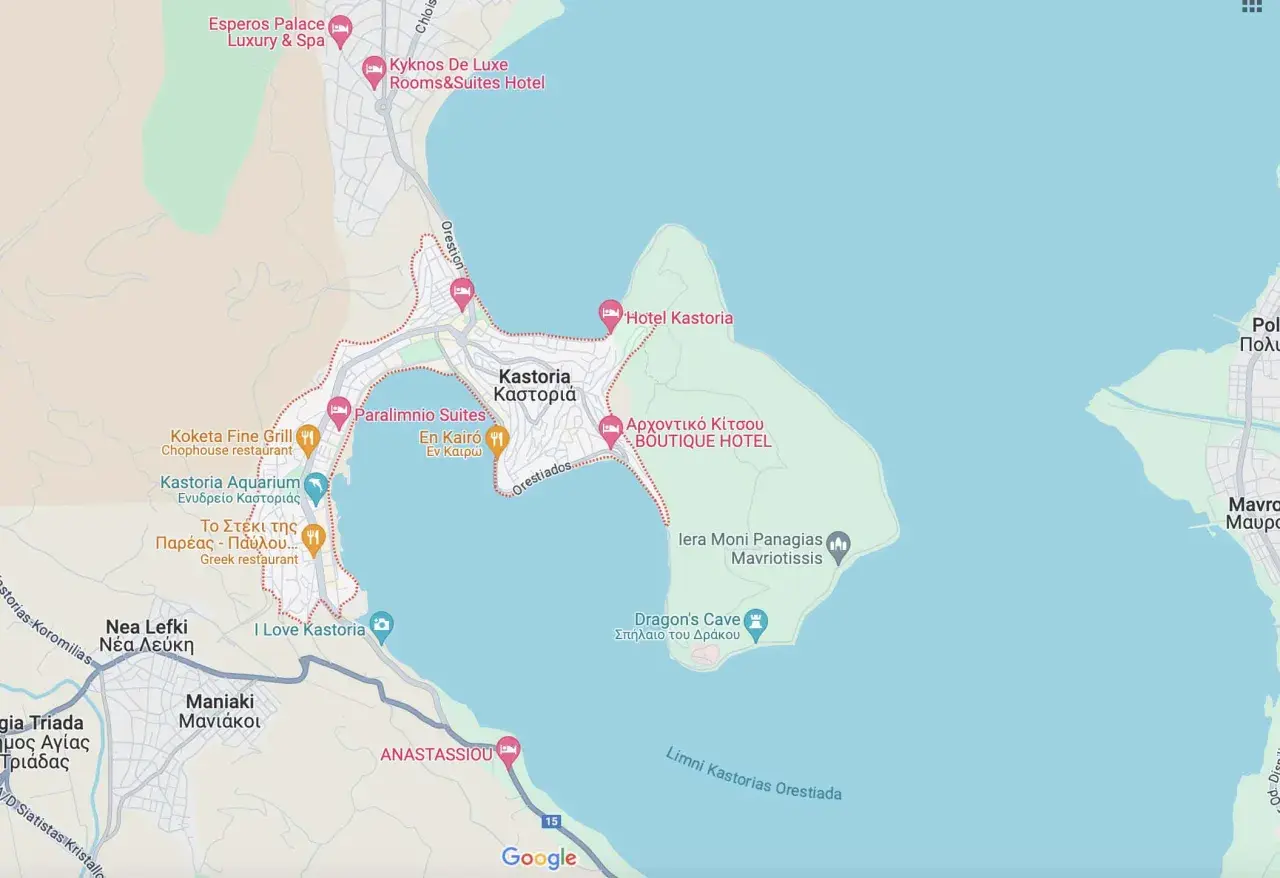
The city is easiest to read if you start with the lake
- Kastoria sits on a promontory beside Lake Orestiada, so its streets are shaped by water and slopes rather than a neat grid.
- The most useful first pins are Doltso, Apozari, the lakefront, the museum-and-church area, and the monastery road.
- For most visitors, walking the historic core and driving the lake edge is the best mix of atmosphere and efficiency.
- Old-town stays give the strongest sense of place, while the modern center is more practical for parking and everyday logistics.
- One full day is enough for the highlights; two days let the city breathe.
How Kastoria is laid out on the ground
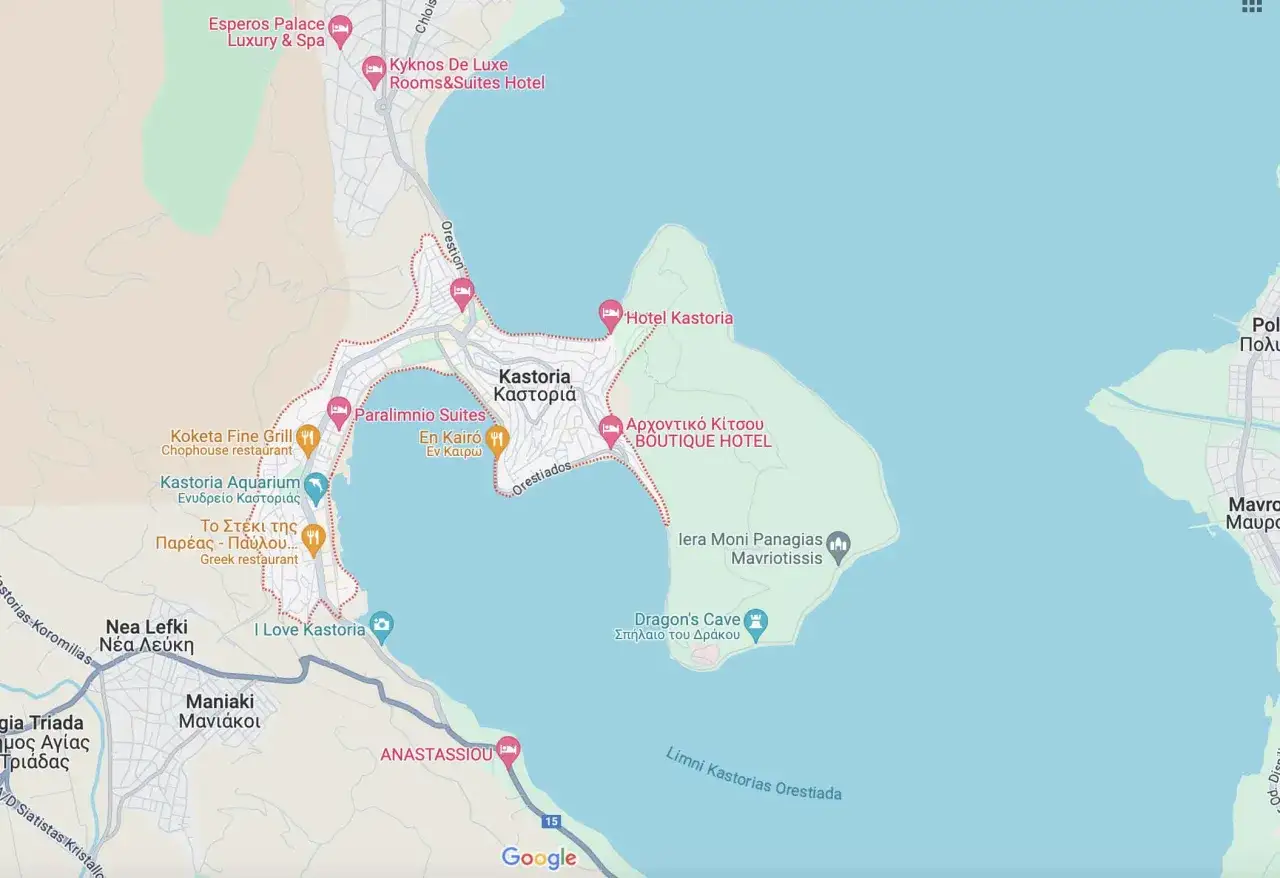
Visit Western Macedonia describes Lake Orestiada as the heart of Kastoria, and that is exactly how I would orient a first-time visit. The town sits on a promontory on the lake's western side, so the streets bend with the terrain instead of forming a tidy grid. In practice, that means a short distance on the map can feel very different depending on whether you are walking beside the water or climbing back toward the upper lanes.
I usually divide the city into three layers: the lake edge, the historic core, and the higher streets that rise away from the water. The lake edge gives you the big picture, the historic core gives you the monuments and atmosphere, and the upper streets explain why the town looks layered rather than flat. Once you see it this way, the map stops feeling abstract and starts working like a trip tool.
One detail matters more than most visitors expect: the peninsula divides the lake into two arms, so views change depending on which side of town you are on. That is why a waterfront walk can feel calm and enclosed in one stretch, then suddenly wide and panoramic in another. Once that mental model is clear, the next step is deciding which pins deserve your first stop.
The landmarks I would pin first on the map
If I only had a few hours, I would not try to "cover" all of Kastoria. I would pin a small set of places that tell the city's story quickly: the old quarters, a couple of churches, the lakefront, and one museum stop. That gives you a clear sense of scale without wasting energy on backtracking.
| Place | What you get | Why it belongs on your route |
|---|---|---|
| Doltso and Apozari | Traditional streets, preserved mansions, layered hillside views | These are the best-preserved historic quarters and the quickest way to feel the old city’s character. |
| Lakefront promenade | Open water views, easy orientation, sunset walks | This is the cleanest place to understand the shape of the city and reset between stops. |
| Byzantine churches and museums | Church architecture, icons, local history, cooler indoor breaks | They give the trip depth, especially if you want more than scenery alone. |
| Monastery of Panagia Mavriotissa | A quieter lakeside stop with strong setting | It works well when you want the map to expand beyond the urban core without a long detour. |
| Dispilio | A broader lakeside heritage stop | Best for travelers who want one meaningful side trip rather than a packed checklist. |
The point is not to tick every monument. The point is to build a route that feels coherent, with the lake, the old town, and one or two cultural stops reinforcing each other. Once those pins are set, the next decision is where to stay so the city works in your favor instead of against you.
Where to stay if you want the map to work in your favor
For a first visit, I would choose location before hotel style. In Kastoria, a modest room in the right place is often more useful than a nicer room that forces you to drive every time you want dinner or a walk by the water. The city rewards slow evenings, so the base you choose really matters.
| Area | Best for | Trade-off |
|---|---|---|
| Doltso and Apozari | Atmosphere, old houses, memorable mornings | Steeper streets, tighter parking, and less convenience for carrying luggage. |
| Near the lakefront | Views, walking access, easy evening plans | Some properties still require a short uphill walk to reach the historic lanes. |
| Modern center | Practical parking, restaurants, straightforward logistics | Less of the postcard feel, especially if you are after the classic lakeside mood. |
| Outside the core | Car-based trips, easier in-and-out movement | You will spend more time commuting into the scenic part of town. |
For most travelers, one night is the minimum that makes sense, and two nights is the sweet spot if you want to combine the old quarters with a slower lake loop. The more time you spend here, the more valuable the base becomes. From there, the next practical question is how to arrive without wasting half a day.
How to get here and move around without friction
From Thessaloniki, Kastoria is about 190 km away and roughly a two-hour drive, which makes it realistic as part of a northern Greece road trip. The drive is usually the simplest option because it gives you freedom to stop for viewpoints and keeps the lake loop flexible. If you are arriving by air, the local airport is close enough that the transfer into town is short rather than stressful.
- Drive if you want flexibility, especially if you plan to visit Mavriotissa, Dispilio, or nearby villages.
- Use the airport if you are optimizing for convenience, but treat it as a small regional arrival rather than a major hub.
- Park once and walk through the old town, because moving the car repeatedly inside the historic core is usually a poor use of time.
- Keep buses as a workable backup if your schedule is flexible, not as the most efficient option for a tight weekend.
The main habit I recommend is simple: do not try to move the car for every sight. In Kastoria, the map rewards a parking-and-walk rhythm, and that becomes even more obvious once you start planning your day route.
A route plan that fits three different lengths of stay
I like to match the route to the amount of daylight, not the other way around. Kastoria is a city where a half day can still feel satisfying if you stay focused, but a second night changes the experience because the lakefront and old streets feel more relaxed after dark. This is where the map stops being theoretical and starts shaping the mood of the trip.
| Time available | What to focus on | What to skip |
|---|---|---|
| 3 to 4 hours | Doltso, Apozari, one church or museum, and a slow walk on the lake edge | Long side trips, repeated driving, and any route that pulls you too far from the historic core |
| One full day | Old town in the morning, a lakefront lunch, Mavriotissa in the afternoon, sunset by the water | Overpacking the afternoon with too many cultural stops |
| Two days | The full old-town circuit, museums, a slower lakeside drive, and one extra heritage stop such as Dispilio | Rushing the city as if it were a pass-through stop |
If I had only one evening, I would choose sunset by the water rather than another indoor stop. If I had a full day, I would let the route breathe and leave room for coffee, short detours, and an unplanned viewpoint. That flexibility is what makes Kastoria feel rewarding instead of busy.
The mapping mistakes that make Kastoria feel harder than it is
Most first-time visitors do not get lost in Kastoria because the city is confusing; they get delayed because they assume it behaves like a flat grid. The old town is full of slopes, some streets narrow sharply, and the most scenic corners are often the least convenient for cars. That is manageable, but only if you plan for it.
- Treating the lake loop as a quick errand instead of a scenic drive. The roads look short on a map, but they invite stops.
- Parking too close to the oldest lanes. It is usually better to park on the edge and walk in.
- Assuming every church or museum is open continuously. Build a little buffer into the day.
- Forgetting that views change by shoreline. The north, south, and peninsula edges do not feel the same.
- Packing the day too tightly. Kastoria works best when the itinerary has a bit of breathing room.
If I had to give one practical rule, it would be this: build the day around the best walking zone first, then add the car only when it clearly improves the route. That approach keeps the city scenic instead of stressful, which is exactly why the map matters.
The pins I would save before I stepped into the city
A simple set of saved places turns a first visit into an easy one. Before I arrive, I would save Doltso, Apozari, the lakefront promenade, the main museum-and-church cluster, and one lakeside outlier such as Panagia Mavriotissa. If I planned to stay longer, I would also save Dispilio so the route can stretch beyond the urban core without becoming chaotic.
- Doltso for preserved architecture and the strongest old-town feel.
- Apozari for atmospheric lanes and classic Kastoria views.
- Lakefront promenade for orientation, walking, and sunset timing.
- Byzantine museum and church area for cultural depth and indoor backup on a slower day.
- Panagia Mavriotissa for a calm lakeside add-on that expands the trip naturally.
If I were planning the city from a map today, I would keep the route compact, sleep near the water, and leave enough time for one slow walk after sunset. That is usually the difference between visiting Kastoria and actually remembering it well.