The quickest way to plan a good Procida day
- Marina Corricella is the island’s most memorable harbor, and it works best when you linger rather than rush.
- Terra Murata gives you the highest views, the oldest history, and the steepest walk on the island.
- Procida’s beaches are not interchangeable; Chiaia, Pozzo Vecchio, and Chiaiolella each suit a different pace.
- A boat trip is the cleanest shortcut if you want to understand the coastline without doing a lot of climbing.
- Walking plus one bus hop is usually the smartest way to move around the island.
- Leave extra time for meals and sunsets; Procida feels better when the schedule is loose.
Build your route around the island’s four anchors
I like to think of Procida as a place where you choose a rhythm, not a checklist. If I am planning a first visit, I anchor the day around Marina Grande, Marina Corricella, Terra Murata, and the Chiaiolella side, because those are the places that give the island its shape and save you from wasting energy zigzagging around. With less than 4 square kilometers to cover, the real decision is not how much ground you can physically reach, but how slowly you want to move.
| Area | Why it matters | Best use of your time | What to expect |
|---|---|---|---|
| Marina Grande | Arrival point and practical base | First coffee, luggage drop, orientation | Ferries, buses, rentals, easy services |
| Marina Corricella | Most atmospheric fishing village | Lunch, walking, photography, dinner | Pedestrian lanes, pastel houses, no vehicles |
| Terra Murata | Historic high point of the island | Views, abbey visit, former prison complex | Steep climb, big panoramas, compact sightseeing |
| Chiaiolella and Ciraccio | Beach and sunset side of Procida | Swimming, long beach time, relaxed evenings | Bus access, beach clubs, open horizon views |
Once those four points are in place, the rest of the island stops feeling scattered and starts feeling intuitive. From there, the logical next stop is the harbor that most people remember long after they leave.
Wander Corricella slowly instead of treating it as a quick photo stop
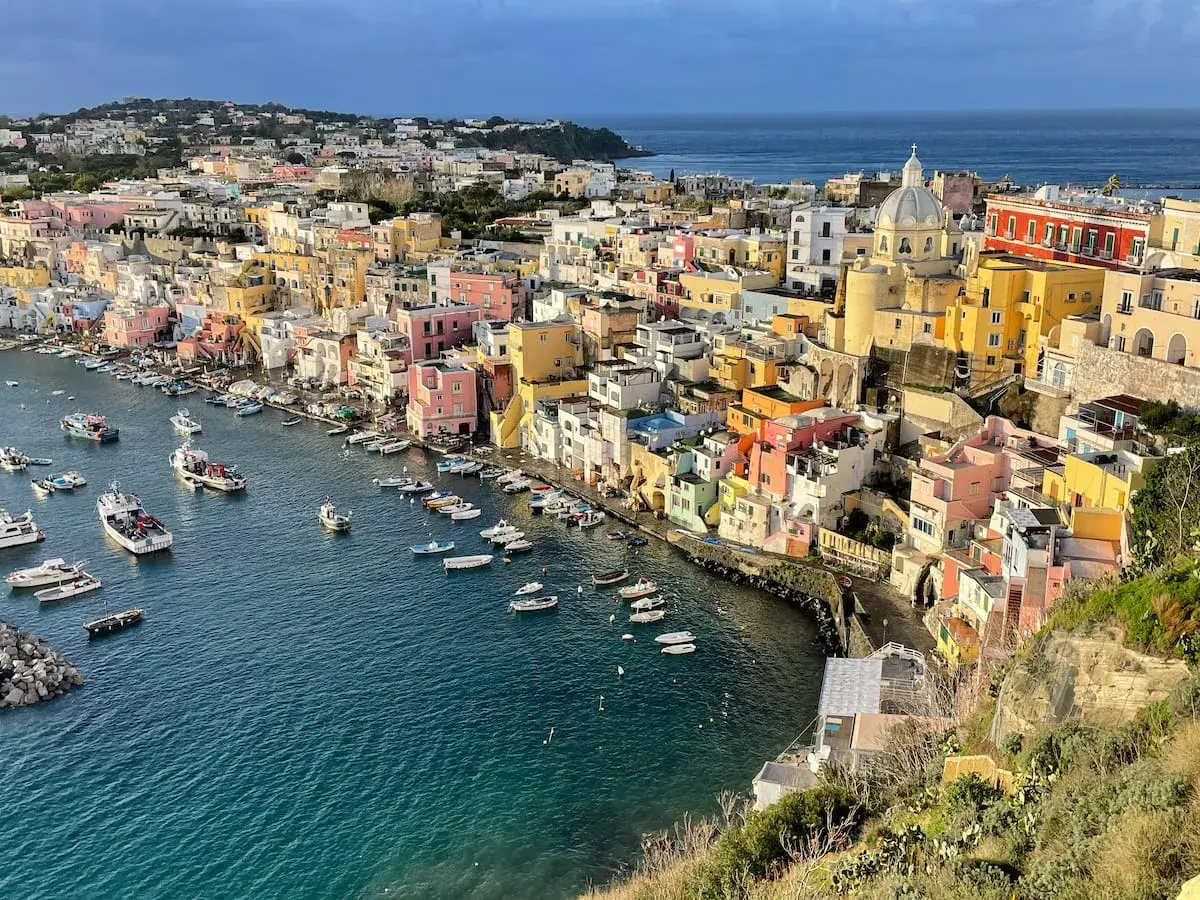
Corricella is Procida’s strongest visual card, but it is better than a postcard. The village is arranged like an amphitheater on the sea, and because it remains a real fishing harbor, it has a lived-in rhythm that makes the colors feel earned rather than staged. I would not treat it as a five-minute stop: sit down for lunch, watch the boats come and go, and let the small lanes pull you around without a fixed route.
The timing matters. Early morning is calmer and better for unforced photos; late afternoon brings softer light and more atmosphere. If you want the island to feel authentic rather than curated, this is where it happens. A long seafood lunch here is not an indulgence, in my view, but part of understanding why Procida works so well for slower travel. Once you have seen the harbor from sea level, the island asks you to climb.
Climb to Terra Murata for the island’s highest views
Terra Murata is the historic center and the most rewarding uphill walk on the island. The climb is steep, but that is exactly why the view feels earned: you look out across the Gulf of Naples, the coastline opens up, and the island’s older layer of history becomes visible in one compact stop. What I like here is the density. You get medieval fortifications, the Abbey of San Michele Arcangelo, and the former prison at Palazzo d’Avalos in a very small area.
For planning, the practical details are simple. The abbey is open Monday afternoon, Tuesday through Saturday in the morning and afternoon, and closed on Sundays. Palazzo d’Avalos can currently be visited only with advance booking, and it is worth reserving if you care about the history behind the building rather than just the view from outside. Simple entry starts around €8, while a guided visit starts around €13. If you are visiting in hot weather, I would do this section early or late in the day, because the climb is exposed and there is little reason to make it harder than it needs to be.
After that uphill block, the beach side of the island feels like a reward rather than a separate plan.
Pick beaches by mood, not by name
Procida’s beaches are compact, volcanic, and very different from one another. The mistake I see most often is assuming that one beach visit will tell you everything. In practice, the right choice depends on whether you want an easy arrival, a quiet cove, a long swim, or sunset light. If you only have time for one beach, choose the one that fits your day rather than the one that sounds most famous.
| Beach | Why go | Tradeoff | Best for |
|---|---|---|---|
| Chiaia | Central, beautiful, and partly free, with a dramatic view back toward Corricella | You have to handle 186 steps if you go on foot | Travelers who do not mind a climb and want a classic Procida scene |
| Pozzo Vecchio | Quieter, cinematic, and linked to Il Postino | Less convenient if you want fast facilities | Slow afternoons, couples, and people who prefer a more secluded bay |
| Chiaiolella and Ciraccio | Longest shoreline, sunset views, and easy bus access | Can feel windier in the afternoon | Beach days, families, and anyone who wants more space |
| Lingua | Very close to Marina Grande and easy for a quick dip | Pea gravel rather than soft sand | Short stops before or after the ferry |
| Silurenza | Convenient, family-friendly, and close to the port | Less dramatic than the island’s more hidden beaches | Travelers who want comfort over drama |
My rule is simple: pair one beach with easy access and one with a stronger atmosphere if you are staying longer than a day. That balance keeps the island feeling varied without turning the schedule into a race. If you want the coastline without the effort of reaching every cove on foot, the cleanest shortcut is at sea level.
Add one boat trip instead of trying to see every cove from land
A boat trip is the best way to understand Procida’s shape in a single sweep. A group tour lasts about two hours, leaves from Marina Grande several times a day, and starts at around €30 per person, which is good value if you are short on time and want the full coastline in one pass. The route typically takes in Corricella, Chiaia, Chiaiolella, Ciraccio, Pozzo Vecchio, and the lighthouse side, with a swim stop when conditions allow.
I would treat this as the flexible part of the day, not the fixed centerpiece. Small boats are sensitive to sea and weather changes, so the itinerary can shift, and that is normal here rather than a sign that something has gone wrong. If you are staying longer, there are also fuller day-boat options and sunset aperitifs on the water, but for most travelers the two-hour loop is the sweet spot. Vivara is best kept as a view or a sea-side bonus unless you have confirmed access in advance, because it is not the kind of stop I would build the whole day around. After that, the last planning variable is how you move around the island without making the logistics noisy.
Make transport work for you, not against you
This is where many first-time visitors overcomplicate Procida. For most of the year, non-resident vehicles are not allowed to disembark, and even when restrictions are relaxed, the island’s narrow streets and limited parking make a car more trouble than it is worth. I would leave the car on the mainland unless you have a very specific reason not to.
From Naples, hydrofoils reach Procida in about 40 to 45 minutes, while traditional ferries take around 60 minutes. If you are traveling from Pozzuoli, the crossing is usually about 30 to 35 minutes and is often the easiest option if you are already driving in from elsewhere in Campania. Foot-passenger fares from Naples start at roughly €20, though exact prices change by operator and season. In practical terms, this means Procida is easy to reach, but not a place where you gain anything by overengineering the transfer.
- Walk for Marina Grande, Corricella, and Terra Murata if your day is mainly sightseeing.
- Take the L1 or L2 bus for Chiaiolella and the beaches on the opposite side of the island.
- Rent an e-bike if you want range without parking stress; it is one of the smartest middle-ground choices.
- Choose a scooter only if you are comfortable with narrow roads and local traffic.
- Use a micro-taxi if mobility is limited or if you want a more personalized route.
With the transport question settled, the route itself becomes simple enough to enjoy rather than manage.
The route I would use for a first visit
If I had one day, I would not try to do everything. I would start in Marina Grande, walk or ride up to Terra Murata while the light is still comfortable, come back down through Corricella for lunch, and save the beach side for the afternoon. That sequence gives you history, views, food, and water in the right order, which matters more than it sounds.
- Arrive at Marina Grande and keep the first 30 minutes practical, not ambitious.
- Go to Terra Murata before the day gets too hot.
- Spend unhurried time in Corricella and sit down for a proper meal.
- Choose Chiaia for drama or Chiaiolella for a longer beach session.
- End with sunset near the marina or on the Chiaiolella side.
For a weekend, I would keep the same core and simply slow it down: one extra beach stop, one longer meal, and one boat trip if the sea cooperates. That is usually enough to make the island feel complete without turning the trip into a checklist. If I had to reduce the whole plan to one sentence, it would be this: choose one harbor, one climb, one beach, and one sunset, and leave enough time to do less than you planned.