There is no single best answer to how to get to Calabria, Italy, because the right route depends on where you are landing, where you are staying, and whether you want to move around once you arrive. Calabria is the toe of Italy’s boot, so the last leg can be very different for a beach base in Tropea, a city stay in Reggio Calabria, or a road trip through the mountains. The good news is that the region is straightforward to reach once you choose the right gateway and stop trying to force one transport mode to do everything.
The quickest route is usually a flight to Lamezia Terme, but the best choice depends on your final stop.
- Lamezia Terme is the most useful all-round airport for first-time visitors and beach stays.
- Reggio Calabria works best for the far south, the Strait of Messina, and city breaks in Reggio.
- Train travel is practical if you are already in Rome, Naples, or southern Italy and do not want to drive.
- A rental car gives the most freedom for beaches, hill towns, and national parks, but parking and narrow roads matter.
- If you are combining Calabria with Sicily, the Villa San Giovanni ferry is the key crossing.
The simplest way to reach Calabria from the United States is to treat it as a two-step journey: one long-haul flight into Italy, then a short domestic or European connection south. I would not count on a nonstop transatlantic flight into Calabria; in practice, U.S. travelers almost always connect through Rome, Milan, or another European hub. Rome is the safest starting point because it gives you the most onward choices, but Milan can be just as sensible if the schedule fits your arrival better.
If you are buying one ticket, I usually favor Rome Fiumicino for the second leg because it reduces the risk of a messy handoff. If you book separate tickets, give yourself more time than the minimum connection window, especially in summer when delays ripple through the whole itinerary. The last 90 minutes of the trip matter more than most first-time visitors expect, and that is exactly where the best route decision starts to appear.
Which Calabrian airport makes the most sense for your trip
Calabria’s official tourism site treats Lamezia Terme as the main international gateway, with Reggio Calabria and Crotone as the other regional airports. That matters because each one fits a different style of trip, and landing at the wrong one can turn a short holiday into a long transfer day.
| Airport | Best for | Why I’d choose it | Typical last transfer |
|---|---|---|---|
| Lamezia Terme (SUF) | Tropea, Pizzo, Vibo Valentia, central west coast, first-time itineraries | Largest schedule, easiest all-round gateway, and the safest choice if you are still deciding where to base yourself | About an hour to Tropea by car |
| Reggio Calabria (REG) | Reggio city, Scilla, the Strait of Messina, far south Calabria | Close to the city center and very convenient if you want to stay in the deep south | About 4 km from the city centre, roughly 10-15 minutes by taxi |
| Crotone (CRV) | Ionian coast trips, Crotone, Capo Rizzuto, quieter eastern itineraries | Useful when your trip is focused on the east side of the region | Usually around 20 minutes to Crotone city |
The practical read is simple: choose Lamezia for flexibility, Reggio for the far south, and Crotone only when your base is already nearby. For a first visit, I still think Lamezia is the safest default because it gives you the least painful fallback when plans change. Once you know your airport, the next question is whether rail can do a better job than a second flight.
When the train is the smarter choice
Trenitalia’s current long-distance network reaches Reggio Calabria, and that makes rail a real option instead of a romantic one. Frecciarossa and Frecciargento services connect the south back to Rome, Naples, and Salerno, while Intercity trains cover a broader but slower network. In plain English, the train works best when you want city-center to city-center travel and you do not want another airport, another transfer, or another luggage shuffle.
I like the train for travelers staying in Reggio Calabria, Paola, Scalea, Lamezia Terme, or along the main coastal spine. It is less attractive if your final stop is a small hill town, a remote beach, or a place that depends on a very short transfer after arrival. From Rome, I would budget roughly five to six hours to the main Calabrian corridor by fast or intercity rail, depending on the exact station and service; from Naples it is shorter, but still long enough that you should treat it as a proper travel day.
One practical advantage is that rail removes a lot of uncertainty. If your arrival city is already in Calabria, you can step off the train and continue by taxi, local bus, or rental car without passing through another airport terminal. That said, if your route depends on several changes, the train stops being elegant fast, so I usually reserve it for people who are comfortable trading speed for simplicity.
That tradeoff becomes more obvious once you compare rail with driving, which is where Calabria starts to feel much more open.
Driving is best for beaches and mountain villages
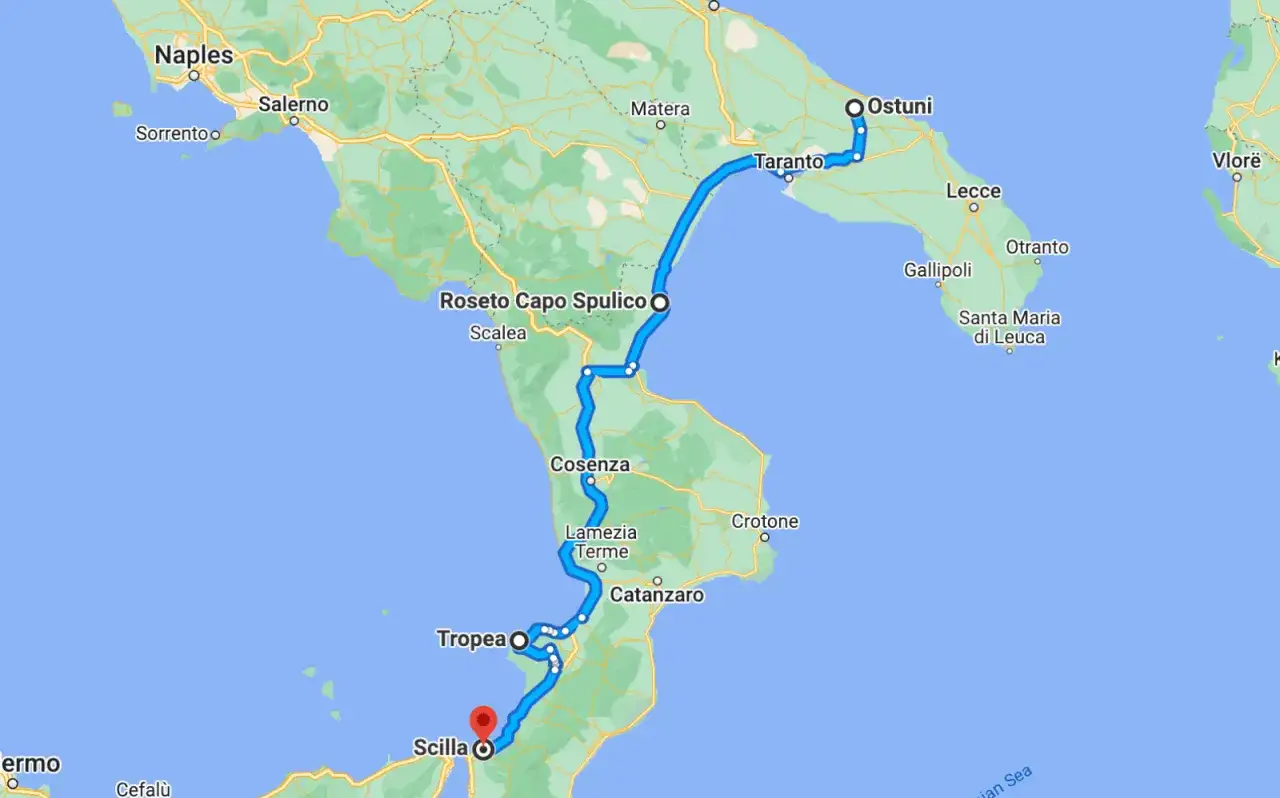
If your plan includes multiple bases, coastal detours, or mountain parks, I would seriously consider a rental car. Calabria is one of those regions where the map looks compact and the roads reveal the real scale: short distances can still take longer than expected because the terrain folds between sea and mountains. The A2 motorway handles the long north-south movement well, but once you leave the main spine, the pace drops and the roads become narrower, more winding, and occasionally more demanding than first-time visitors expect.
That is not a reason to avoid driving. It is a reason to be honest about what kind of trip you are building. For a beach holiday in one area, a car is optional. For a road trip that includes Tropea, Capo Vaticano, Scilla, mountain villages, and more than one viewpoint, a car is the difference between a flexible itinerary and a frustrating one. I would also budget extra time for parking and for the ZTL zones that appear in many Italian historic centers; those restrictions are easy to ignore on a map and expensive to discover in person.
My rule is simple: if you want the freedom to stop at viewpoints, detour for dinner, or move between scattered villages without checking timetables, drive. If you only need one coastal base and you are happy using taxis or hotel transfers for the last mile, you may not need the car at all. Once you know that, the Sicily ferry is the other route that can completely change the shape of the trip.
Use the ferry when Sicily is part of the trip
The Strait of Messina is the one place where Calabria and Sicily feel almost like one travel system. Villa San Giovanni is the key ferry terminal on the Calabrian side, and that makes it the obvious crossing point if your route includes Messina or eastern Sicily. Long-distance trains also use the ferry connection in this area, which is one reason rail travel in southern Italy can be more interesting than people expect.
This is not the option I would choose just to see a ferry. It is the option I would choose if Sicily is genuinely part of the itinerary or if I am combining a Calabrian coastline stay with a Sicilian city or island base. With a car, the crossing is useful because it keeps you from making a much longer drive around the island. Without a car, it can still be efficient, but you should build in a little slack for boarding and local transfers on both sides of the strait.
If your trip is Calabria only, the ferry probably stays in the background. If Sicily is on the same route, it becomes one of the smartest logistics choices in the whole plan. That leads naturally to the final question: which route fits the kind of holiday you actually want to take?
Match the route to the kind of holiday you want
I usually stop thinking in transport modes and start thinking in trip styles. That is where the best decision appears quickly, because the fastest route is not always the smartest one for the actual itinerary.
| Trip style | Best way to arrive | Why it works |
|---|---|---|
| Beach-first stay in Tropea or Capo Vaticano | Fly to Lamezia Terme, then transfer by car or train | Good balance of schedule, convenience, and short final transfer |
| Reggio Calabria or Strait of Messina trip | Fly to Reggio Calabria or take the train from Rome, Naples, or Salerno | Shortest practical last mile and strong rail connection |
| Multi-stop road trip | Fly in, rent a car, and possibly fly out from a different airport | Lets you move through beaches, villages, and mountain parks without backtracking |
| Calabria plus Sicily | Build the route around Villa San Giovanni and the Messina crossing | Keeps the island hop simple and avoids a long detour |
For a first-time visitor, I still think the safest default is Lamezia plus a short transfer. For a repeat traveler, the best option is often the one that cuts the most backtracking out of the itinerary. That is why planning the arrival is really about planning the shape of the whole trip, not just the first airport.
The small arrival choices that make Calabria feel easy
Three details usually decide whether arrival day feels smooth or slightly chaotic: how late you land, how far your base sits from the airport or station, and whether you need a car immediately. In summer, I would book earlier than feels necessary, because flight schedules tighten and road traffic along the coast becomes less forgiving as the day goes on. If you are landing after dark, I also prefer a transfer that is short and familiar rather than a long unfamiliar drive.
My most practical advice is to keep the number of moving parts low. One flight plus one transfer is usually better than two flights, a train change, and then a last-minute taxi hunt. Calabria rewards travelers who arrive with a simple plan and enough flexibility to slow down once they are there, which is exactly why the region works so well for scenic road trips, coastal stays, and low-stress rail arrivals.
For most visitors, the smartest approach is still straightforward: fly into the gateway that matches your base, keep the final transfer short, and only add a car or ferry when it genuinely improves the itinerary. That is the easiest way to turn the trip into time well spent rather than logistics for their own sake.