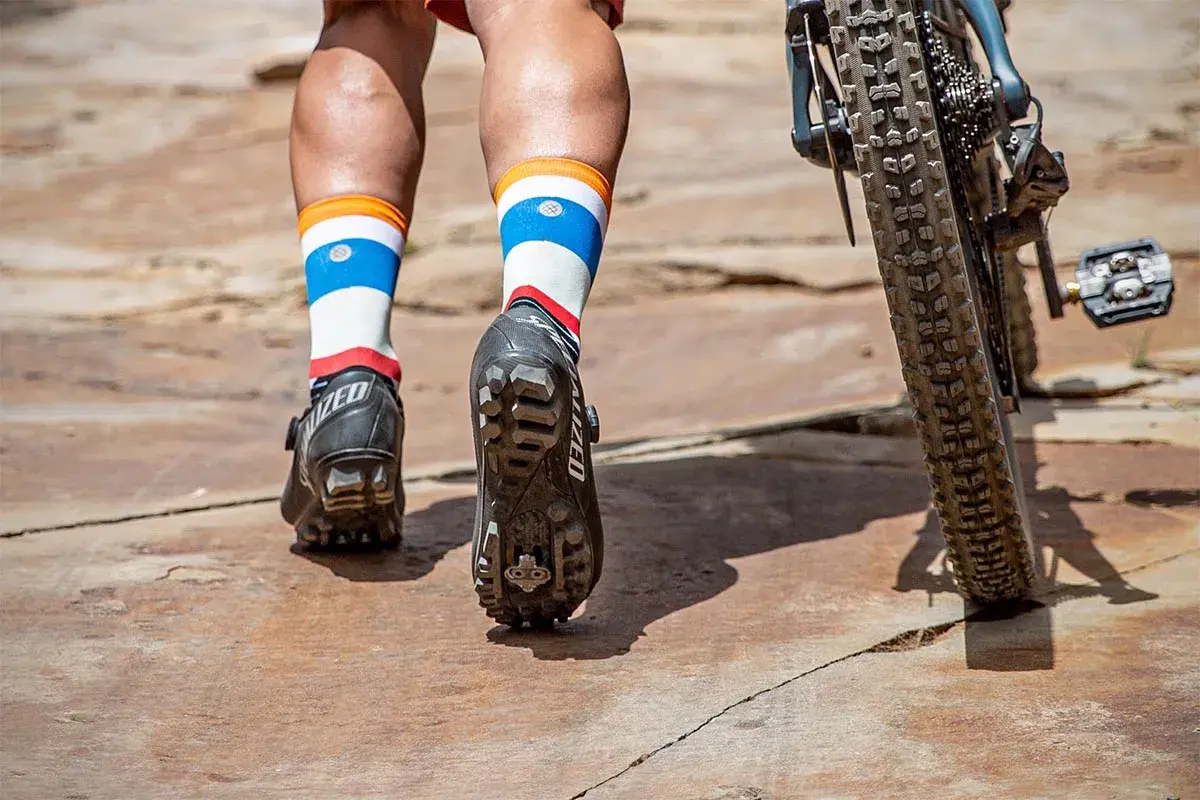
Hiking boots can work for a mountain bike ride, but I’d treat them as a backup, not a default. The answer to can you wear hiking boots for mountain biking depends on your pedals, the trail surface, and how much time you spend walking the bike instead of pedaling it. On a mellow loop or a mixed day with lots of hike-a-bike, they may be perfectly serviceable; on rough singletrack, they are usually the weaker choice.
The practical answer in one glance
- Yes, but only with compromises. Hiking boots are acceptable for short, low-intensity rides, especially on flat pedals.
- They are a poor match for clipless pedals. Without a cleat, you lose the locked-in connection those pedals are built around.
- Deep tread can reduce pedal contact. That often means less grip and a less precise feel on technical terrain.
- Weight adds up fast. A sturdy boot can weigh more than 3 pounds a pair, which you feel on climbs.
- Low-cut hiking shoes or flat-pedal MTB shoes are usually better. They give you more grip on the bike and less bulk off it.
Can you wear hiking boots for mountain biking on flat pedals
If you ride flat pedals, hiking boots are usable when the ride is short, the pace is relaxed, and the trail has more walking than descending. I would still call them a compromise, because most hiking boots are built to protect your foot on the ground, not to lock onto pedal pins. The deeper the lugs, the less clean the contact patch on the pedal, and that is where the grip starts to feel vague.That does not mean they are useless. On a casual loop around a fire road, a wet trail to a coastal viewpoint, or a bikepacking day with long stretches of pushing, the boot can be a sensible one-shoe solution. The question is not whether they work at all, but whether they work better than a lower, lighter option.
Once the trail gets steeper, the limits show up fast.
Why hiking boots start to feel awkward on technical trails
Technical mountain biking rewards quick foot changes, precise pressure, and a stable connection to the pedal. Hiking boots usually add height, mass, and a more pronounced tread pattern, so they feel secure on dirt but less exact on the bike. A light hiking shoe can be about 1 pound per pair, while a sturdy boot can top 3 pounds; that extra mass matters on long climbs and repeated accelerations.
Hike-a-bike, the push-or-carry section of a route, is the one place where boots start to look smarter. But outside those sections, the extra bulk and reduced pedal feedback make technical riding feel duller than it should.
- Pedal feel gets duller. You lose some of the direct feedback that tells you whether your foot is centered or slipping.
- Toe and heel placement take longer. High cuffs and bulkier uppers make small corrections less natural.
- Heat builds up. Waterproof boots and thick socks can be great in cold shoulder-season weather, but they are easy to overheat in summer.
- Walkability is not the same as rideability. A boot that feels great on a rocky approach may still feel clumsy once the trail turns rough.
That trade-off becomes more important once you compare flat pedals with clipless systems.
Flat pedals, clipless pedals and why the pedal system changes everything
The pedal interface is the contact point between your shoe and your pedal. That sounds obvious, but it is the whole story here: the same boot that feels acceptable on flat pedals becomes a poor fit on clipless pedals, because clipless shoes rely on a recessed cleat that hiking boots simply do not have.
| Pedal system | How hiking boots behave | Best call |
|---|---|---|
| Flat pedals | Usable, but grip depends on sole shape and pedal pins | Fine for casual rides, not my first choice for technical trails |
| Clipless pedals | Not a real fit, because there is no cleat to engage | Choose a true MTB shoe with a recessed cleat |
With flat pedals, a boot can physically sit on the platform. With clipless pedals, it cannot do the job the system was built for. That is why I separate the answer by pedal type before I talk about brand, waterproofing, or ankle height.
What to look for if you still want to ride in hiking boots
When I do end up riding in hiking boots, I pay attention to the sole first. A lower-profile tread with a flatter center section usually works better on pedals than deep, widely spaced lugs, because the boot settles onto the platform instead of perching on the edges. I also want a boot that bends a little at the forefoot; if it feels like a shank-heavy backpacking boot, it will ride like one.- Pick the least bulky boot that still matches the terrain. Mid-cut day-hiking boots are usually easier to ride than heavy backpacking boots.
- Keep the heel locked down. Heel lift wastes control and makes pedal pressure feel sloppy.
- Avoid oversized winter models unless the temperature justifies them. Insulation adds warmth, but it also adds bulk and sweat.
- Use them with flat pedals and pins, not smooth commuter pedals. The pedal needs something to bite into.
- Expect the boot to wear faster. Sharp pins and rough trail use can chew through softer rubber faster than hiking alone.
That is the point where most riders realize they do not need a tougher boot so much as a better shoe.
Better footwear choices for most mountain bikers
For most riders, the best answer is not a heavy boot at all. It is usually a shoe that sits closer to the middle: lighter than a boot, grippier than a casual sneaker, and designed with the bike in mind. On mixed days in the mountains, that balance matters more than brand loyalty or marketing language.
| Option | Where it shines | Main limitation | My take |
|---|---|---|---|
| Low-cut hiking shoe | Comfort on foot, decent traction, lighter weight | Less pedal grip than a true MTB shoe | A better fallback than a full boot for shorter rides |
| Approach shoe | Sticky rubber, good walking comfort, solid rocky-trail traction | Still not as bike-specific as MTB footwear | One of the smartest hybrids for ride-and-walk days |
| Flat-pedal MTB shoe | Best grip on pins, good pedal feel, enough walking comfort | Less cushioned than some hikers | My first pick for most trail riders |
| Clipless MTB shoe | Efficient pedaling and secure connection | Requires compatible pedals | Best if you want control on long or technical rides |
If I were packing for a scenic ride through rocky terrain, I would reach for a flat-pedal MTB shoe first, then an approach shoe, then a low-cut hiking shoe. Full hiking boots would be the last option unless I expected a lot of walking, cold weather, or a genuinely mixed objective.
My rule for mixed hike-and-ride days in the mountains
My rule is simple enough that I use it without overthinking it at the trailhead:
- Choose the shoe for the harder part of the day. If the ride is more demanding than the walk, I favor a bike shoe. If the walk is longer and rougher, I favor the hiking side.
- Match the shoe to the pedals before you match it to the weather. Compatibility beats comfort on paper.
- Keep the route in mind. Smooth fire roads are forgiving; steep, loose, or rooty singletrack is not.
- Use boots when walking will be a major part of the day. That is common on bikepacking detours, ridge crossings, and all-day alpine approaches.
- Do not confuse waterproof with suitable. Dry feet are nice, but a warm, dry foot that keeps slipping on the pedal is still a problem.
In practice, that means a boot is easiest to justify when the day looks more like an outdoor traverse than a pure ride. On a pure ride, especially anything technical, I would rather have a shoe that was built for the bike from the start.
The compromise that makes the most sense
So, can you wear hiking boots for mountain biking? Yes, and in the right setting they are perfectly workable. I would use them for short rides, cold-weather outings, mixed hike-a-bike days, or any route where walking matters more than chasing perfect pedal feel.
For regular trail riding, though, I think a lighter hiking shoe, approach shoe, or dedicated mountain bike shoe makes more sense. You get better grip, less fatigue, and a more natural connection to the bike, which is what matters once the trail stops being gentle. If you want one rule to keep, let it be this: choose the shoe that matches the ride’s hardest section, not the easiest one.