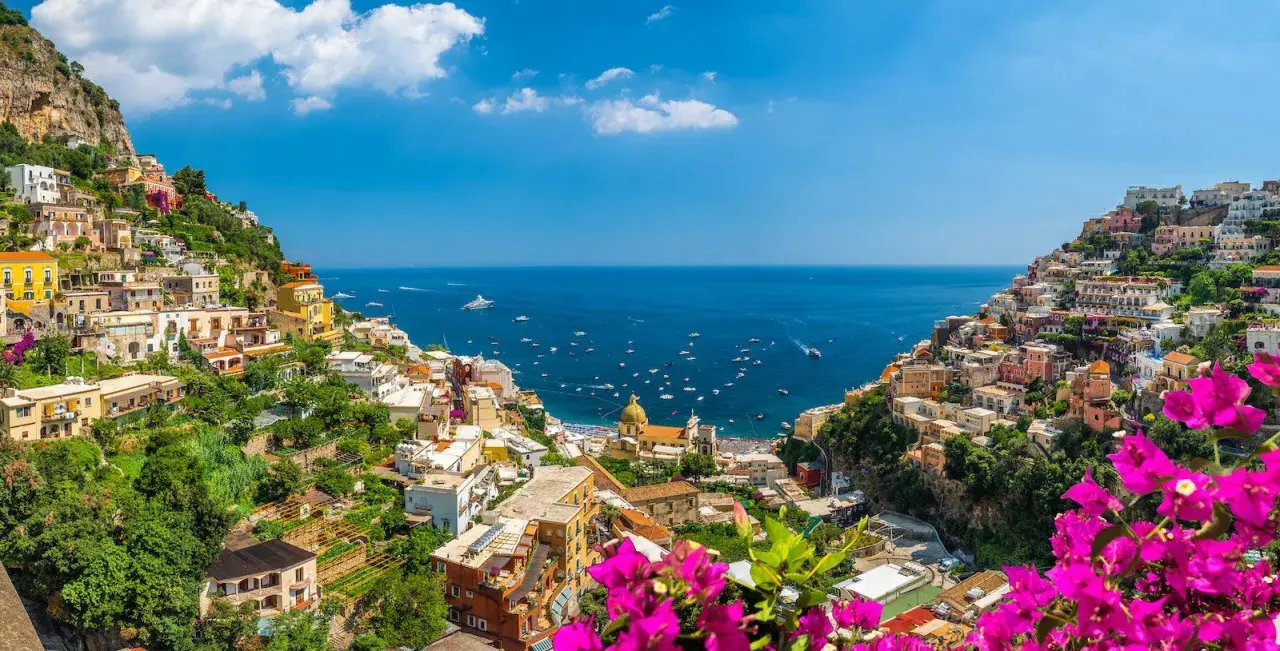
The Naples Airport to Amalfi Coast transfer is one of those trips where the “best” choice depends less on distance and more on how you want the first part of your holiday to feel. You can keep it cheap, keep it scenic, or keep it simple, but rarely all three at once. In this guide, I break down the real options, the time and cost trade-offs, and the route I would choose for each type of arrival in 2026.
The shortest route is not always the easiest one
- Best overall for comfort: a private transfer, especially for Positano, Ravello, late arrivals, or heavy luggage.
- Best value when the timing works: the direct airport shuttle, which is strongest for Amalfi, Atrani, Maiori, Minori, and Vietri sul Mare.
- Most scenic public option: airport to Naples port, then ferry, or train to Salerno and ferry from there.
- Cheapest option: train plus bus, but it is the least forgiving after a flight.
- Best for families and first-timers: a prebooked car or van, because it removes the friction that usually causes delays.
The route options that matter most
I like to judge this trip by the town you are actually staying in, because Positano, Amalfi, and Ravello do not play by the same rules. A route that feels clean for Amalfi can be awkward for Positano, and Ravello usually benefits from the most direct option available. If you frame the decision that way, the right choice becomes much clearer.
| Option | Typical time | Typical cost | Best fit | Main drawback |
|---|---|---|---|---|
| Private transfer | About 75 to 140 minutes, depending on the town and traffic | From about €120 to €144 per vehicle, higher for larger vans | Positano, Ravello, families, late arrivals, lots of luggage | Highest price |
| Direct airport shuttle | About 1 hour 50 minutes to 2 hours 40 minutes | About €20 per adult | Amalfi, Atrani, Maiori, Minori, Vietri sul Mare | Fixed departures and limited stops |
| Ferry via Naples port | About 2 to 3 hours including the airport-to-port transfer | About €32.50 one way to Amalfi, €65 round trip, plus the short city transfer | Daytime arrivals, scenic travelers, summer trips | Seasonal and weather-dependent |
| Train plus bus | About 3 to 4.5 hours | About €12 to €15 total | Budget travelers with light luggage | Multiple connections and crowding |
| Rental car | About 75 to 110 minutes of driving, plus parking time | Variable | Broader road trips, not a simple transfer | Parking, narrow roads, and restricted traffic zones |
If you already know your base town, the decision gets easier fast. If not, I would start with convenience first, because the cheapest option can cost you the most time once you factor in baggage, waiting, and missed connections. That is why I usually move to private transfers next.
Private transfer is the smoothest way to arrive
For most travelers, this is the option I would recommend first. A driver meets you at the airport and takes you straight to your hotel, which matters more than people think after a long flight. You skip the port, skip the bus platforms, skip the luggage shuffle, and you avoid turning your first hour on the coast into a logistics exercise.
From current 2026 pricing, a private transfer usually starts around €120 to €144 per vehicle, with Positano and Ravello often sitting at the higher end and larger vans costing more. The travel time is usually around 90 minutes to Positano, 100 to 130 minutes to Amalfi, and a little longer again for Ravello because of the climb inland. Those numbers move with traffic, but the point is consistency: you know what you are paying for and where you will arrive.
I think this option earns its value in three situations. First, if you land late and do not want to gamble on a missed ferry. Second, if you are traveling with children, older relatives, or a lot of luggage. Third, if your hotel sits up a hill, where a “short walk” can turn into a sweaty staircase drill. A private car does not just save time, it saves energy, and that changes the tone of the whole trip. If you want a cheaper compromise, the direct shuttle is the next route I would examine.
The direct shuttle is the best middle ground
The direct airport shuttle is the route I would call the practical sweet spot. It is cheaper than a private transfer, but far less awkward than chaining together trains and buses. Current shuttle listings show about €20 per adult, with several daily departures and a run time that lands around 1 hour 50 minutes to Amalfi on the fastest services.
This is the option I would choose for Amalfi, Atrani, Maiori, Minori, and Vietri sul Mare. It is less compelling for Positano, simply because the route is not built around that town. The real benefit is that the shuttle keeps you on one vehicle for the whole trip, which is exactly what most travelers want after a flight. It is not door-to-door, but it is close enough to feel simple.
The other reason I like it is predictability. The shuttle is built for airport arrivals, so it fits a schedule better than the more improvised public options. It is still worth booking ahead in high season, because seats go faster when flights are bunched together and the coast is busy. If your flight lands during daylight and your destination matches the stops, this is the option that gives you the best balance of price and ease. If the sea is calm and the timing is right, though, the ferry can be even better.
Ferry connections are the scenic public option
This is the choice I use when the schedule works and the weather looks kind. It is the prettiest way to approach the coast, and it also avoids some of the worst road traffic. In 2026, NLG’s Naples Beverello to Amalfi service is listed for the period from April 1 to November 3, with adult fares shown at €32.50 one way and €65 round trip. A few sailings on the page also note a connection via Capri, so I would always check the exact departure rather than assume every boat is a simple nonstop.
If you are coming from the airport, the ferry usually works in two steps. The first is the short hop from the terminal to Naples port, and GESAC’s shared taxi service to Molo Beverello is listed at €6 per person, luggage included. The second is the ferry itself. That combination is not the cheapest route on paper, but it can feel very efficient if your flight lands early enough and you want to start the trip by sea instead of by road.I also like the Salerno-side ferries for a different reason. For many travelers, they make the public-transport chain cleaner because the rail link to Salerno is straightforward and the ferry network fans out naturally along the coast. That is especially useful if you are headed to Amalfi, Atrani, Maiori, Minori, or Vietri sul Mare. The catch is obvious: ferries help most when you arrive during the day, so once the sun goes down, the budget route starts looking more complicated.
Budget travel is possible, but it asks more from you
The cheapest way to make the trip is usually a chain of local transport legs, not one clean ride. A common version is Alibus from the airport to Napoli Centrale, then the Circumvesuviana or regional rail, then a bus toward the coast. In real terms, you are often looking at about €12 to €15 total and roughly 3 to 4.5 hours, depending on the route, the crowding, and how lucky you are with connections.
This is a decent choice for a solo traveler with light luggage and a flexible schedule. It is much less appealing after a transatlantic flight, because every transfer adds a small layer of uncertainty. One delay is manageable. Two delays can become exhausting. And a packed bus on the coast road after an airport transfer is not the kind of memorable you want from day one.
If you are headed to Amalfi itself, I usually prefer the ferry version of the budget route over the full bus chain. It is cleaner, and it gives you a better chance of actually enjoying the scenery instead of clinging to your bag. That said, budget travel is still perfectly viable if you know what you are signing up for, which is why the next question I always ask is whether a car would help or hurt.
Why I usually skip a rental car on this route
I rarely recommend renting a car just to get from the airport to the coast. The road is beautiful, but beauty is not the same thing as convenience. The SS163 is narrow and winding, parking is scarce and expensive, and many town centers sit inside restricted traffic zones. Even when the drive itself is not long, the parking problem can steal the time you thought you were saving.
A car can make sense if the coast is only part of a larger road trip, especially if you are mixing in inland stays or multiple regions. For a simple airport-to-hotel transfer, though, it usually adds stress rather than removing it. I would rather pay for a transfer and arrive calm than save a little and spend the first hour looking for a legal place to stop.
That is why I treat driving as a special case, not the default. Once you accept that, the final step is simply matching the route to your arrival pattern, which is where most of the planning payoff comes from.
How I would book this trip in 2026
If I were planning this journey for myself, I would use a very simple rule set:
- Arriving in the afternoon and staying in Amalfi, Atrani, Maiori, Minori, or Vietri sul Mare: check the direct shuttle first, then compare it with the ferry if the departure times line up.
- Arriving in Positano or Praiano: book a private transfer or a ferry, because the direct shuttle is not built around those towns.
- Arriving late or traveling with kids and heavy bags: I would choose a private transfer without overthinking it.
- Staying in Ravello: I would again lean toward a private transfer, because the uphill final leg changes the whole equation.
- Wanting the most scenic first day: I would use the ferry, but only if the weather and departure window give me enough slack.
The cleanest decision is usually the one that protects your arrival day from unnecessary friction. If you want speed and simplicity, book the car. If your town matches the shuttle, take it. If the sea is calm and you have daylight, the ferry is the most memorable route. I would not overcomplicate it beyond that, because on a trip like this, the real luxury is starting the Amalfi Coast relaxed instead of already tired.