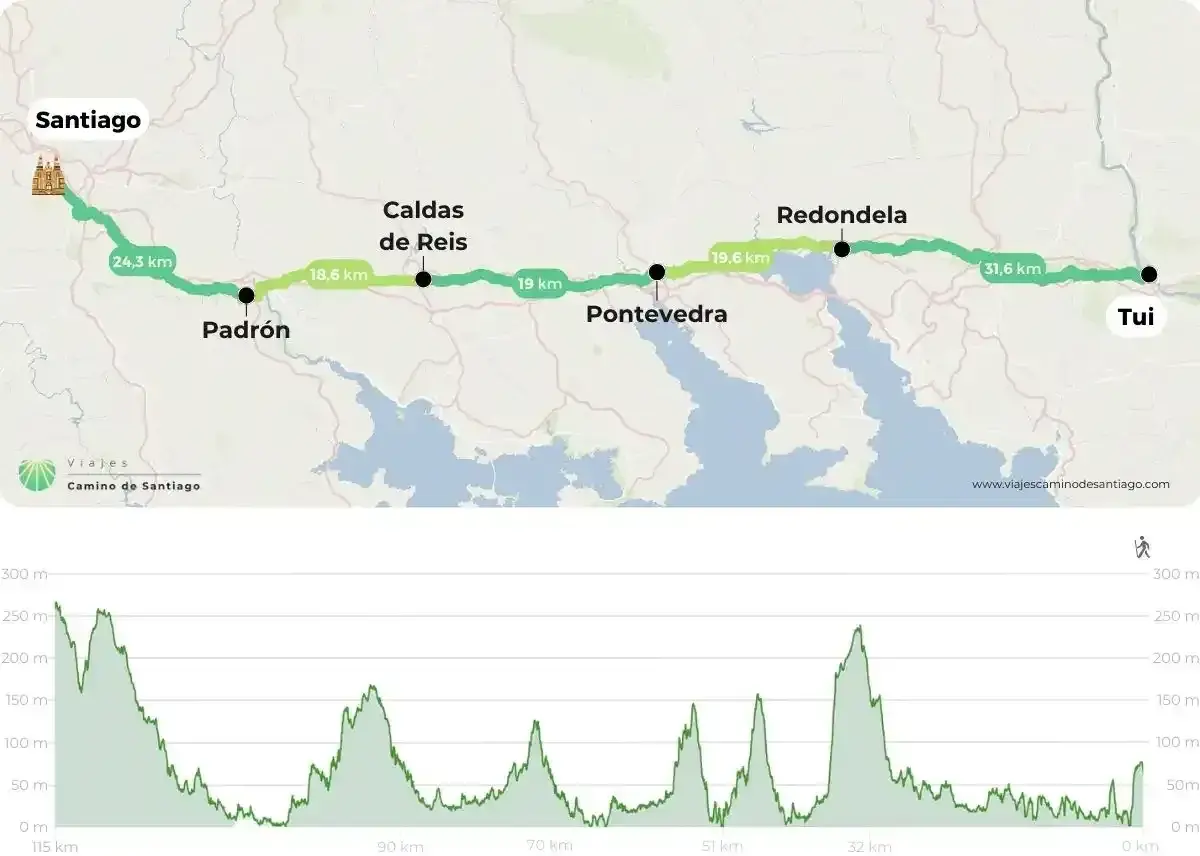
The Porto to Tui journey is short enough to feel easy, but the border changes the logic. You are usually deciding between a scenic rail hop, a cheaper bus route that may end in Valença, a flexible drive, or a Camino-style walk that takes several days. The details that matter are simple: station names, the one-hour time difference, and whether you need the border town itself or just a clean connection across the Minho.
The essentials for planning the crossing
- Rail is usually the smoothest option, but the official international service is framed as Porto-Vigo via Valença, so station labels can vary by booking site.
- Bus is often the cheapest simple transfer, especially if you are starting from Porto Airport or want to avoid changing trains.
- Tui sits on the Spanish side of the border, and crossing from Portugal means your clock moves forward by one hour.
- If you are walking the Camino, this is not a transfer but a multi-day route of roughly 120 km from Porto to Tui.
- Valença is the practical fallback name if you cannot find a direct result for Tui when booking transport.
What this trip means on the ground
I would think of this as a border corridor, not a standard city-to-city hop. Tui is small, historic, and tied closely to Valença on the Portuguese side, so many travelers are really trying to reach the border area rather than a single downtown station.
That matters because the best route depends on your real goal. If you want a same-day arrival with the least fuss, you care about the transport end point and the last kilometer into town. If you are starting a pilgrimage, you care about accommodation, walking mileage, and where to sleep before the border crossing. If you are only passing through, you care about time and the least number of changes. Once you frame it that way, the rest of the plan becomes much clearer.That border logic is the reason I always separate the transport choice from the final arrival plan, which brings us to the options that actually make sense.
The transport options that make sense
| Option | Typical time | Typical cost | Best for | Watch out for |
|---|---|---|---|---|
| Train | About 1h45-2h | Roughly €12-€25 | Fast, comfortable travel without driving | Limited departures and station-name confusion |
| Bus | About 1h50-2h15 including the final hop | Often around €8-€15 | Budget travel and airport arrivals | Usually ends in Valença rather than Tui itself |
| Car | About 1h15-1h30 driving | Fuel, tolls, parking | Maximum flexibility and stopovers | Tolls and parking can erase the convenience |
| Walking the Camino | About 6-7 days | Variable | Pilgrims and long-distance walkers | Not a transfer; it is the trip itself |
The table makes the decision fairly obvious. Train wins on comfort, bus wins on price, car wins on flexibility, and walking only makes sense if the journey is part of the experience. The rail option deserves a closer look because it is the one people most often overthink or misread on booking sites.
Why the train is the cleanest option when the timetable fits
CP’s official Celta service links Porto and Vigo and stops at Valença on the way, which is the most important detail to understand before you book. In practice, that means the border section is covered by the international rail corridor, but the exact station label you see online may not always match the language you use in your search.
For most travelers, the train is the best fit when the day is simple: you are leaving Porto, you want a comfortable seat, and you are happy to move with the timetable instead of around it. The route is scenic as well, with the Minho landscape doing some of the work for you. You get river views, a quieter northern corridor, and none of the fatigue that comes from navigating a car on arrival.
There are a few practical details worth knowing. You can usually book up to 60 days ahead, and tickets are available until shortly before departure. The service also has panoramic windows, a bathroom, and space for a couple of bicycles or scooters with prior reservation. That does not make it luxurious, but it does make it genuinely comfortable for a route this short.
The one thing I would not do is assume every booking site labels the same endpoint the same way. If your search result shows Valença or Vigo instead of Tui, that is not automatically a problem. It is a reminder to check the final transfer, which is exactly where the bus can become more convenient.
Why the bus sometimes wins anyway
If I were optimizing for price or airport logistics, I would take the bus more seriously. Current bus search results show direct Porto to Valença do Minho options in about 1 hour 50 minutes, with fares often starting around €13. There are also airport departures that can be even more useful if you land in Porto and do not want to cross the city first.
That airport angle matters more than most first-time travelers expect. If you are flying into Porto and heading straight toward the border, a direct bus to Valença can remove a metro ride, a station transfer, and one more decision at the end of a long travel day. That is not glamorous, but it is efficient.
Once you reach Valença, the finish is straightforward. The town and Tui are separated by the Minho, and the crossing is short enough that many travelers simply walk it. You will usually see pedestrian access on the bridge, and there is no dramatic border procedure in normal travel. The bigger surprise is the clock change: Spain is one hour ahead of Portugal, so your phone may jump forward as soon as you cross.
That time shift is small, but it matters if you are meeting someone, checking in late, or booking dinner on the Spanish side. It is one of those details that sounds trivial until it breaks a perfectly reasonable plan, which is exactly why I mention it here.
If your real plan is the Camino
For walkers, this route changes category completely. The distance from Porto to Tui is roughly 120 km on the Portuguese Camino, which is why it is usually planned as a 6-7 day walk rather than a transport link. If your goal is the Camino certificate, Tui is popular because it sits at the classic threshold for the final 100 km into Santiago.
That is also why many pilgrims choose to overnight in Valença or Tui instead of trying to force a complicated arrival day. Valença gives you the fortress town and a gentler border atmosphere, while Tui gives you the Spanish start point and a good base for the next stage. Both can work; the right choice depends on how hard the previous day was and how early you want to start the next morning.
I would not treat a Camino start like a transfer with a fixed schedule. If you arrive tired, sleep near the bridge. If you arrive early and want to see the town, give yourself time for the old center and the river crossing. That bit of flexibility usually improves the rest of the walk more than any single hotel choice.
The small details that save the most time at the border
- Search Valença as well as Tui when booking transport. It is the name that often produces the cleanest rail and bus results.
- Do not ignore the time change. Spain is one hour ahead, and that can matter for arrivals, meals, and hotel check-in.
- Leave a buffer if you are flying into Porto. A same-day border arrival is easy, but only if you avoid a tight connection.
- Pick the transfer that matches your real priority: rail for comfort, bus for price, car for freedom, walking for the experience.
- Sleep near the bridge if you are walking. It reduces stress and makes the first Camino day feel more intentional.
If I were planning this trip for myself, I would book the simplest route into Valença, verify the final hop into Tui, and keep the day flexible enough to absorb the border time change. That approach is boring in the best possible way, because it gets you across the Minho without turning a short journey into a complicated one.