The quickest way to narrow the right bike trip
- Slovenia’s biking season is broad, but mountain routes still work best in the warmer months.
- The Julian Alps and Soča Valley suit riders who want scenery and climbs; river and coastal routes suit riders who want easier mileage.
- Self-guided tours are often the best balance for experienced travelers who still want luggage transfer and route support.
- In 2026, official cycling offers start at around €88 to €92 for short packaged stays, while longer supported tours rise quickly once hotels, transfers, and bike hire are included.
- A first trip is usually better as a 5 to 7 day route than as a full country-crossing epic.
Why Slovenia works so well for organized bike trips
Slovenia is unusually efficient as a cycling destination. In one compact country you can move from high mountain scenery to vineyard hills, from calm river paths to a coastal ride, without spending half the holiday in transit. That matters for organized tours because the trip can stay focused on the riding instead of turning into a logistics exercise.
According to I feel Slovenia, biking is possible almost all year round because of the Mediterranean climate influence. The same official tourism material also points to 14 regions that meet biking destination standards, which is a good sign that this is not a one-route country. For me, that is the real advantage: you can build a trip around the kind of riding you enjoy, rather than forcing yourself into the same template every time.
That broad fit is why Slovenia works for more than one type of cyclist, and the next step is deciding which part of the country matches your style.
Which region matches your riding style
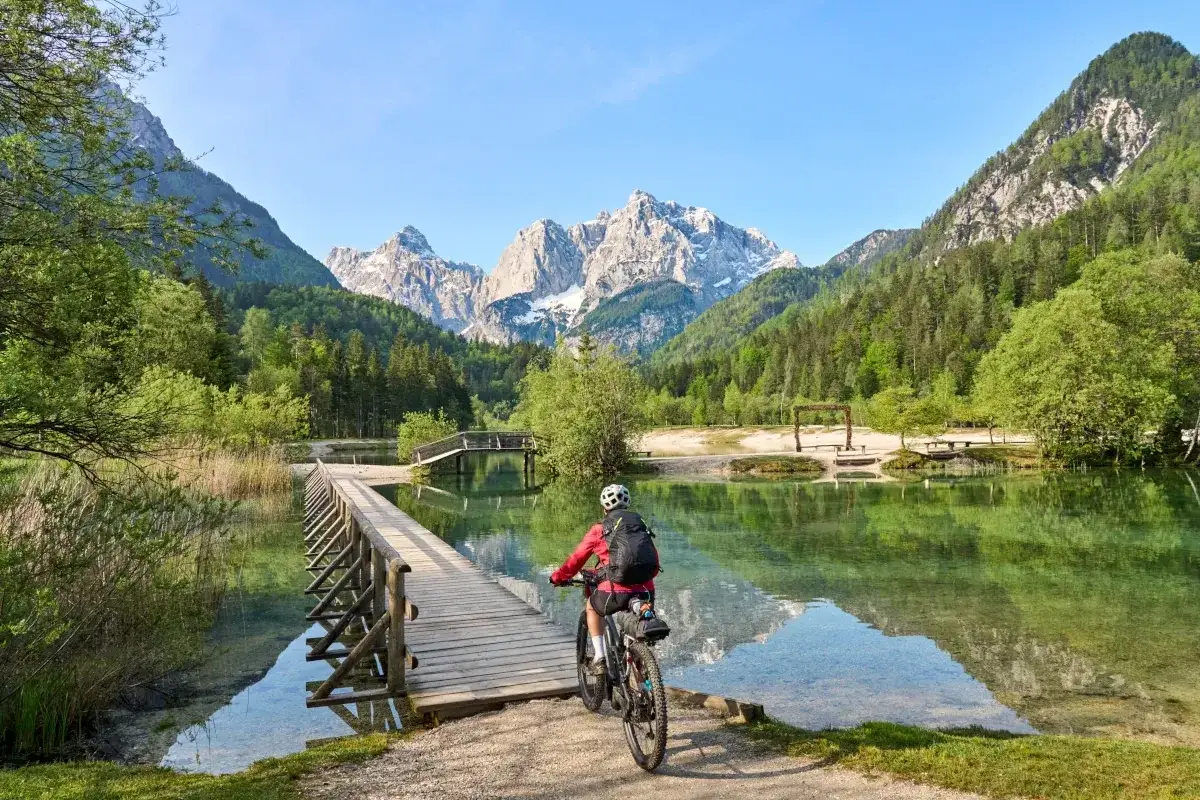
The right Slovenian route depends less on the country as a whole and more on the landscape you want to wake up to each morning. If you choose well, the scenery does a lot of the emotional work for you; if you choose badly, even short stages can feel tiring.
| Area or route | Best for | What the ride feels like | What to watch out for |
|---|---|---|---|
| Julian Alps and Juliana Bike | Strong riders, mountain lovers, people who want a classic Alpine trip | 290 km / 180 mi across 7 stages plus 3 additional stages, with about 8,500 m / 27,900 ft of climbing | This is not casual touring; the climbing and weather can change the mood of the day fast |
| D2 from the Julian Alps to Dolenjska | Riders who want a longer point-to-point journey with variety | 242 km / 150 mi, moderate difficulty, following the Sava River through changing landscapes | The scenery is strong, but it is less dramatic than a pure high-Alpine route |
| Drava Cycling Route | Recreational cyclists and gravel-bike riders | 145 km / 90 mi in Slovenia across 4 stages, with about 1,911 m / 6,270 ft of climbing, mostly on local asphalt roads | Better for steady riding than for chasing extreme mountain drama |
| Parenzana on the coast | Families, mixed-ability groups, riders who want a lighter pace | About 130 km / 81 mi along the former railway line between Koper and Sečovlje Saltpans | Heat and exposure matter more here, especially in midsummer |
| Slovenia Green Wellness Route | Travelers who want spas, soft recovery days, and flexible stage planning | 16 stages, 680 km / 423 mi, average stage length of 40 km / 25 mi, with 6,700 m / 22,000 ft of ascent and descent | It works well as a modular trip, but the full route is too long for most first-time visitors |
| Amazon of Europe in Prekmurje | Riders who prefer flat or rolling terrain and a quieter pace | The Slovenian section is 90 km / 56 mi along the Mura River through plains and villages | Less dramatic than Alpine touring, but much easier to ride day after day |
If I had to simplify it, I would put it this way: the Alps are for riders who want a story, the rivers are for riders who want flow, and the coast is for riders who want easier mileage with scenery. Once that choice is clear, the next decision is how much support you want on the road.
Guided, self-guided, and e-bike tours are not the same product
These labels sound similar until you are actually on the bike. A guided tour gives you a leader and more direct backup, a self-guided tour gives you structure without the group pace, and an e-bike changes what counts as a hard day.
| Format | Best for | What you get | Trade-offs |
|---|---|---|---|
| Guided | First-timers, social riders, travelers who want local context | Route leadership, pacing help, local knowledge, and easier problem-solving if something goes wrong | Less freedom, more group compromise, and usually a higher price |
| Self-guided | Independent riders who still want the trip organized | Booked accommodation, luggage transfer, GPS tracks or maps, and a pre-built route | You are responsible for pacing, navigation checks, and small decisions on the road |
| E-bike-based | Mixed-ability couples, older riders, and anyone who wants hills without constant strain | Electric assist on climbs, easier stage planning, and more flexibility on hilly terrain | You still need to manage charging, battery range, and bike weight |
For most experienced travelers, self-guided is the sweet spot. You keep your own rhythm, but you still get the parts that matter most on a holiday trip: route planning, luggage transfer, and overnight structure. If you want local storytelling or you do not want to think about rerouting, guided makes more sense, especially on more technical or mountain-heavy itineraries.
That choice matters because it changes not just the feel of the holiday, but also what a proper package should include.
What a properly organized package should include
A good cycling package removes friction without making the trip feel overprocessed. In practical terms, I want to see a clear route, real support, and enough flexibility to handle weather, fatigue, or a small mechanical issue without the holiday unraveling.
- Daily stage lengths and ascent figures shown up front, not buried in the small print.
- Luggage transfer between accommodations so you are not riding with a full load.
- GPS files, offline maps, or a navigation app that works without mobile signal.
- Correct bike sizing, especially if you are booking an e-bike.
- A repair or rescue plan for punctures, broken chains, or an unrideable bike.
- Accommodation that is actually practical for cyclists, meaning storage, charging, and a sensible start point for the next day.
- Weather rerouting options or at least a clear policy for missed stages.
- Transport details if the route uses train segments or one-way transfers.
One thing I would not ignore is the map format. Some newer routes are still heavily digital. Trans Dinarica, for example, is presented as a route that relies on digital navigation rather than special on-the-ground markings, so if a package includes that kind of itinerary, the navigation support needs to be genuinely solid.
Once those basics are clear, the budget becomes much easier to understand.
What it costs in practice
In 2026, the official tourism listings I checked still show short cycling packages from around €88 to €92 for 2 nights. That is a useful anchor, because it tells you where the entry level sits for a basic organized stay in Slovenia. It also shows how quickly pricing can rise once you move from a short package to a longer, more supported holiday.
For me, the important lesson is not the headline number itself but what drives it. Bikes, luggage transfer, guide time, hotel category, spa access, and one-way logistics all add cost. A 2-night package and a 7-day touring holiday are not even the same business model.
| Cost driver | Why it changes the price | What I would check first |
|---|---|---|
| Bike hire | Standard bikes, road bikes, and e-bikes sit in very different cost brackets | Frame size, battery range, pedals, helmet, and whether repairs are included |
| Luggage transfer | Convenience is expensive, but it is also what makes point-to-point touring pleasant | Whether transfer is daily, between selected stages, or not included at all |
| Accommodation | Hotel level and location change the character of the trip as much as the riding does | Breakfast quality, bike storage, spa access, and proximity to the route |
| Guide support | Guides are valuable on technical, mountain, or culturally dense itineraries | Group size and whether the guide rides with you every day |
| Transfers and rail links | One-way logistics add comfort but also cost | Airport pickup, train connections, and return transport for bikes |
I usually tell people to compare the package contents before they compare the price. A slightly higher rate can be better value if it includes the parts that are hardest to organize on your own. A lower rate can be a false bargain if it leaves you paying separately for transfers, gear, and backup.
After that, timing becomes the last major filter, because a good package still becomes a poor trip if the season does not fit the route.
When to go and how to avoid the common planning mistakes
Slovenia is flexible enough to ride in more than one season, but that does not mean every route is equally pleasant all year. The broad season works because the country mixes Alpine and Mediterranean influence, yet altitude still matters. If your itinerary climbs into the higher mountains, I would lean toward late spring through early autumn. For river routes, wine roads, and coastal paths, the window is broader.
The mistakes I see most often are simple but expensive. People underestimate climbing because the distance looks modest. They book a road bike for a route that includes gravel or forest track. They land in the country and expect to ride hard the same day. Or they choose a route style that looks scenic in photos but is too exposed, too hilly, or too long for their actual fitness level.
- Do not judge a stage only by distance. A 40 km day with serious ascent can feel harder than a flat 80 km ride.
- Do not assume every Slovenian cycling route is fully paved.
- Do not book a mountain itinerary if you really want a relaxed touring holiday.
- Do not ignore battery and charging logistics if you plan to use an e-bike.
- Do not start with a country-crossing epic unless you already know you enjoy multi-day touring.
If I were booking for myself or for a client, I would treat the route profile as more important than the brochure photos. That is the difference between a trip that feels easy to love and one that feels harder work than it should.
The first Slovenia ride I would book for most travelers
If I were planning a first trip for a U.S. traveler, I would start with a 5 to 7 day self-guided tour in one region rather than a full country-wide crossing. That gives you enough structure to enjoy the country without turning the holiday into a logistics puzzle. It also leaves room to adjust for weather, fatigue, or a day when you simply want to linger longer over lunch or a viewpoint.
- Choose one base region instead of trying to sample every landscape in one trip.
- Keep most daily stages in the 30 to 60 km / 19 to 37 mi range unless the route is very flat.
- Confirm luggage transfer, GPS files, and bike sizing before you pay.
For a first-timer, the safest starting points are usually the Drava or Sava corridors if you want easier riding, or the Julian Alps if you are comfortable with climbing and want the classic mountain version of Slovenia. When those pieces line up, the trip stops feeling like a package and starts feeling like a genuinely well-designed cycling holiday.