What matters most before you go
- This is a dramatic inlet, not a conventional beach town, so expectations matter.
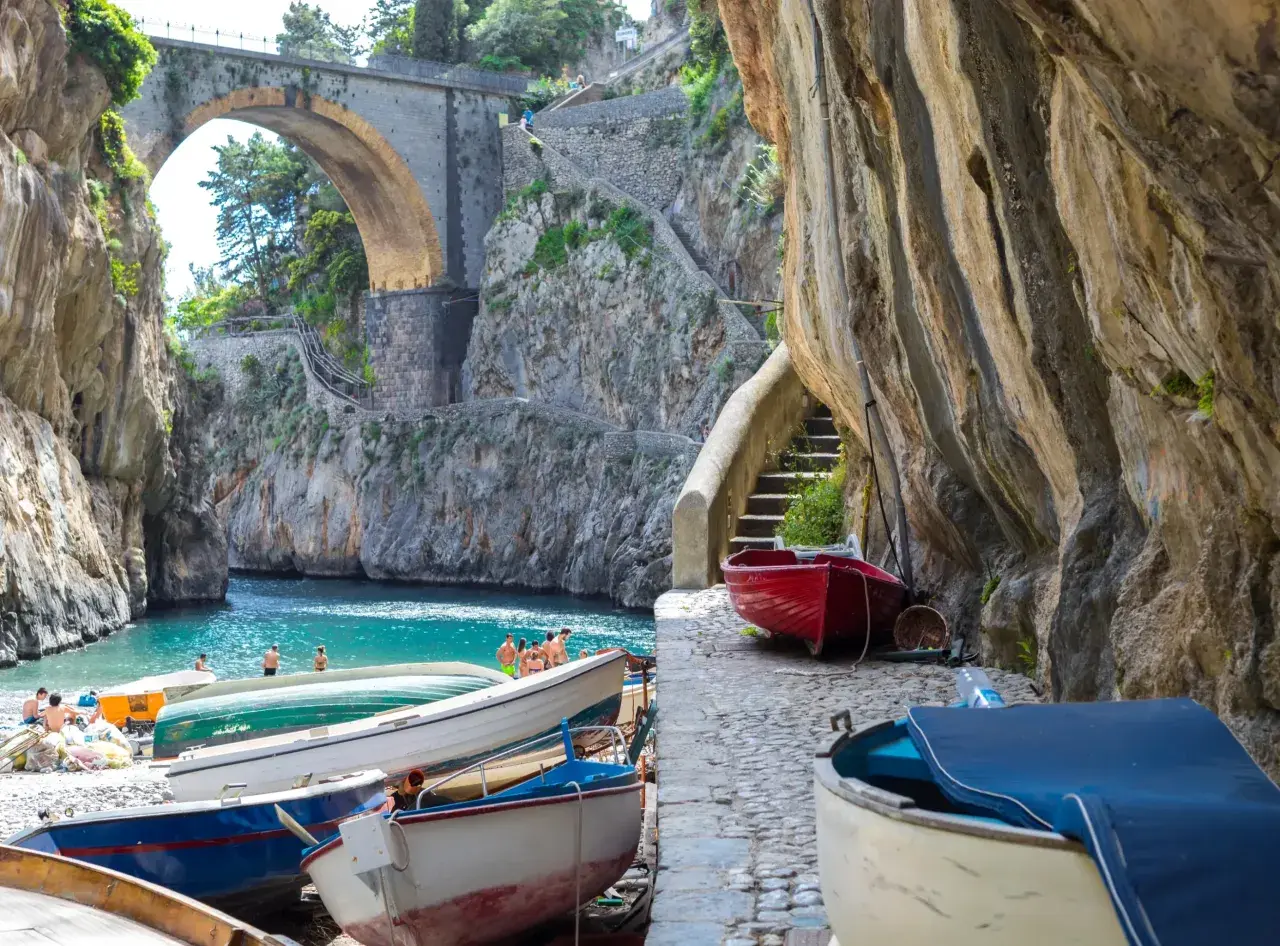
- The shore is small and pebbly, and access is usually by a steep stair descent from the road.
- Early morning usually gives the best mix of light, space, and easier movement.
- The best visit is often a short stop, a quick swim on calm days, or a scenic detour on a coastal route.
- It pairs well with Praiano, Conca dei Marini, Agerola, and the terraced hills above Furore.
What makes the inlet stand out on the Amalfi Coast
What makes this place memorable is the contrast of scale. The cliff walls rise sharply around a very small strip of shore, so the whole scene feels compressed, vertical, and almost theatrical. The beach itself is tiny, roughly 25 meters long, and the bridge overhead is part of the image as much as the water below. That is why the stop works so well for scenic travel: it is not trying to compete with larger beaches, it is offering a compact landscape that feels unusual the moment you see it.
I think that distinction matters. If you arrive expecting a normal seaside day, you may feel underwhelmed by the size. If you arrive expecting a dramatic viewpoint with the option of a short swim, it makes a lot more sense. The inlet is also useful as a visual anchor for the coast, because it shows the geography that defines the region: steep rock, limited flat ground, and a constant negotiation between land and sea. Once you understand that, the logistics become easier to plan.
How to reach it without burning half the day
For most travelers, the practical challenge is not finding the place, but fitting it into the Amalfi Coast without losing time in traffic or on awkward transfers. The area is usually reached from Amalfi, Positano, or Naples via a combination of car, bus, taxi, or private transfer. The final descent to the water is on foot, and the walk back up is the part people underestimate. I would build the visit around that stair climb from the start, not as an afterthought.
| Option | Best for | Trade-offs | My take |
|---|---|---|---|
| Car or private transfer | Travelers who want flexibility and plan to stop at viewpoints | Summer traffic, limited parking, and stress on the coastal road | Best if you start early and want to combine several stops in one day |
| Local bus | Budget-conscious visitors and people without a car | Crowding, delays, and less control over timing | Workable, but I would not plan a tight onward connection around it |
| Taxi or driver | Short stays, photo stops, and travelers with limited time | More expensive than public transport | The simplest choice if you value time more than cost |
| Walking from Agerola | Hikers and active travelers | Steep gradients and a tiring return | Excellent if you already want a hike, less ideal as a standalone transfer |
The beach access itself is the other detail worth knowing. Expect a steep stair descent from the road, and do not be surprised if the route feels longer on the way back up. Depending on where you start, people often describe the descent as a few hundred steps, so I would wear shoes with grip and avoid carrying more than you need. If you are coming from the U.S. and building a wider Italy trip, Naples is usually the most practical gateway, but the coast itself rewards slower pacing than a simple point-to-point transfer.
What to do there beyond taking the same photo everyone else takes
The obvious activity is photography, and the bridge is the best-known angle for that. But the site is more interesting when you treat it as a short sequence of experiences rather than a single photo stop. From the road, you get the wide view of the gorge. On the stairs, you notice how enclosed the space feels. On the beach, the scale shifts again, and the cove starts to feel quieter and more intimate.
On a calm day, a quick swim can be worthwhile. The water often looks especially clear in the protected inlet, and the small pebble shore gives the place a more rugged feel than a sandy beach would. That said, I would not plan a long beach day here. There is simply not enough space for that, and the experience works better if you accept its limits. If the sea is choppy or the wind is up, I would skip the swim and keep the stop focused on the view instead.
- Use the bridge viewpoint first because it gives you the clearest sense of the landform before you descend.
- Walk down early if you want quieter conditions and fewer people on the stairs.
- Pack water shoes if you plan to enter the water, since the shore is pebbly and uneven.
- Do not expect a full beach club setup unless you have already checked current facilities for your exact visit.
- Keep the stop short unless you are hiking or swimming, because the site is strongest as a scenic detour, not a destination that fills a whole day.
If you are lucky enough to visit during a summer diving event, you will see the bridge used in a very different way, but that is a special occasion rather than the normal rhythm of the place. For most visitors, the value is in the landscape itself. Once you see it in person, the next question is not what to do on the cove, but when to come so the experience feels less crowded and more rewarding.
The best time to visit and the traps I would avoid
I would place timing near the top of the decision list. Early morning is usually the sweet spot because the light is softer and the road, stairs, and viewpoint are easier to handle before the day heats up. Late afternoon can also look beautiful, especially for photos, but it tends to attract more people. In midsummer, the place can feel much busier than its size suggests, and that makes a compact site feel even smaller.
| Timing | What you get | My take |
|---|---|---|
| Early morning | Better light, fewer people, smoother movement on the stairs | My first choice for a relaxed visit |
| Late afternoon | Warm color and good photo conditions | Good, but expect more visitors |
| Midday in peak summer | Bright light and heavy foot traffic | Usually the least comfortable time |
| Shoulder season | More space, easier road conditions, calmer pacing | The most balanced option if your schedule allows it |
The common mistake is to treat the stop as an easy, casual add-on at the hottest, busiest part of the day. That is when parking becomes annoying, buses are fuller, and the stairs feel harder than they should. Another mistake is ignoring sea conditions. If the water looks rough, I would not force a swim just because you are there. The gorge is beautiful in bad weather too, but the best version of the visit depends on sensible timing and realistic expectations.
Where to pair it with nearby stops that actually fit the route
The site works best when paired with places that sit naturally on the same stretch of coast. That keeps the day efficient and gives the fjord more context. I usually think in terms of short combinations rather than long circuits, because the coast rewards selective stops more than it rewards cramming everything into one drive.
| Nearby stop | Why it fits | Best for |
|---|---|---|
| Praiano | Easy to combine on the coastal road and good for a slower lunch or sunset | Travelers who want a less frantic base |
| Conca dei Marini | A natural add-on if you want another coastal viewpoint or the Emerald Grotto area | Scenic variety and short, focused outings |
| Agerola | Useful if you want hiking and a higher-elevation contrast to the coast | Walkers and active travelers |
| The terraced hills above Furore | They add wine country and agricultural context to the coastal scenery | Visitors who like landscapes with a stronger sense of place |
If I were building a simple half-day route, I would either pair the inlet with a nearby village stop and lunch, or with a hike from Agerola if the goal is movement rather than relaxation. That combination feels more complete than trying to see five places in one rushed sweep. The real win here is not coverage, it is rhythm. The coast makes more sense when you leave space between stops, and this is one of the clearest places where that advice pays off.
The easiest way to make the stop feel worth it
My rule for this corner of the Amalfi Coast is simple: arrive early, keep your expectations precise, and leave enough time to enjoy the viewpoint before you descend. If you only have a short window, make it a bridge-and-beach visit and then move on. If you have more time, add a nearby village, a coastal lunch, or a short hike so the day has more texture than a single photo stop.
That approach keeps the experience honest. The inlet is small, but it is not minor, and it becomes more memorable when you treat it as part of a wider coastal sequence rather than a standalone attraction. That is the version I would recommend for most travelers: short, scenic, unhurried, and tied to the landscape around it. If you plan it that way, the place delivers exactly what it is best at, which is a concentrated slice of the Amalfi Coast without the noise of a larger resort stop.