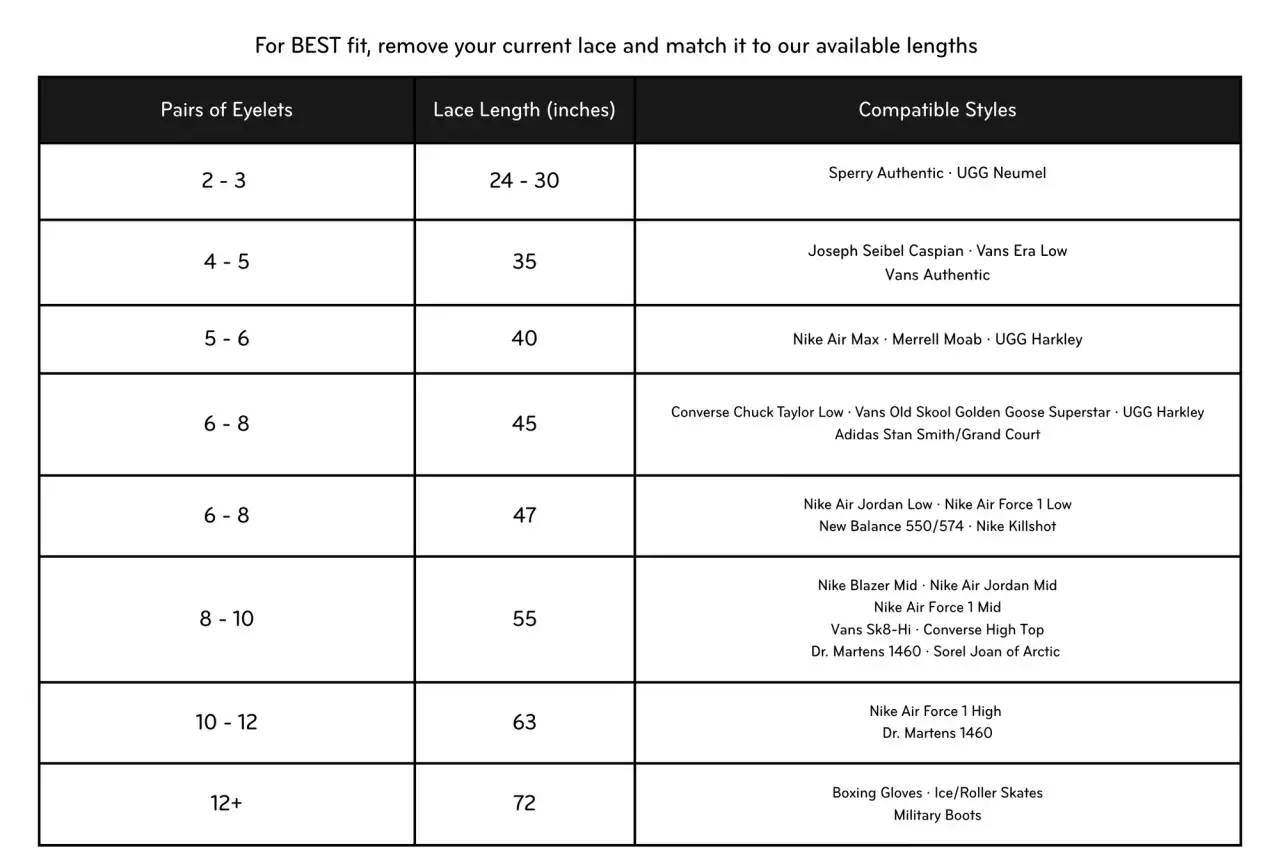
Hiking boot lace length is less random than it looks. One practical question comes up quickly when a pair wears out: How long are hiking boot laces? For most hikers, the answer lands somewhere between 54 and 72 inches, with shorter laces for low-cut hikers and longer ones for taller boots with more hooks. I prefer to choose from the boot itself, the eyelet count, and the lacing style, because those three details tell you more than the size on the box.
The main numbers in one glance
- 54 inches is a common starting point for low hiking shoes and some shorter boots.
- 63 inches is the safest middle-ground choice for many mid-height hiking boots.
- 72 inches often fits taller 8-inch boots and models with more hooks.
- 84 inches shows up on very tall or mountaineering-style boots.
- The right length depends on eyelet count, boot width, and knot style, not height alone.
- If you still have the original pair, measure that lace first; it is usually the fastest answer.
The lengths you will see most often
If I had to give a simple shopping answer, I would start here: 54 inches for low hikers, 63 inches for most mids, and 72 inches for taller boots. Danner's support guidance lands in that same territory, with 5-inch to 6-inch boots typically using 63-inch laces and 8-inch boots typically using 72-inch laces.
| Lace length | Typical hiking footwear | What it usually signals |
|---|---|---|
| 54 in / 137 cm | Low hiking shoes and shorter boots | Shorter lacing run, fewer hooks, less extra tail |
| 63 in / 160 cm | Most mid-height hiking boots | The most useful all-around replacement size |
| 72 in / 183 cm | Tall hiking boots and 8-inch boots | More eyelets, more ankle coverage, more room for knots |
| 84 in / 213 cm | Very tall or mountain-style boots | Long lacing zone, extra hooks, or special wrapping |
That range is broad on purpose. I have seen some specific hiking and mountain models use 58-inch, 68-inch, or even 84-inch laces, so I never treat one number as universal. The next step is to look at the boot itself, because the eyelets usually explain the length better than the model name does.
The good news is that the pattern is easy to read once you know what to count. That is where the eyelets come in.
Count eyelets before you buy
The simplest rule is this: more eyelets usually mean longer laces. Count the pairs on one boot, not both, and remember that wider boots need more lace than narrow boots with the same eyelet count. Ian's Shoelace Site makes that point clearly: width changes the total length even when the eyelet count stays the same.
| Eyelet pairs | Good starting length | Best fit for |
|---|---|---|
| 5-6 pairs | 54 in to 63 in | Low hikers, short boots, compact lacing zones |
| 6-7 pairs | 63 in | Many mid boots and lighter hikers |
| 7-8 pairs | 72 in | Taller mids and sturdier ankle boots |
| 8-9 pairs | 72 in to 84 in | High boots, mountain boots, or extra-lacing setups |
I use that table as a starting point, not a verdict. A narrow boot with 7 pairs of eyelets may still feel fine on 63-inch laces, while a wide boot with the same count can push you toward 72 inches. That is why the chart works best when you pair it with a real measurement of the laces you already trust.
Once you know the eyelet count, the next fastest check is the pair already on the boot.
Measure the pair you already own
If the original laces are still around, I would measure them before buying anything else. REI notes that most boots come with long laces so you can use different tying techniques, and that replacement laces should match both the shape and the length of the old pair.
- Pull one lace out and lay it flat.
- Measure from tip to tip, not just the visible center section.
- If the lace is too frayed to trust, thread a string through the boot the same way and measure that string instead.
- Round to the nearest standard size, then adjust once for your knot style.
That measurement usually beats a generic size chart because it reflects your actual boot, not an average boot. It also catches the little things charts miss, like a gusseted tongue, a wide forefoot, or a lace path that bends more sharply than expected.
With a reliable baseline in hand, the real question becomes whether you tie your boots in a way that uses extra length.
Lacing style can change the length you need
Two boots with the same eyelet count can still need different laces if one of them is tied differently. A surgeon's knot uses more lace than a plain criss-cross, a window lacing pattern can change how the lace travels through the middle of the boot, and a toe-relief setup skips the first hooks entirely. On paper those changes look small; on the boot, they can be the difference between a neat tie and a tail that barely reaches.
- Surgeon's knot is useful when the heel slips and you need a lock that holds its place.
- Window lacing helps if the top of the foot gets pressure from a standard cross-lace pattern.
- Toe-relief lacing gives the toe box a little more breathing room on steep climbs or swollen feet.
- Double knots and long bows need more spare lace, especially if you hike in gloves.
If you regularly use a heel lock or tie a bulky double knot, I would lean longer rather than shorter. If your laces dangle into brush, slap against the boot, or catch on rocky steps, I would lean the other way. On real trails, that trade-off matters more than it does in a shop aisle.
That is why the best replacement is not simply the longest one that fits; it is the one that works with the way you actually hike.
The trail-ready choice I would make first
My practical rule is simple. Start with the brand's recommendation if it exists, then fall back to eyelet count, and finally adjust for the knot you use most often. If you are between two sizes, I usually favor the shorter option for cleaner trail management, unless the boot is wide or you need extra lace for a heel lock.
- Low hikers usually start around 54 inches.
- Mid-height boots usually start around 63 inches.
- Tall boots usually start around 72 inches.
- Very tall or mountain boots can call for 84 inches.
That sequence gets you close fast, and it saves you from the two common mistakes I see most: buying laces that are too short to tie securely, or buying laces so long that the extra tail becomes annoying on the trail. If you are replacing laces for a European mountain boot or a beefier U.S. hiker, the exact model spec still matters, but this rule will put you in the right neighborhood first.
For a clean replacement, I would keep one goal in mind: match the boot you actually wear, not the average boot in a chart. Do that, and you will usually end up with laces that tie securely, sit neatly, and stay out of the way when the trail turns steep, wet, or overgrown.