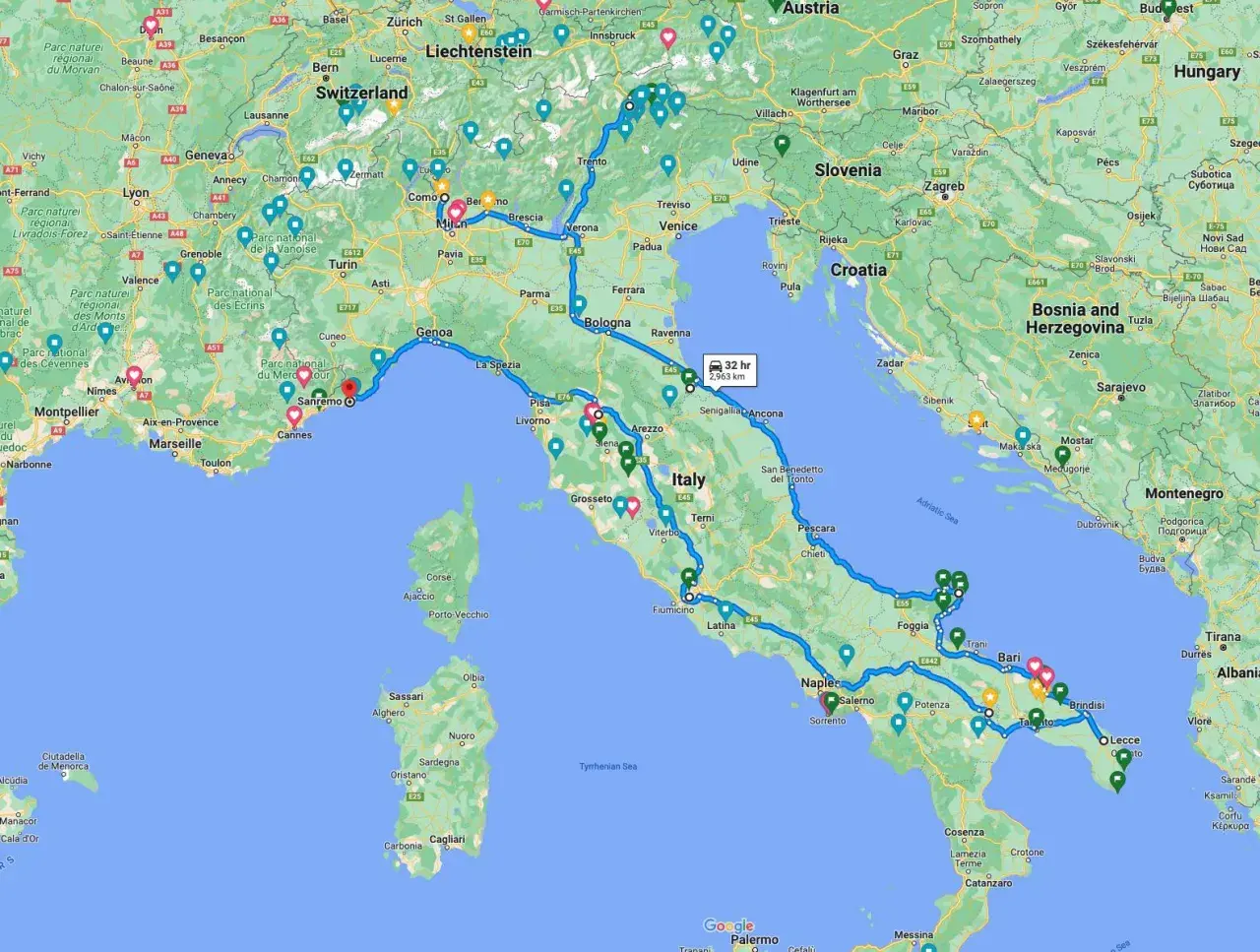
The smartest plan is regional, not continental
- Keep most driving days under 200 km unless you are using motorways for a transfer.
- Carry the right documents, especially an International Driving Permit if you are renting from the U.S.
- Expect ZTL restrictions, paid parking, and motorway tolls in many places.
- Budget roughly €45-€90 per day for a compact rental in normal conditions, plus fuel, tolls, and parking.
- Spring and autumn usually offer the easiest balance of weather, traffic, and scenery.
- For city centres, park outside and walk in instead of trying to force the car into the historic core.
Why the route should follow regions, not mileage
On paper, Italy looks compact. In practice, the landscape changes fast, the roads narrow in old towns, and the best stops are often the ones you cannot rush. A 180-km day can feel easy on the autostrada and exhausting in Tuscany or along the Amalfi Coast, simply because scenery, traffic, and parking slow everything down.
That is why I build most itineraries around two or three bases. I would rather spend an extra night in a good place than drag luggage through five hotels and lose half a day every time I move. The result is a better trip, not a slower one. Once the route is regional, the rest of the planning becomes much simpler.
The main shift in mindset is this: you are not trying to “cover Italy.” You are trying to see a few pieces of it properly, with enough breathing room to enjoy the drive between them.
Choose the right format for the time you have
| Trip length | Best structure | My rule of thumb | What to avoid |
|---|---|---|---|
| 5-7 days | One region with one or two bases | Keep driving days under 150 km when possible | Cross-country transfers and daily hotel changes |
| 8-10 days | Two connected regions | Use one longer transfer, then slow down | Trying to fit Rome, Florence, Venice, and the south into one loop |
| 11-14 days | North-to-central or central-to-south route | Mix scenic days with motorway transfers | More than three or four overnight moves unless the drive itself is the goal |
| 2+ weeks | Deeper regional circuit or open-jaw route | Use the car for the countryside, not for every city hop | Letting the trip become a relocation exercise |
If you only have a week, I would pick one region and let the side roads do the work. If you have two weeks, connect regions with one or two longer transfers, but do not turn the trip into a checklist. The best drives in Italy usually feel unhurried, even when the schedule is tight.
Decide when a car helps and when it hurts
| Option | Best for | Weak spot | My take |
|---|---|---|---|
| Car only | Vineyards, hill towns, coastlines, mountain passes | Historic centres, parking, traffic, tolls | Strongest if your goal is scenery and flexibility |
| Train only | Big-city hops and fast movement between hubs | Remote villages and viewpoint stops | Cleaner and easier if the trip is mostly urban |
| Mixed approach | First trips, city plus countryside itineraries | Requires a little more planning | Usually the best balance of freedom and sanity |
For most first-time visitors, the mixed option wins. I use trains between major cities and a car once I want vineyards, hill towns, coast, or mountain roads. That keeps the trip efficient without forcing me to park in places that were never designed for easy driving.
The car becomes especially valuable when your priority is exploration rather than simple transport. If you want to stop for a roadside winery, a lake viewpoint, or a village lunch that is far from any station, the extra flexibility matters immediately.
What to book before you leave
The U.S. Embassy in Italy recommends an International Driving Permit before departure, and I treat that as essential rather than optional if you are renting as a U.S. traveller. I also expect a credit card in the driver’s name, a valid passport, and a rental policy that actually matches the kind of roads you plan to use.
Documents and rental rules
- Carry your full licence and the IDP together; one without the other is not enough.
- Check the rental age policy early. Many companies set the floor at 21 or 25 and add young-driver fees.
- Book a smaller car than you think you need. A compact car is easier to park and less stressful on narrow streets.
- If you want an automatic, reserve it explicitly. Manuals are still common.
- Confirm whether the car already includes the right insurance level for your comfort, especially if you plan to drive in busy towns.
Lodging and parking
- Ask each hotel whether it is inside a ZTL, and if so, whether they can register your plate.
- Confirm where you will park overnight and whether the space has size or height limits.
- If you are staying near a historic centre, I prefer a hotel with parking just outside the core rather than one inside it.
- For beach towns and mountain villages, reserve parking early in high season because the easy spaces disappear first.
Read Also: Puglia Airports - Bari vs. Brindisi: Which Is Best For You?
Navigation and timing
- Download offline maps for each region before you leave Wi-Fi.
- Save the names of garages and village car parks, not just the hotel address.
- Plan arrivals before late evening. It is easier to understand an unfamiliar town in daylight.
- Leave a margin for lunch, viewpoints, and short wrong turns. Italy rewards detours, but only if you are not racing the clock.
Once those details are set, the trip becomes much easier to execute. The next question is not whether you can afford the drive, but what the drive will actually cost.
What the drive will really cost
Budgeting is where most first-time drivers are too optimistic. The road itself is only part of the bill; parking, tolls, and rental conditions usually decide the real total. A cheap daily rental can become an expensive trip if the pickup fee, one-way charge, and parking stack up faster than expected.
| Cost item | Typical planning range | What pushes it higher |
|---|---|---|
| Compact rental car | About €45-€90 per day in normal shoulder-season conditions | Automatic gearbox, airport pickup, young-driver fee, one-way return |
| Fuel | Roughly €12-€18 per 100 km for a typical petrol compact | Heavier cars, mountain driving, aggressive speeds, current fuel prices |
| Motorway tolls | Often around €10-€15 per 100 km on tolled stretches | Long autostrada transfers and routes that stay on toll roads for most of the day |
| Parking | About €1.50-€4 per hour in many tourist towns; garage days often €15-€40 | Historic centres, beach resorts, and peak-season weekends |
| Extras | Highly variable | Second driver, child seat, full insurance, snow gear, one-way fees |
If you stay mainly on secondary roads, your toll spend can stay modest, but parking often becomes the hidden budget line. On the other hand, a long motorway transfer is usually cheaper in time than in money, which is why I use it when it actually buys me more time on the ground.
The other thing worth remembering is that tolls in Italy are distance-based on the motorway network, so the farther you go, the more you pay. That is one reason a route that looks expensive on the map is sometimes not as bad as it seems once you break it into shorter regional legs.
How to drive without fighting the country
Italy is not difficult to drive in, but it does punish casual assumptions. The rules are simple enough if you respect them: 50 km/h in built-up areas, 90 on secondary roads, 110 on main roads, and 130 on motorways. The bigger trap is not the speed limit itself; it is the combination of narrow streets, camera enforcement, and city centres that quietly turn into restricted zones.
- ZTLs restrict historic centres at posted times. If your hotel sits inside one, send the plate number in advance.
- Blue parking lines usually mean paid parking, white lines mean free parking, and yellow lines mean reserved spaces.
- Most motorways are tolled; you usually take a ticket and pay at exit by cash or card.
- Green signs generally indicate motorways, blue signs suburban roads, and white signs urban roads.
- On coastal or mountain roads, I add 20-30% to the estimated drive time because curves, traffic, and slow vehicles change the pace quickly.
- Keep a little more space than you would at home. The roads are good, but the margins can be tight.
Roundabouts, lane discipline, and unexpected scooter traffic are easier to manage when you are not rushing. I also treat historic-centre parking as a privilege, not a right. If the car belongs outside the old town, I leave it outside and enjoy the walk in.
Once that baseline is in place, the interesting part begins: choosing the roads that are actually worth your time.
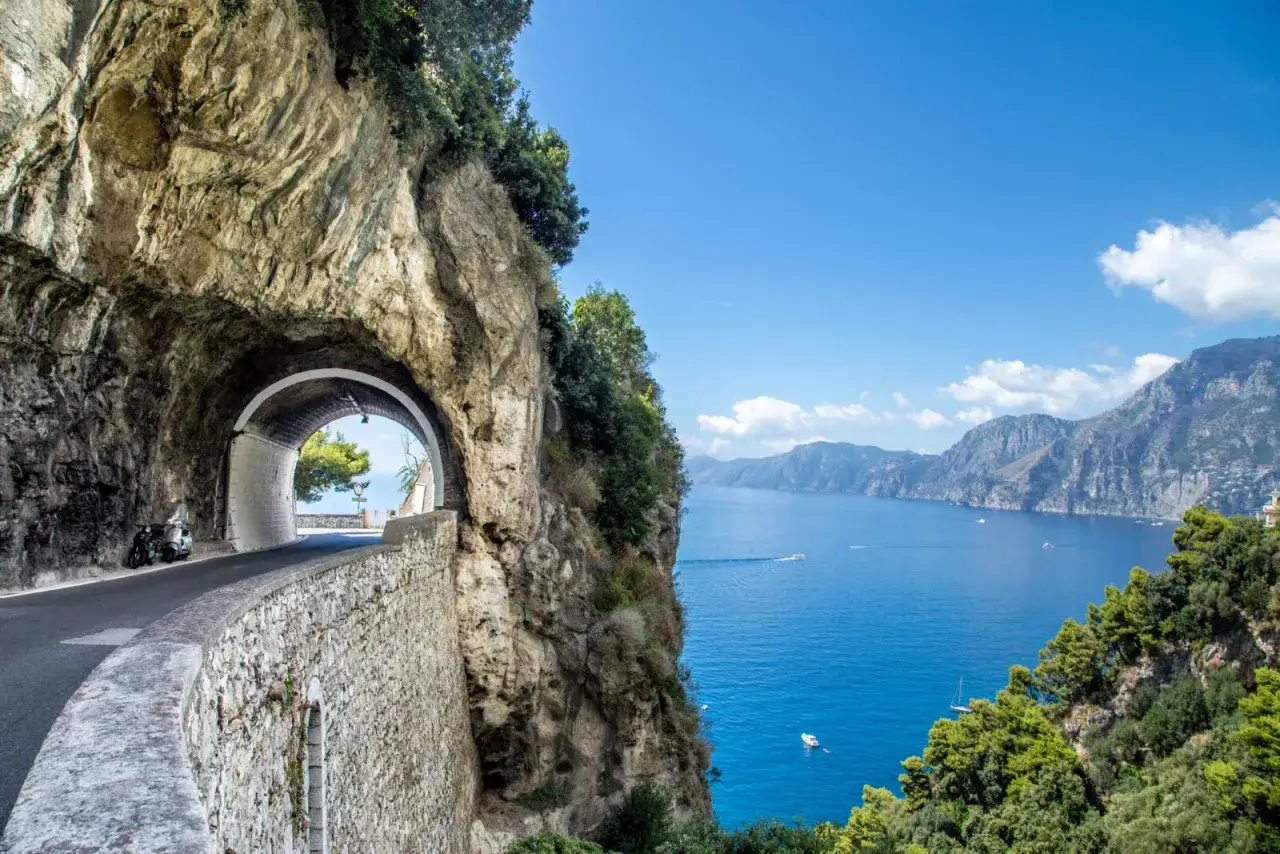
Scenic routes that are worth the wheel time
I do not pick roads because they are famous; I pick them because they make the trip better. These are the kinds of drives that justify renting a car in the first place, especially if your goal is scenery, food, and a slower pace.
- Tuscany and Val d’Orcia is the best example of a drive that works because the distances are short. You get vineyards, cypress-lined roads, and hill towns that invite pauses rather than long transfers. What it teaches: leave room for unplanned stops.
- The lakes and Alpine foothills are ideal for a first road trip. The roads are manageable, the scenery changes quickly, and the bases are easy to combine. What it teaches: you can get a lot of beauty without constant parking stress.
- The Amalfi Coast and Cilento are dramatic but slow. The road itself is the attraction and the bottleneck. I would park once I reached the busiest towns and switch to walking, ferries, or short local transfers. What it teaches: scenic does not always mean efficient.
- The Dolomites are for mountain scenery, switchbacks, and weather that can change the mood of the day in an hour. I only build this into a route if the lodging plan is flexible. What it teaches: mountain drives demand room in the schedule.
Those are the routes I keep returning to because they balance motion and place. They are also the clearest reminder that the best drive in Italy is rarely the longest one.
The last details I would lock in before departure
The trip gets much easier when you finish the small decisions early. If I were putting a road trip through Italy together right now, I would still start with the same five habits: choose a smaller car, book parking before arrival, save offline maps, keep one flexible day in every few days, and avoid trying to force a car into the heart of every historic centre.- Pick the smallest car you are comfortable with.
- Reserve parking first, then the hotel.
- Leave big-city cores for foot, taxi, or train.
- Keep a phone mount, charging cable, and offline maps ready.
- Build in at least one slow afternoon for every few active driving days.
That is the version of the trip I would trust every time: practical, scenic, and calm enough to enjoy the places between the roads.