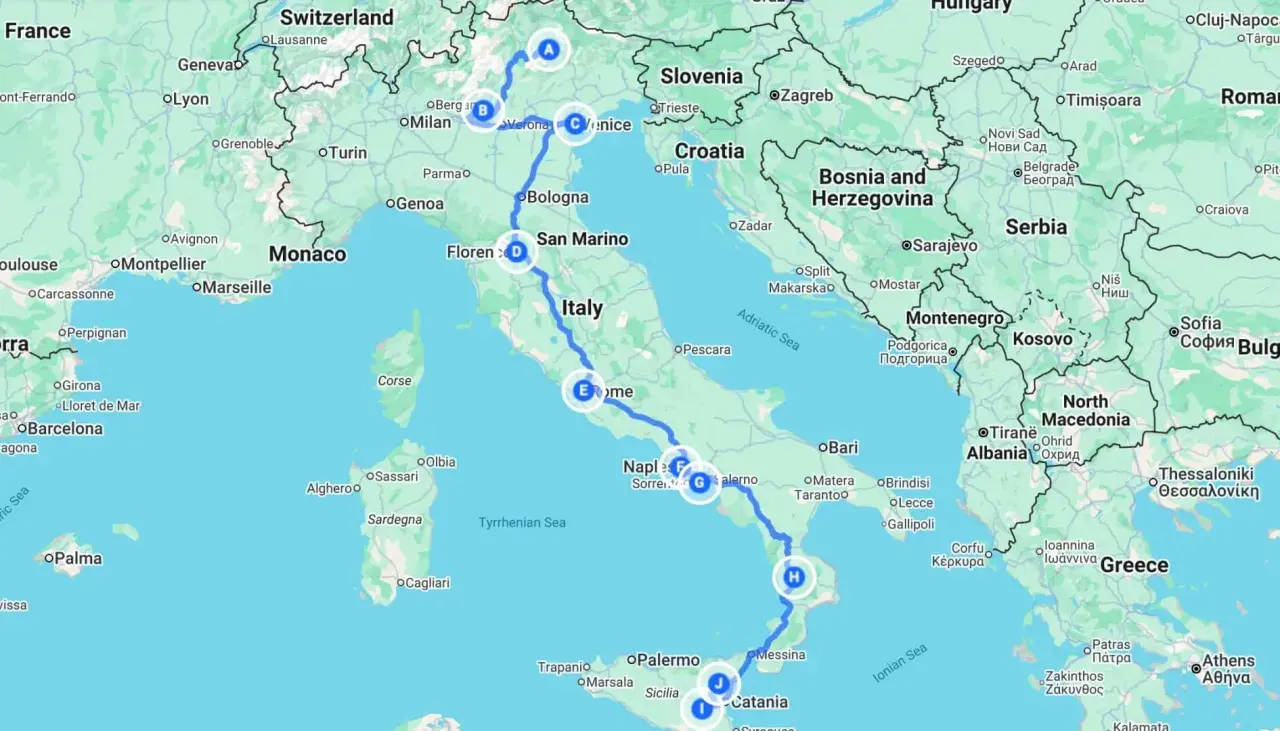
A road trip through southern Italy gives you a rare mix of coastal drama, inland history, and slow-burn food stops that work best when you have your own car. A southern Italy road trip is not about covering every famous town at speed; it works when you shape the route around short driving days, smart overnight bases, and a realistic view of parking and traffic restrictions. In this guide, I focus on the planning decisions that actually change the experience: where to start, how long to stay, when to go, what to budget, and what to avoid.
The practical choices that make the route easy to drive
- 10-14 days is the sweet spot for most travelers who want coast, culture, and a sane pace.
- The best windows are usually April to June and September to October.
- Rent a compact car; big vehicles are a disadvantage in old towns and tight hotel garages.
- Plan around 2-3 base towns instead of changing hotels every night.
- Historic-center restrictions, known as ZTL zones, are the main driving trap in this region.
- Parking, tolls, and fuel are real trip costs, not minor extras.
Choose a route that fits the time you actually have
Most first-time travelers make the same mistake: they try to combine the Amalfi Coast, Matera, Puglia, Calabria, and Sicily in one loop. That sounds efficient on paper, but in practice it turns the trip into a transfer schedule. I usually steer people toward a tighter route that lets them enjoy the scenery instead of checking the clock every day.
| Trip length | Route shape | What it gives you | Best for |
|---|---|---|---|
| 7 days | Naples, Amalfi Coast, Matera | Coast, culture, and manageable driving | First-time visitors with limited time |
| 10 days | Naples, Amalfi Coast, Matera, Valle d'Itria, Lecce | A better balance of road time and sightseeing | Most travelers |
| 14 days | Campania, Basilicata, Puglia, with Salento or Cilento added | Slower pacing and more room for beach time | Travelers who want breathing room |
| 18+ days | Add Calabria or Sicily as a separate extension | Depth instead of rushing from one highlight to the next | Travelers who want a fuller southern Italy loop |
My default first-timer line is Naples or Sorrento, then Matera, then the Valle d'Itria and Lecce. That gives you coast, caves, food, and a believable amount of time behind the wheel. Once the route shape is clear, the next decision is where to start and finish so you avoid unnecessary backtracking.
Start and finish where the driving makes sense
For most US travelers, the smartest move is open-jaw flights: arrive in one city, leave from another, and keep the route one-directional. Naples is the natural anchor if Amalfi, Pompeii, and Matera are on the list; Bari or Brindisi make sense if Puglia is the main event; Palermo or Catania are better if Sicily is the priority. I would only backtrack to the same airport if the airfare difference is significant enough to justify a lost driving day.
If Sicily is part of the plan, I treat it as its own road trip unless you have extra time to spare. The ferry is workable, but once you add loading times, drop-off rules, and island driving, the logistics stop feeling casual. In Naples, I often keep the first night car-free and pick up the vehicle only when I am ready to leave the city. After that, timing matters just as much as geography, because the same roads feel very different in April and August.
Pick the season that matches the kind of trip you want
For this region, shoulder season usually wins. April to June gives you comfortable temperatures, longer daylight, and fewer parking headaches than high summer. September and October are often even better for a driving itinerary because the sea is still inviting, the heat has eased, and the coast is a little less crowded.
- April to June works well if you want mild weather, long sightseeing days, and greener inland landscapes.
- July and August work best only if beach time is the priority and you accept heat, traffic, and higher prices.
- September and October are my favorite months for a mixed coastal and cultural route.
- November to March can be fine for cities, food, and quieter roads, but some seaside towns feel sleepy and daylight is shorter.
As a pacing rule, I try to keep most driving days under 3.5 hours and save one longer transfer day for the middle of the trip. That keeps the holiday feeling like a holiday. Once the timing is set, the next step is understanding the road rules that can derail an otherwise good itinerary.
Know the driving rules before you turn the key
According to Italia.it, you need a valid driving licence to drive in Italy, and US travelers should also carry an International Driving Permit. Rental desks can ask for a credit card in the driver's name, and many companies set a minimum rental age of 21 or 23, with a surcharge for younger drivers. I would also keep a paper or digital copy of the rental contract with the car, just in case you need to explain the vehicle quickly.
- Drive on the right and overtake on the left.
- Do not turn right on red.
- Typical speed limits are 130 km/h on motorways, 110 km/h on main roads, 90 km/h on secondary roads, and 50 km/h in towns.
- Keep headlights on outside built-up areas when required.
- Carry a warning triangle and a high-visibility vest.
- Watch for ZTL zones in historic centers and do not follow local cars blindly.
- Use a compact car and offline maps; both make narrow streets easier to handle.
I would rent the smallest comfortable car, not because the roads are impossible, but because old centers, tight hotel garages, and narrow lanes punish big vehicles. These rules matter even more once you start counting tolls, parking, and fuel, because they change the real cost of the route.
Budget for the hidden costs that change the route
Autostrade per l'Italia calculates motorway tolls by distance and vehicle category, so a long day on the main highways can add up faster than many travelers expect. For planning, I would assume about EUR 9 per 100 km on toll roads, although the actual number depends on the route you choose and how often you leave the autostrada. Fuel prices also move, so it is safer to build a range than to fix a single number into your budget.
| Cost item | Planning range | Notes |
|---|---|---|
| Compact rental car | USD 45-110 per day | Summer and automatic cars cost more |
| Fuel | EUR 1.70-2.00 per liter | A moderate 10-day loop can use about EUR 120-250 |
| Tolls | EUR 40-120 for a 10-day route | Lower if you avoid long autostrada stretches |
| Parking | EUR 10-30 per day | Busy coastal towns can be higher |
| Mid-range hotel | USD 120-250 per night | Amalfi Coast properties often sit above this |
For two travelers, I would budget roughly USD 2,800-5,000 before long-haul flights if the trip lasts 10 days and you stay in comfortable but not luxury hotels. The fastest way to blow that budget is to book oversized hotels with no parking and then pay for garages every night. Knowing the common mistakes helps you avoid those extra costs.
Skip the mistakes that make the trip harder than it needs to be
- Do not pack the itinerary with too many destinations. Three or four real bases beat eight rushed stops.
- Do not drive into old town centers unless you are certain parking and access are allowed.
- Do not assume a satellite navigation app will warn you about every ZTL restriction.
- Do not book a large SUV unless you truly need the space.
- Do not leave ferry timing, parking, or hotel check-in to chance if you are crossing to Sicily or arriving late.
The pattern behind all of these mistakes is simple: the route becomes expensive and tiring when you treat every town like a drive-through stop. If you avoid that trap, the region opens up beautifully and the drive starts to feel relaxed instead of administrative. From there, the final question is which version of the trip gives you the most value for your time.
The version of the trip I would plan first
For a first visit, I would build the itinerary around Naples or the Amalfi Coast, a stop in Matera, and several nights in Puglia, with a compact car and two or three hotel bases. That gives you the biggest payoff without forcing you to race from region to region. If you have extra time, add Calabria or Sicily as a separate extension rather than squeezing them into the same loop. Before you lock the trip, I would book the car, confirm parking at every overnight, and decide which towns are strictly walk-in only. The more you let the route breathe, the more the drive feels like the point of the journey instead of the obstacle between stops.