
What matters most before you sign the rental agreement
- Bring the original driving licence, not a photo or scan.
- For U.S. travelers, a passport plus a valid licence is the baseline; an IDP reduces friction at some branches.
- Many Greek rental companies require the driver to be at least 21, with higher minimums for larger vehicles and a one-year licence history.
- A credit card in the main driver’s name is the safest payment method for the deposit, even when debit cards are sometimes accepted.
- Check the excess, additional-driver fee, and any restrictions on ferries or unpaved roads before you pay.
The documents I would keep ready at pickup
At the counter, I want every document in one hand, not scattered through luggage or a phone gallery. The usual core set is simple: a valid driving licence, a passport or government ID, and a payment card in the main driver’s name.
| Document | Why it matters | Practical note |
|---|---|---|
| Driver’s licence | Proves you are legally allowed to drive | Bring the physical original and check that it is still valid |
| Passport or government ID | Matches the reservation to the person collecting the car | For U.S. travelers, a passport is the cleanest option |
| Payment card | Used for the deposit and final charges | Use the card name that matches the main driver |
| Booking confirmation | Speeds up pickup and helps resolve rate disputes | Keep it offline on your phone as well as in email |
| IDP or translation, if needed | Helps when the branch or local rules ask for an extra document | Worth carrying even when the rule is not universally enforced |
I also make sure the name on the reservation, the licence, and the card all line up. That sounds basic, but it is one of the easiest ways to avoid a counter problem before the trip even starts. Once that is settled, the next question is whether your licence is actually accepted without an IDP.
Who needs an IDP and who usually does not
This is the part people overcomplicate. In Greece, many drivers from the U.S. and a handful of other countries can rent without an International Driving Permit, but some branches still ask for one anyway. That is why I treat an IDP as a friction-reducer, not just a legal formality.
| Traveler type | Usual situation in Greece | What I would do |
|---|---|---|
| EU/EEA and Swiss drivers | Home licence is typically enough | Carry your licence and passport or ID |
| U.S., Canadian, Australian, and similar travellers | Many major rental companies accept the home licence without an IDP | Still carry an IDP if you want the smoothest pickup |
| Licences in Latin characters from many non-EU countries | Often accepted, but branch policy can vary | Confirm the branch rules before booking |
| Licences in non-Latin scripts | Usually need an IDP or a certified translation | Do not rely on a screenshot or a rough translation |
| People who have become residents in Greece | Local conversion rules can apply | Check the resident rules before assuming your home licence is enough |
For U.S. travelers, I like the conservative approach: if you can get an IDP before departure, do it. It is valid for one year, it must be carried with your home licence, and it gives you a cleaner answer if the branch agent or a roadside stop wants an extra document. With that out of the way, the next gatekeeper is age and payment policy.
Age, licence history, and payment rules that matter more than the headline price
Greek rental companies are often stricter here than travelers expect. A common pattern is a minimum age of 21 for smaller car groups, with 23 or 25 for larger vehicles, premium models, or less flexible contracts. Many companies also want the driver to have held a full licence for at least one year.
- Minimum age: 21 is common for economy cars, but bigger categories often start at 23 or 25.
- Licence age: one year of full, valid driving history is a frequent requirement.
- Young driver surcharge: if you are under 25, expect an extra fee on many bookings.
- Payment card: a credit card is the least painful option for the deposit.
- Debit cards: accepted by some branches, but often with exclusions or extra conditions.
- Prepaid cards: I would not count on them for a rental deposit.
The reason this matters is simple: the cheapest quote on the screen may disappear once the branch applies age or card restrictions. If you are under 25, or if you are booking an SUV, automatic, or premium car, I would double-check the terms before paying. Next comes the part that affects your actual financial risk if the car gets damaged.
Insurance and deposits are part of the requirement, not an afterthought
I treat the rental agreement as a financial document, not just a key handoff. The important words are deposit and excess. A deposit is the card hold the company places at pickup; an excess is the amount you may still owe if something happens before the insurance layers kick in.
In practice, you want to know four things before you sign:
- how large the deposit hold will be;
- what damage is covered in the base rate;
- whether glass, tyres, underbody, or theft protection are included or optional;
- whether an additional driver or young driver fee is already baked into the quote.
I also read the fine print on road use. Some Greek rental policies are much happier on paved roads than on gravel, beach access tracks, or steep farm lanes. That matters in Greece because the most beautiful routes are often the least forgiving for a rental contract. Once you understand the risk side, the next choice is whether the car itself matches the trip you actually want to take.
Why route planning matters more than the cheapest quote
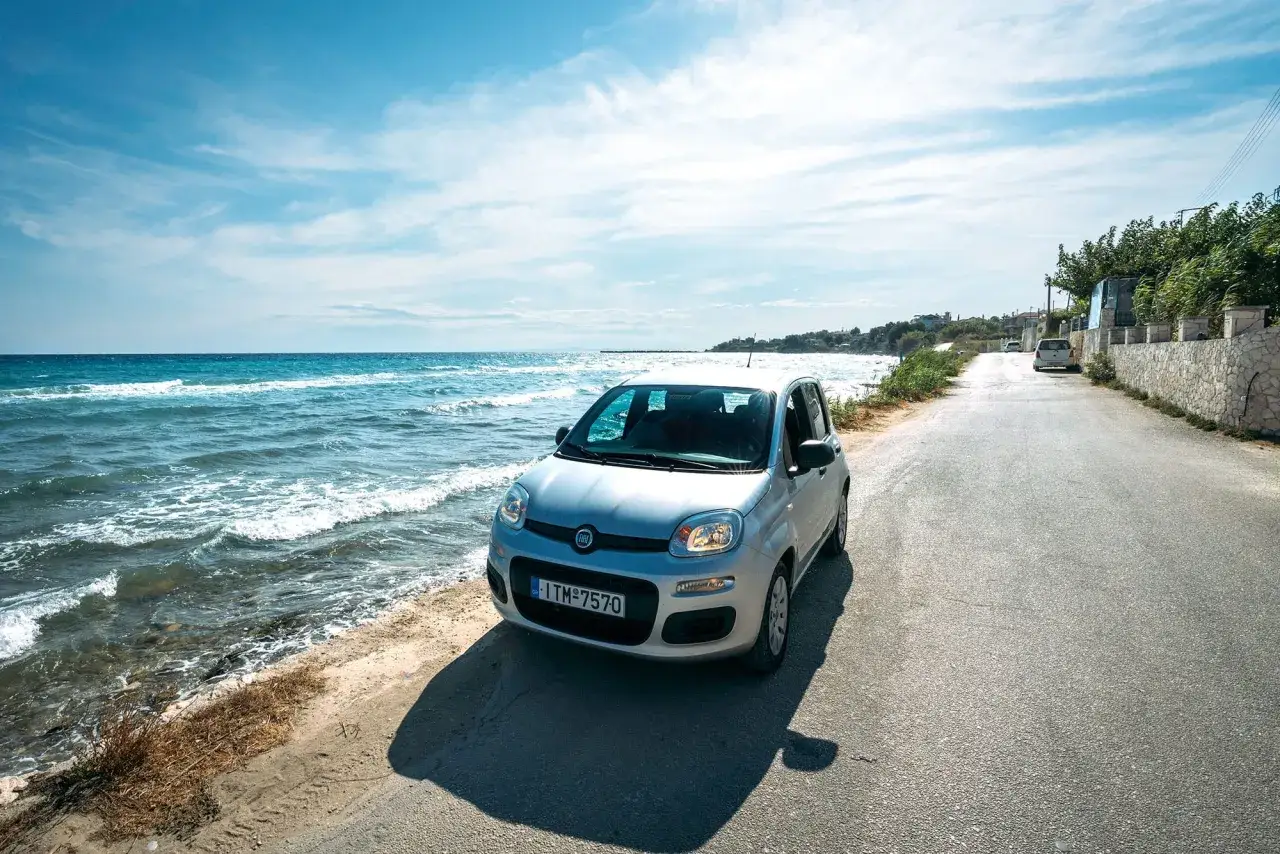
Greece rewards people who choose the right car for the route, not just the lowest daily rate. Coastal drives, ferry hops, mountain villages, and tight old-town parking all punish oversized cars and reward clear planning. I usually aim for the smallest car that still fits the luggage and the terrain.| Trip style | Vehicle logic | Why it helps |
|---|---|---|
| Athens plus highways | Compact car | Easy parking and lower fuel use |
| Island towns and port areas | Small automatic if available | Less stress on narrow streets and hills |
| Mountain or remote routes | Compact SUV or sturdy hatchback | More comfort on rougher surfaces |
I also confirm whether the contract allows the exact kind of trip I want. If I plan to use a ferry, visit multiple islands, or drive onto roads that are not clearly paved, I ask the branch before booking rather than hoping for the best. That habit has saved me more than once, because the final problem is rarely the road itself. It is the assumption you made before you got there.
The mistakes I see travelers make most often
Most pickup headaches are self-inflicted. I see the same mistakes repeat: bringing a digital copy instead of the original licence, assuming a U.S. licence automatically covers every branch, and forgetting that an additional driver must be listed on the contract before the keys are handed over.
- Relying on a photo of your licence. Branches want the real document.
- Ignoring the age rule. The driver may be old enough to rent one car but not another.
- Using the wrong card. If the card name does not match the renter, the deposit can become a problem.
- Leaving out a second driver. A spouse or friend is not automatically covered.
- Skipping the walk-around photos. Damage disputes are easier to settle when you have timestamped pictures.
- Assuming all roads are fair game. Unpaved shortcuts can put you outside the contract.
These are small mistakes, but they are exactly the kind that turn a calm pickup into an argument. My rule is simple: if a detail could delay the handoff, I verify it before I leave home. That leads naturally to the final checklist I would use myself.
The checklist I would use before leaving the airport
If I were planning a Greek road trip today, I would keep the booking boring and the itinerary flexible. That means one confirmed driver, one payment card, one passport, one valid licence, and an IDP in my bag if there is any doubt about the branch or the route.
- Confirm the rental class matches your age and licence history.
- Check whether the branch wants a credit card, debit card, or both.
- Ask about the deposit, excess, and what counts as damage.
- Verify additional-driver and young-driver fees before payment.
- Make sure you understand ferry, island, and unpaved-road restrictions.
The simplest approach is usually the best one: travel with the original documents, choose a car that fits the roads you will actually drive, and do not let a cheap headline rate hide a stricter contract. If you do that, renting a car in Greece becomes less about paperwork and more about getting to the good parts of the trip.