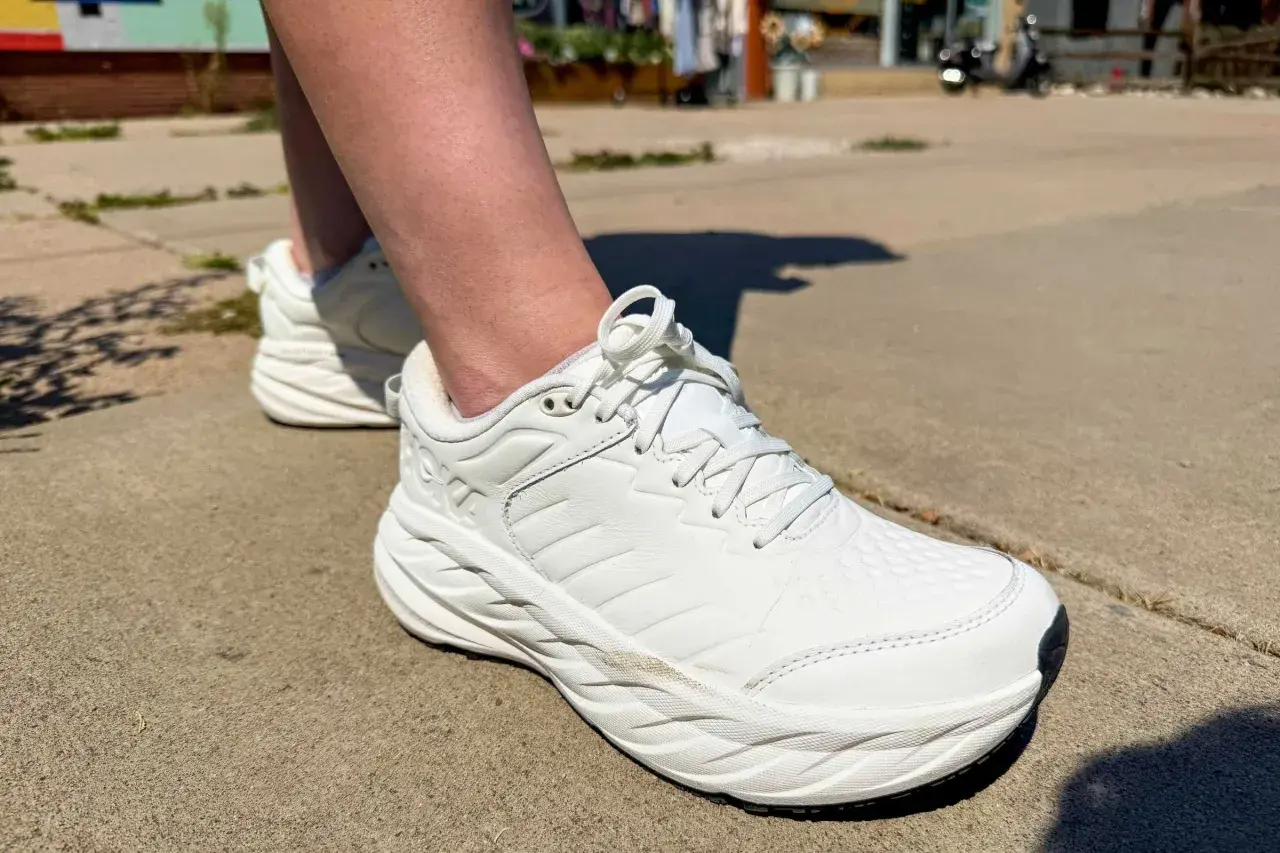
Walking shoes should leave enough room for the foot to expand, bend, and settle over the course of a long day. The question of whether walking shoes should be a size bigger comes up because a shoe that feels fine in the morning can feel tight after a few miles, especially on hills, warm pavement, or a full day of travel. The useful answer is not a dramatic size jump; it is a fit that keeps the heel secure and the toes free.
The fit rules that matter most
- A half-size increase is a common starting point, but it is not automatic.
- Heel hold and toe room matter more than the size label.
- Shop later in the day and wear the socks you actually plan to use.
- If the forefoot feels cramped, a wider width may solve the problem better than extra length.
- For long walks and light hiking, enough front-room matters because the foot moves forward on descents and swells during the day.
- If the shoe only feels acceptable after a painful break-in, it is probably the wrong shoe.
The short answer and where extra room helps
In practical terms, should walking shoes be a size bigger? Often, yes, but usually only by half a size and only if the rest of the fit still works. I treat that as a starting point, not a rule carved into stone, because brands, widths, and sock thickness change the result more than most buyers expect.If your shoes are used for long commutes, sightseeing, or light trails, a little extra length can save your toes on descents and give you breathing room after your feet swell. But if you have to lace the shoe so tightly that the top of your foot aches, or if the heel starts floating, the bigger size is solving one problem by creating another.
For most people, the goal is simple: a secure heel and midfoot, plus enough space in front for the toes to move naturally. That usually means a modest size-up, not a full size leap. Once you know that, the real test is fit, and that is where the next section matters.
Fit checks that matter more than the number on the box
I do not trust size labels on their own. I trust motion. The heel should stay put when I walk, the forefoot should not feel pinched, and the toes should be able to spread a little when the foot loads forward.
- Heel hold - The heel should feel snug, not loose. If it lifts with every step, expect blisters later.
- Toe room - Aim for about a thumb's width, or roughly 3/8 to 1/2 inch, between your longest toe and the front of the shoe.
- Midfoot pressure - The shoe should feel secure across the middle of the foot without creating a hot spot on top.
- Forefoot spread - Your toes should be able to splay a little when you stand and walk.
- Walking test - A short lap in the store is not enough. Walk on a slope, stairs, or a ramp if you can.
- Sock match - Try the shoe with the same sock thickness you will actually wear on the walk.
A shoe that looks fine standing still can change completely once you start moving. That is why I pay more attention to the walking test than to the size printed inside the shoe. If the fit only seems right when you are not using it, the fit is not really right.
That is also why I move from static checks to real movement before I decide, because the next question is when a larger size is genuinely the better choice.
When a half-size bigger is the right call
There are several situations where I am comfortable recommending a small size increase. The best one is simple: the shoe fits everywhere except the front of the foot during a normal stride.
| Situation | What I would choose | Why it matters |
|---|---|---|
| Long sightseeing day | Half-size up | Feet often swell as the day goes on. |
| Warm weather or summer travel | Half-size up if fit is close | Heat and standing time increase foot volume. |
| Hills, stairs, or downhills | Half-size up, then test toe room | Descents push the toes forward inside the shoe. |
| Wide forefoot | Try a wider width first | Length may already be correct. |
| Orthotics or thicker insoles | Half-size up or more volume | Inserted support reduces internal space. |
| One foot is slightly larger | Fit the larger foot | The smaller foot can usually be adjusted more easily. |
This is especially relevant for travel days, when one pair of shoes has to handle airports, cobblestones, museum floors, and a late climb back to the hotel. In that kind of day, a shoe that is just barely short in the toe box tends to feel worse hour by hour, not better.
The catch is that a bigger shoe can just as easily create new problems, which is why I check the downsides before I buy.
When bigger shoes create new problems
A larger shoe is not automatically a better shoe. Once the heel starts sliding, the foot spends energy gripping the shoe, and that can lead to blisters, numbness, or a tired arch. Extra length can also make the foot feel less stable on uneven ground.
- Heel lift usually means the shoe is too long or too low-volume.
- Toe curling can happen when the foot is trying to keep itself stable inside a shoe that is too roomy.
- Arch fatigue can show up when the midfoot is not held securely.
- Blisters on the heel or toes often come from too much movement inside the shoe.
- Clumsy footing on stairs can happen when there is more space than control.
The technical term I pay attention to here is the last, which is the mold a shoe is built around. Two shoes with the same stated size can fit very differently because of that shape. Sometimes the answer is not a larger shoe at all; it is a different last, or a different width, that matches the foot better.
Once that is clear, the difference between walking shoes and hiking shoes becomes easier to judge.
Walking shoes vs hiking shoes on real travel days
For flat city walking, I am usually conservative: secure heel, enough toe room, and not much more. For hiking shoes, especially routes with descents or mixed terrain, I am more willing to allow a little extra room because the foot moves more inside the shoe and the trail can drive the toes forward.
That difference matters on routes with long downhills, rock steps, or a backpack that changes posture. It also matters on European trips where one day can start on smooth pavement and end on a steep lane, gravel path, or uneven coastal track.
| Use case | Fit bias | What I would watch for |
|---|---|---|
| Flat city walking | True fit or slight room | Comfort over several hours, not just in the store |
| All-day sightseeing | Half-size up if the fit is close | Swelling, heat, and repeated steps |
| Light hiking | Slightly more toe room | Downhill impact and uneven ground |
| Steeper trail days | Half-size up plus careful testing | Toe jamming, heel slip, and stability |
That is also why I always finish with a short try-on routine instead of trusting the label alone.
A fitting routine I trust before buying
- Shop later in the day, when your feet are naturally a little larger.
- Wear the same socks you plan to use on the walk or hike.
- Lace both shoes firmly and walk for at least a few minutes.
- Check whether the heel lifts, the toes hit the front, or the top of the foot feels pressed.
- Try a slope, stairs, or a ramp if the store allows it.
- If you are between sizes, compare the half-size up with the wider width.
- Choose the pair that feels right immediately, not the one you hope will get better later.
If a shoe needs a painful break-in just to become tolerable, I would keep looking. A good walking shoe should be usable on day one, not merely survivable.
The small details matter most on long days, which is what I would keep in mind after the purchase.
The small details that make long walks easier
Small fit choices often matter more than the brand name. A slightly thinner insole can free up volume without changing length, a wider width can solve a cramped forefoot more cleanly than sizing up, and trimmed toenails can prevent front-of-shoe contact on descents. If you have bunions, hammertoes, or orthotics, I would prioritize toe-box room and support over any idea of a perfect number.
My practical rule is simple: choose the smallest size that still gives your longest toe a little breathing room, keeps the heel locked, and lets you walk briskly without thinking about the shoe. For most people, that ends up being a half size larger than their casual shoes, but the fit test always wins.