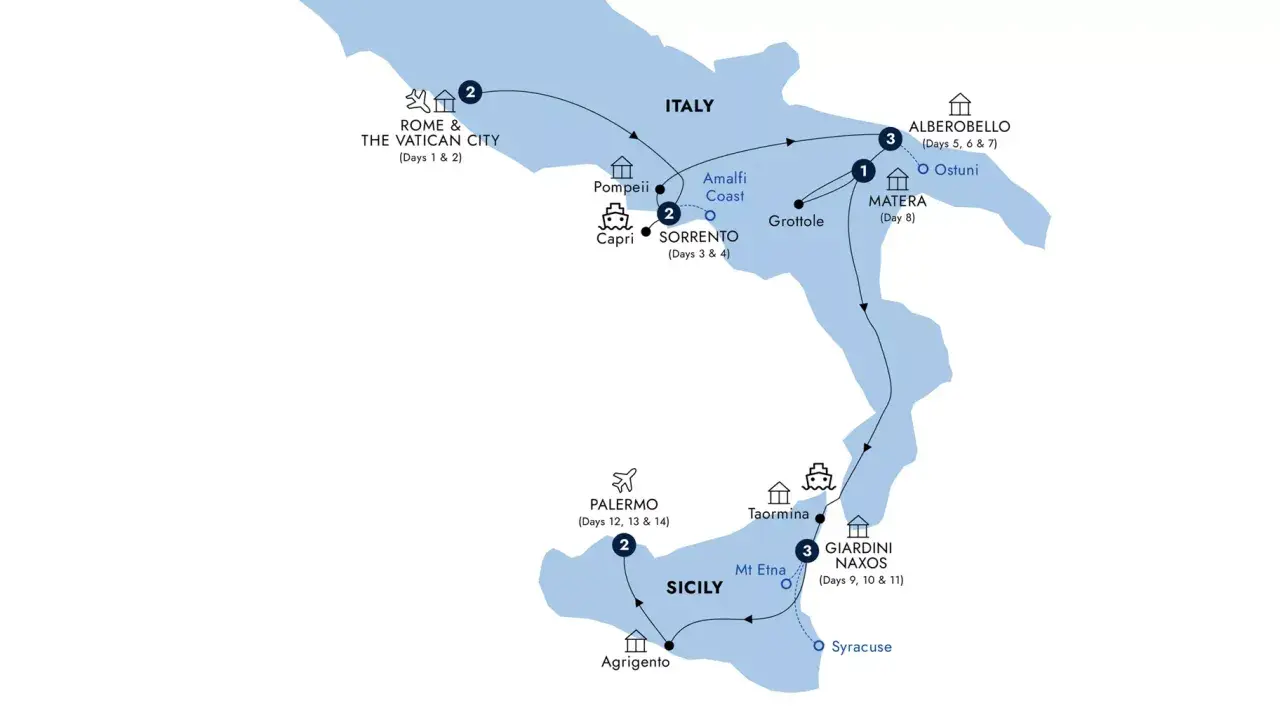
The coastline of southern Italy is not one continuous experience; it changes character from cliff roads and ferry ports to sandy bays, fishing towns, and long sunlit peninsulas. A strong coastal map helps me decide where to base a trip, which stretches are worth the detour, and how to avoid wasting time on transfers that look short on paper but feel much longer in reality. This article focuses on the parts that matter most for trip planning: the main coastal zones, the best bases, the best time to go, and the mistakes that tend to derail an itinerary.
The smartest coastal trips in southern Italy start with one region, one base, and one pace
- Campania, Calabria, Puglia, Basilicata, and Sicily each offer a very different shoreline.
- The Tyrrhenian, Ionian, and Adriatic sides behave differently for driving, beaches, and day trips.
- If you have less than a week, I would focus on one coastal cluster instead of trying to stitch the whole south together.
- Shoulder season usually gives the best balance of weather, sea conditions, and crowd levels.
- A car helps in some areas, but it is not the right tool for every part of the coast.
How the coastline is organized
When I read a southern Italy coastline map, I do not look at it as one long edge of land. I break it into sea-facing sections: the Tyrrhenian side on the west, the Ionian side on the southeast, and the Adriatic side on the east. That simple mental shift makes the route planning much easier, because each side has its own road patterns, ferry options, beach style, and crowd profile.
Campania is the most dramatic and the most famous. This is where you find the Amalfi Coast, the Sorrento Peninsula, and the quieter Cilento coastline, all of which reward slow travel and short hops rather than long drives. Basilicata has only a small coastal slice, but Maratea gives it outsized scenic value. Calabria is more rugged and less polished, with strong sea views, long beaches, and places like Tropea and Scilla that feel less staged than the better-known postcard stops. Puglia stretches farther and feels more open, with a mix of Adriatic cliffs, broad beaches, and coastal towns that are easier to connect in a single road trip. Sicily is its own coastal world, and I usually treat it as a separate branch of the trip rather than a simple add-on.
This matters because a map that looks compact can hide very different travel conditions. Once you understand the structure, the next step is deciding which stretch deserves the first pin.
The stretches I would map first
For trip planning, I would start with the coastal areas that give the best mix of scenery, access, and flexibility. These are the places that most often shape the rest of the itinerary, because they determine whether you travel slowly by design or spend your time recovering from long transfers.
| Stretch | What it feels like | Best for | Watch out for |
|---|---|---|---|
| Amalfi Coast and Sorrento Peninsula | Cliff roads, dramatic viewpoints, ferry links, dense tourist infrastructure | First-time visitors, short scenic stays, photo-heavy trips | Traffic, parking stress, higher prices, crowded high season |
| Cilento | Longer beaches, less pressure, a slower and more local pace | Travelers who want beauty without the most obvious crowds | It is less flashy, so it can be underestimated on a map |
| Maratea | Compact but scenic, with a strong overlook-to-beach contrast | A short stop between bigger regions | The coastal stretch is small, so it is not a full-trip destination for everyone |
| Calabria | Rugged, wide-open, and often more authentic than polished | Road trippers, beach seekers, travelers who want fewer crowds | Distances can be deceptive, and public transport is thinner in some areas |
| Puglia | Accessible, varied, and easy to combine with town-hopping | Families, food-focused trips, longer beach stays | Popular zones can book up early, especially in peak summer |
| Sicily | Volcanic, historic, and coastal in a more layered way | Longer itineraries and travelers who want a bigger regional story | It deserves more days than most people initially budget for |
I would not try to do all of these in one short holiday. The coastlines are connected on a map, but they are not interchangeable in real travel time. The best itinerary usually starts with one stretch and explores it properly, which leads directly to the question of where to sleep.
Where to base yourself matters more than the exact shoreline
For coastal travel in southern Italy, the base town is often more important than the exact road you drive on. A good base reduces transit fatigue, gives you better restaurant options at night, and makes it easier to adapt if weather or ferry schedules change.
| Base | Works well for | Why I like it |
|---|---|---|
| Salerno | Amalfi Coast and Cilento | It is more practical than sleeping deep inside the most crowded cliff towns, and it gives you easier rail access. |
| Sorrento | Amalfi Coast, Capri, and day-trip style coastal travel | It is convenient if you want ferries and a strong tourist base, even if it is busier and pricier. |
| Tropea | Western Calabria | It gives you a compact, scenic base without forcing you to move every night. |
| Monopoli or Bari | Central Puglia | These bases work well if you want a balance of transport access, seaside atmosphere, and easier logistics. |
| Lecce or Otranto | Salento and the southern Puglia coast | Lecce is stronger for city comfort; Otranto puts you closer to the water. |
| Syracuse, Ortigia, or Taormina | Different faces of Sicily | Choose Syracuse for a more grounded base, Ortigia for atmosphere, and Taormina if you want a more dramatic northeastern coast. |
My rule is simple: if the coastline you want is already scenic enough, do not force yourself to chase a new hotel every day. Once the base is set, timing becomes the next big factor, because the same road can feel relaxed in May and frustrating in August.
When to go and what the map cannot show you
For most travelers, the most useful window is the shoulder season. I usually prefer April to June and September to October because the weather is easier, the sea is still pleasant enough for many trips, and you are less likely to spend your days fighting traffic or waiting for parking. July and August can still work, but they demand more planning, earlier reservations, and a lot more patience.
Winter is the quietest period, and it can be excellent for town-focused travel, food, and scenery. The trade-off is obvious: beach services are thinner, some boat operations scale back, and the energy of a classic seaside trip is lower. That is not a flaw if you want a calm trip, but it is a mistake if your goal is swimming, boat rides, and long beach days.
The other thing maps hide is topography. A road that looks short may involve steep climbs, switchbacks, limited parking, or slow access to a cove. I always treat distance on the map as a starting point, not a promise. On the Amalfi Coast especially, a modest number of kilometers can still absorb a good part of the day once transfers, viewpoints, and bus timing enter the picture. That is why route shape matters just as much as destination choice.
How I would build an itinerary around the coast
When I plan a trip around southern Italy’s shoreline, I usually think in trip lengths rather than in abstract places. That keeps the route realistic and makes the map work for me instead of against me.
| Trip length | Best approach | Why it works |
|---|---|---|
| 3 to 4 nights | Choose one coastal cluster only, such as the Amalfi Coast, Tropea and Scilla, or a slice of southern Puglia. | You stay close to the scenery and avoid spending half the trip in transit. |
| 5 to 7 nights | Combine two neighboring bases in the same region, or add one inland stop only if it breaks the route efficiently. | You get variety without making the trip feel fragmented. |
| 8 to 12 nights | Split the journey into two coastal zones, such as Campania plus Puglia or Calabria plus Sicily, and keep the transfer day intentional. | This gives you enough room for a real road trip rather than a rushed checklist. |
| Two weeks or more | Mix the coast with a few inland anchors, then let the shoreline be the thread instead of the whole story. | You can absorb slower transport and still enjoy the trip at a comfortable pace. |
I rarely recommend trying to cover Amalfi, Puglia, Calabria, and Sicily in one short itinerary. That kind of plan looks efficient on paper and usually becomes tiring in practice. If you keep the route compact, the coastline feels richer instead of more complicated. That brings me to the small checks that save the most time before you book the first night.
The checks that save the most time before booking the first night
Before I confirm a coastal stay, I check a few practical details that make a bigger difference than people expect:
- Arrival method - If I land by train, I prefer a base that connects cleanly to rail or port access.
- Parking reality - Cliff towns and historic centers can be beautiful and awkward to park in, so I do not assume a car-friendly layout.
- Seasonal services - Beach clubs, boats, and some smaller restaurants may run on a lighter schedule outside the core summer period.
- Terrain - A sandy coast and a cliff coast create very different day plans, even if they are only a short drive apart.
- Budget pressure - The most famous coastal towns often cost more for less space, so I compare them against a nearby base rather than against the whole region.
- Fallback days - I always want one plan that still works if wind, heat, or ferry timing changes the original idea.
If I had to reduce the whole trip-planning process to one rule, it would be this: choose one coastline, one base, and one realistic radius for day trips. That is the simplest way to turn a map into a trip that feels scenic, manageable, and worth the time you give it.