
The essentials at a glance
- The direct bus is a budget-friendly public option, but it is not a frequent all-day shuttle.
- The published in-bus time is about 2 hours, with some runs stretching to roughly 2 hours 15 minutes.
- The Naples departure point is Varco Immacolatella, near the port rather than the main rail station.
- Tickets must be bought before boarding, because onboard sales are not the standard way to travel.
- Seats are not guaranteed, especially in the busy months when buses fill fast.
- A one-way Naples-Amalfi fare currently falls in the NA7 band, which is €6.10 for a single ticket or €7.10 for the time-based option.
How the Naples-Amalfi bus actually works
The key thing to understand is that this is a direct public bus service, not a rail connection with a short local transfer at the end. That matters because there is no train line on the Amalfi Coast itself, so the bus is one of the few straightforward public options if you want to go from Naples all the way to Amalfi in a single ride.
In the current timetable, the service is limited enough that I would treat it as a real transfer, not something you can casually improvise. The published departures from Naples are spaced through the day rather than running every hour, and the journey time depends heavily on traffic once the bus reaches the coast.
| Detail | What I would plan for |
|---|---|
| Boarding point | Naples (Varco Immacolatella), near the port |
| Published departures | Current timetable shows departures around 9:00, 14:00, 14:30, and 17:30 |
| In-bus time | About 2 hours, with the longest published run taking roughly 2 hours 15 minutes |
| Fare band | NA7 |
| Seat policy | No guaranteed seat, especially in summer |
That is why I would think of this route as the budget-first option: it is direct and practical, but it rewards travelers who are flexible with timing. Once you accept that, the next question is where to board and which ticket actually makes sense.
Where to board and which ticket to buy
The boarding point is the first detail I would verify. The published Naples stop is Varco Immacolatella, which is closer to the port than to Napoli Centrale, so if you are arriving by train or from the airport you should not assume the bus leaves from the station itself. I would build in enough time to reach the stop calmly, because last-minute arrivals are where this route starts feeling stressful.
Tickets are another place where travelers trip themselves up. You need to buy before boarding, and the usual places to get them are partner outlets such as tabaccherie, newsstands, bars, cafes, and other local shops in the area. I would not plan to “sort it out on the bus,” because that is not how this service is meant to work.
| Ticket type | Price | Best use |
|---|---|---|
| NA7 single ticket | €6.10 | One straightforward one-way ride from Naples to Amalfi |
| NA7 Orario ticket | €7.10 | The same route if you want the time-based ticket instead of the single-ride version |
| Costierasita 24-hour pass | €10 | Multiple rides on the coast after you arrive, if your day includes extra bus travel there |
The 24-hour coastal pass is useful if you are staying in Amalfi and plan to move around the coast that same day, but it does not replace the Naples departure ticket. That distinction is easy to miss, and it is exactly the kind of detail that keeps a trip simple when the schedule is tight.
What the ride feels like once you leave Naples
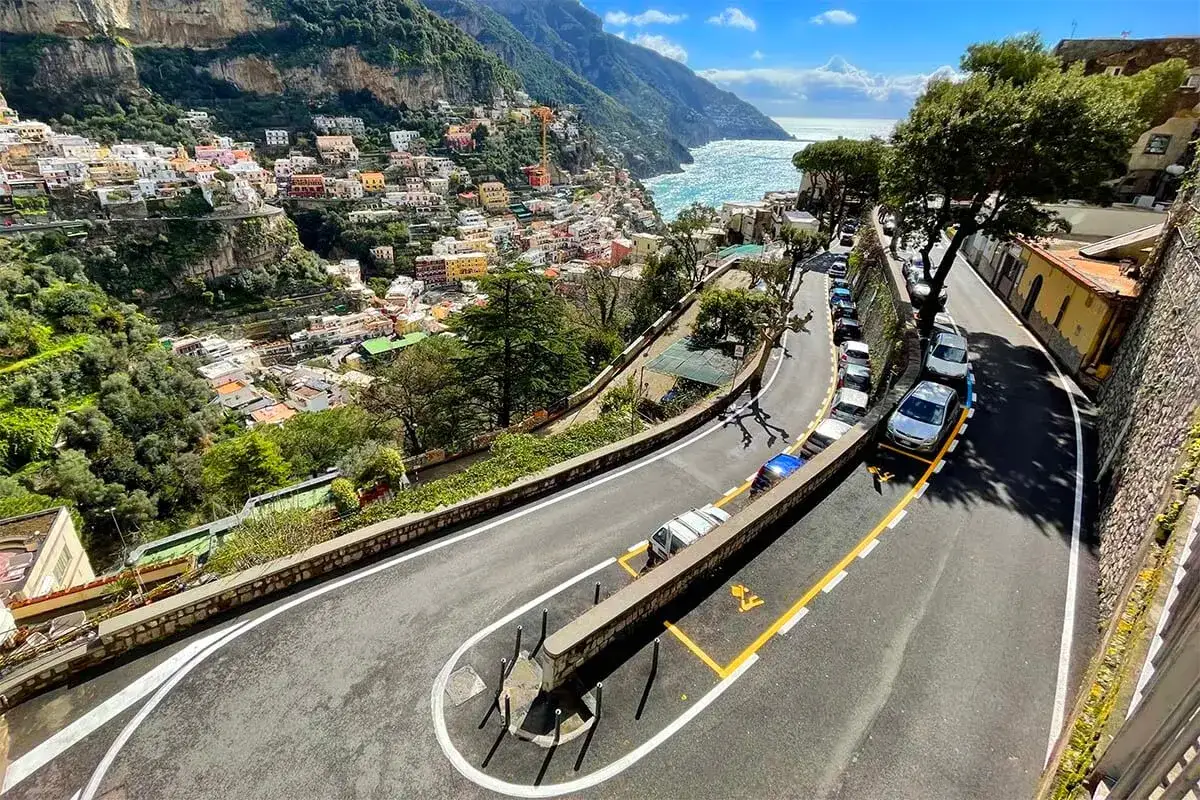
Once the bus gets out of the city, the ride becomes a mix of coastline, tight road sections, and slow-moving traffic whenever the road backs up. This is the part of the trip people imagine when they think of the Amalfi Coast, but it is also the part where the timetable can start to feel optimistic. In plain terms, the route is scenic, but it is not a relaxed glide.
I would also plan around the practical limits of the vehicle. There is storage space for luggage, but it is still a bus, not a coach built for oversized bags. If you have a stroller or pram, it needs to be folded and stowed, and in summer the bus can be crowded enough that seat choice becomes less important than simply getting on comfortably.
One small detail I like on routes like this is that the main stops are announced by the driver. If you are not sure where you are getting off, ask before departure and keep your ticket handy. That simple habit prevents a lot of unnecessary anxiety on a ride that already has enough moving parts.
That mix of scenery and friction is exactly why this route works beautifully for some travelers and poorly for others, which brings me to the real decision point: whether the bus is actually the best option for your trip.
When the bus is the right choice and when it is not
For a lot of travelers, the bus wins on one thing above all else: value. It is direct, public, and far cheaper than a private transfer. For other travelers, especially those arriving late, carrying a lot of luggage, or trying to make a tight same-day connection, the bus is the least forgiving option on the table.
| Option | Best for | Trade-off |
|---|---|---|
| Direct bus | Budget-minded travelers with flexible timing | Limited departures and possible traffic delays |
| Private transfer | Door-to-door convenience and bulky luggage | Much higher cost |
| Ferry-based plan | Scenic travel when seasonal services line up | Seasonal and weather-dependent |
If I were choosing for myself, I would use the bus when the timing fits comfortably and I want to keep the trip inexpensive. I would choose a private transfer when I care more about predictability than price, and I would treat ferries as the nicer seasonal alternative rather than the default answer. In practice, that is the simplest way to match the transport to the day you actually have.
The next step is avoiding the mistakes that make a simple transfer feel harder than it should be.
The mistakes I would avoid on this route
- Assuming the bus leaves from Napoli Centrale. The published Naples stop is at Varco Immacolatella, so I would check the location before I leave my hotel or station.
- Trying to buy the ticket at the stop. Tickets are meant to be bought in advance, and that is where many first-time travelers waste time.
- Trusting the timetable too literally in summer. The road can slow down fast, so I would treat the published arrival as a baseline, not a promise.
- Planning a tight onward connection. If you need to catch a ferry, train, or check-in slot, I would add a real buffer instead of assuming the bus will land exactly on time.
- Traveling with more luggage than the route comfortably handles. There is storage, but a compact bag makes boarding and unloading much easier.
If you avoid those five errors, the route becomes much more manageable. At that point, the remaining job is mostly about timing, patience, and a little bit of route discipline.
The small details that make the trip easier
The best version of this transfer is usually the one with the fewest moving pieces. I would choose an earlier departure if possible, keep my bag compact, and make sure I know the exact boarding point before I leave Naples. If I expected to move around the coast again later the same day, I would also think about whether the 24-hour coastal pass makes more sense than buying separate rides.
For a one-off transfer, the rule I would use is simple: take the bus when the timetable fits your day and the savings matter, but pay for a more reliable option when certainty matters more than cost. That balance is what turns this route from a stressful guess into a clean part of the trip, and it is usually the difference between arriving tired and arriving ready to enjoy Amalfi.