The Porto to Baiona journey looks simple on a map, but the practical version is more nuanced: you are usually choosing between driving, a two-step public-transport connection through Vigo, or a multi-day coastal walk. I’d plan it as a route decision rather than a transfer, because the fastest option, the cheapest option, and the most scenic option are not the same. This guide breaks down the timing, the transfer logic, and the parts of Baiona that are actually worth building time around.
The route in practical terms
- By road, the trip is about 134 km and usually takes around 1 hour 44 minutes in normal conditions.
- Without a car, the cleanest plan is usually Porto to Vigo, then Vigo to Baiona.
- Baiona is one hour ahead of Porto, so time stamps can trip you up if you rush a connection.
- The local Vigo-Baiona bus is inexpensive, but I would still check the same-day timetable before committing.
- Baiona works best as an overnight stop, not just a pass-through.
What the route really looks like
There is no reason to overcomplicate this route. For most travelers, Porto is the long-haul starting point, Vigo is the transfer city, and Baiona is the coastal finish. Once you understand that structure, the rest of the planning becomes much easier: you are not looking for a single magical connection, you are building a reliable chain.
That distinction matters because the route behaves differently depending on how you travel. By car, the trip is short enough to feel almost like a regional hop. By public transport, the same journey becomes a combination of intercity and local services, plus the buffer time you need for a border crossing, station change, and the one-hour time difference. In other words, the journey is compact, but it still rewards discipline.
My rule is simple: if I am arriving from the airport or trying to preserve a relaxed afternoon, I leave extra margin in Vigo. The route is easy when the pieces line up; it is frustrating when you treat it like a straight point-to-point transfer.
Which transport option fits your trip
The best choice depends on whether you value speed, flexibility, or budget. I would not choose based on the headline distance alone, because the transfer city changes the real experience more than the map does.
| Option | Typical time | Typical cost | Best for | Main tradeoff |
|---|---|---|---|---|
| Drive or private transfer | About 1 hour 40 minutes to 1 hour 50 minutes | Variable, depending on fuel, tolls, and vehicle | Travelers who want the least friction and the most flexibility | Parking, tolls, and the stress of driving after a long arrival day |
| Train to Vigo, then local bus or taxi | About 4 to 5 hours door to door | Train fares often start around €15 to €35 when booked early, plus a few euros for the local leg | Travelers without a car who still want a straightforward connection | Two separate legs and the need to manage transfer timing |
| Bus to Vigo, then local bus or taxi | About 4 to 5 hours door to door | Porto-Vigo buses often start around €7 to €16, plus a few euros for the local leg | Budget-minded travelers who do not mind a longer journey | Less comfort and a schedule that matters more than you think |
| Walking the coastal Camino | Several days, not a single transfer | Depends on lodging and pacing | Walkers who want the route to be the trip | Requires time, planning, and a willingness to think in stages rather than hours |
That is why the most useful comparison is not just price versus speed. It is whether you want a clean arrival, or whether you are comfortable managing one more moving part before you reach the coast.
How to handle the Vigo connection without wasting time
The public-transport version is perfectly workable, but it needs more attention than a lot of travelers expect. The key is to separate the long-distance leg from the local one and build a buffer around the handoff.
I would plan it like this:
- Decide whether you are arriving in Vigo by train or bus.
- Check whether your onward connection is leaving from Vigo-Guixar, Vigo E.I., or a taxi point near the station.
- Give yourself enough slack that a delayed arrival does not wreck the rest of the day.
- Remember that Baiona is one hour ahead of Porto, so local departure times can look deceptively close on your screen.
- If the timing is messy, use a taxi for the final hop instead of gambling on a tight bus connection.
One practical detail makes a bigger difference than people expect: the local bus service from Vigo to Baiona is the part most likely to punish a bad transfer decision. A route like Lugove’s 2B is useful because it is direct enough to be sensible, but it is still a local service with stops, schedule windows, and less flexibility than the intercity leg. On a normal day, I would still leave at least 30 to 60 minutes of breathing room.
The same advice applies whether you arrive by train or by coach. Do not plan your day around a perfect handoff. Plan it around a comfortable one.
Why the coastal Camino version is a different trip
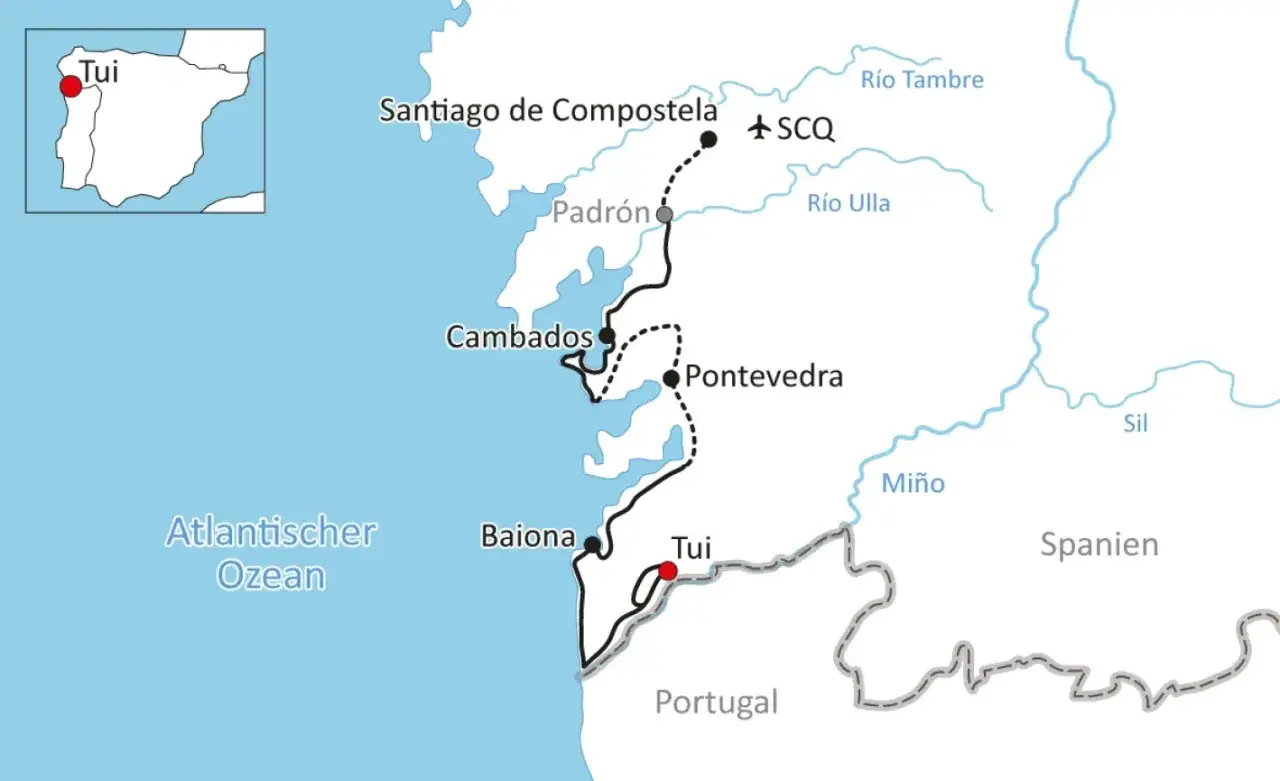
If your trip is not just about getting from one town to another, the walking version changes the entire character of the journey. The coastal route from Porto to Baiona is usually planned at roughly 140 to 143 km, often spread across about 7 nights and 8 stages. That makes it a proper trip in its own right, not just a transfer with scenery.
I like this version because it rewards patience. The terrain is mostly flat or gently rolling, which keeps it approachable, but the surface can vary a lot more than beginners expect. Boardwalks, village roads, sandy sections, and short stretches of rougher footing all change how a stage feels. Distance alone does not tell the whole story.
There is also a useful planning reason to treat Baiona as a stop, not a checkpoint. The Baiona-to-Vigo continuation is about 26.8 km, rated low in difficulty, and typically takes around 5 hours 25 minutes. That is a solid day for a walker, but it is not the kind of segment I would casually add on after a long sightseeing afternoon.
- Choose the walking version only if you actually want the route to be the trip.
- Book lodging earlier if you are traveling in a busy walking season.
- Do not underestimate how much surface changes matter on a coastal stage.
- Use Baiona as a natural overnight stop if you want to enjoy the town instead of rushing out of it.
This is the version I would pick for travelers who care more about scenery, rhythm, and coastal atmosphere than about arriving as fast as possible.
What Baiona rewards you with once you arrive
Baiona is small enough to feel immediate, but there is enough to do that an overnight stay actually makes sense. The town works because it combines a compact old center, sheltered waterfront views, and one of the more memorable fort settings on the Galician coast.
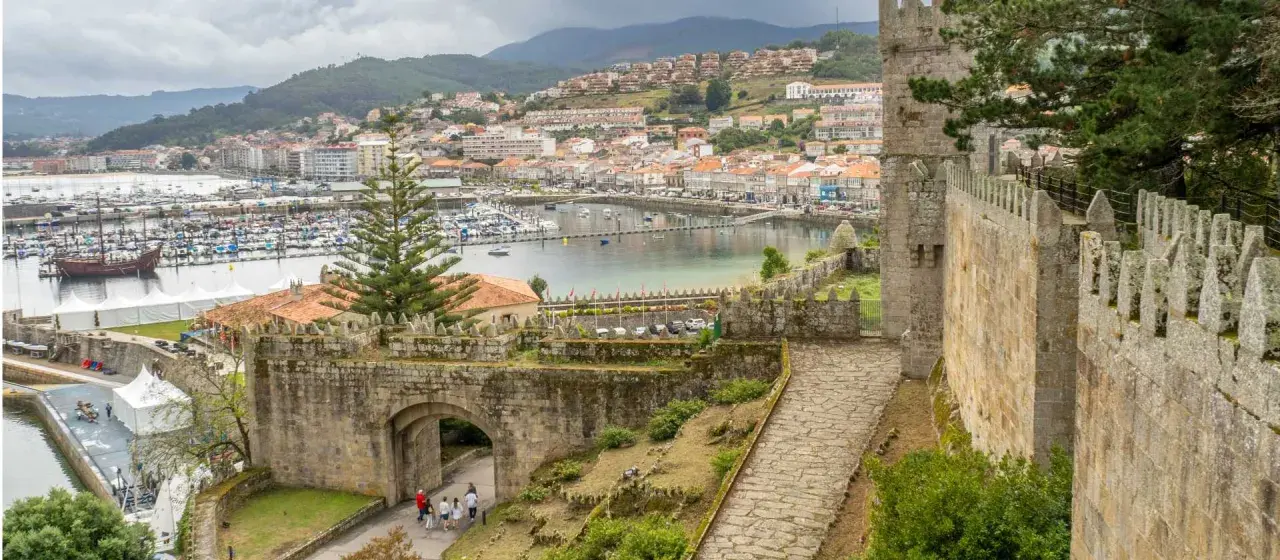
The place I would save time for first is Monterreal Fort. Its defensive walls run for about 3 km, and the sunset view from the peninsula is the kind of low-effort, high-return stop that makes a trip feel complete. The old town is equally walkable, which means you can arrive, drop your bag, and still have a proper evening on foot instead of another car ride.
- Monterreal Fort and the Parador setting for the strongest views over the bay.
- The compact old town, which is easy to explore without a fixed plan.
- The waterfront and small beaches, which give the town its slower rhythm.
- Santa María Collegiate Church, especially if you like older religious architecture with a fortress-like feel.
- The Festa da Arribada on 1 March, if your timing happens to line up with it.
For a short stay, I would keep the plan simple: one slow walk, one sunset, one decent meal, and no pressure to overpack the day. Baiona is best when it feels like a coastal pause, not a checklist.
The version I would book for most travelers
If I had to reduce the whole trip to one practical recommendation, I would leave Porto in the morning, get to Vigo with a comfortable margin, and finish in Baiona by local bus or taxi. That keeps the long leg clean, removes pressure from the transfer, and still leaves enough of the day to enjoy the waterfront.
- Use a morning departure from Porto rather than trying to squeeze the trip into a late arrival window.
- Keep your Vigo connection loose enough that a small delay does not matter.
- Stay in Baiona if you want the town at sunset; stay in Vigo if you need more transport flexibility.
- Do not forget the one-hour time shift when checking schedules and booking onward travel.
For most people, that is the version of the trip that works best: simple, scenic, and flexible enough to survive a delayed train or a crowded bus. Once you stop treating Vigo as a nuisance and start treating it as the hinge point, the whole journey makes more sense.