I think a southern Italy itinerary works best when you treat the region as a few connected travel corridors, not one giant loop. Naples, the Amalfi Coast, Matera, and Puglia each reward a different pace, so the real challenge is choosing the right mix of scenery, culture, and transfer time. In this guide, I lay out realistic 7-, 10-, and 14-day routes, explain how I would get around, and show where to slow down so the trip still feels like a holiday.
The best route is the one that fits your days, not the one that tries to cover everything
- 7 days: Stay in Campania and keep the focus on Naples, Pompeii, and the Amalfi Coast.
- 10 days: Add Matera and a compact Puglia loop for the strongest balance of coast, food, and culture.
- 14 days: Either slow the mainland trip down or split it into mainland Italy plus Sicily as a second chapter.
- Best season: April to June and September to October are the easiest months for weather, crowds, and logistics.
- Transport rule of thumb: Use trains for major city-to-city legs, a car for Puglia and inland villages, and ferries for islands.
- Budget reality: Midrange travelers usually land around EUR 120-250 per person per day before long-haul flights, with the Amalfi Coast costing the most.
Why the route matters more than the map
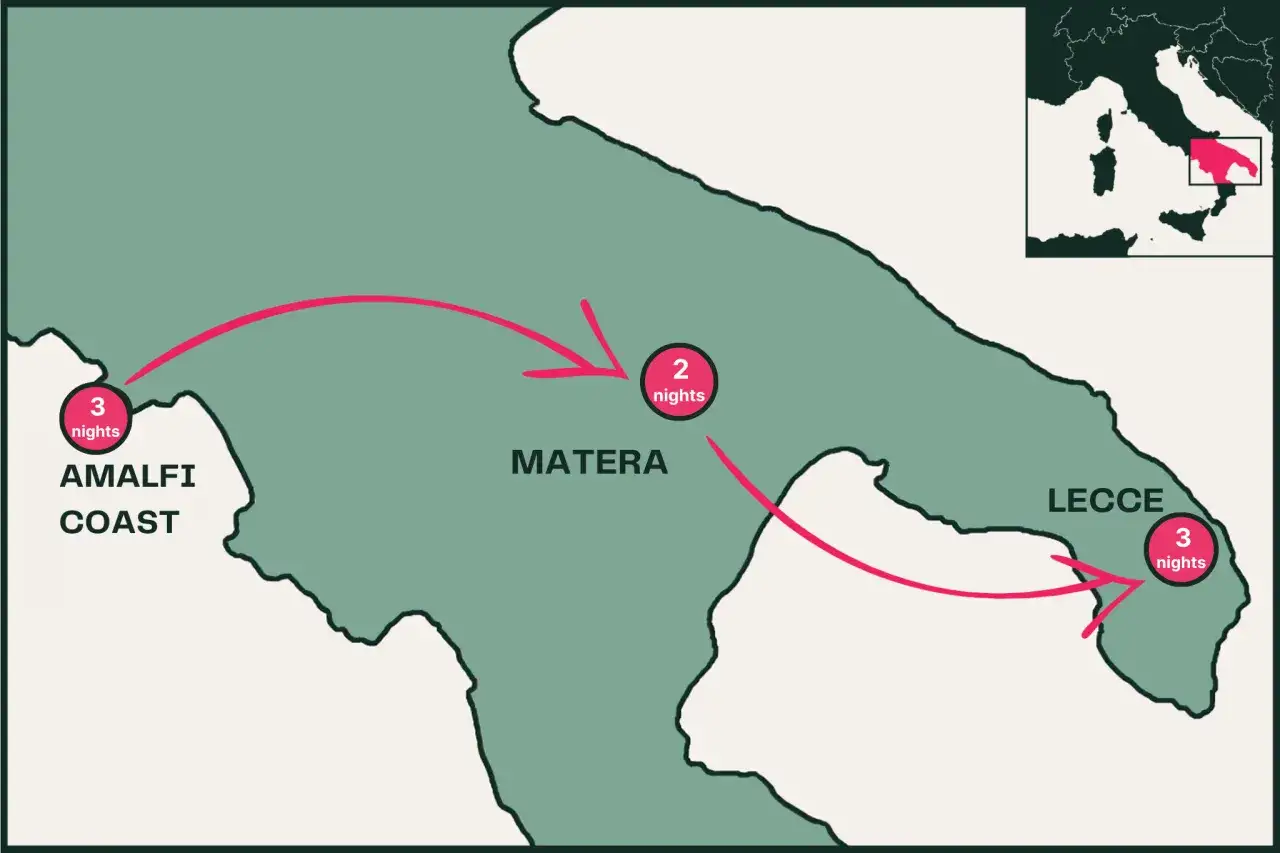
Southern Italy is beautiful, but it is not compact. The Amalfi Coast is a cliffside chain of towns, Matera sits inland in Basilicata, and Puglia stretches into a long, layered route of beaches, whitewashed villages, and slow rural roads. The mistake I see most often is trying to make one trip do everything. That usually turns a scenic holiday into a transfer-heavy checklist.
For planning, I think in three route shapes. The first is Campania only, which gives you Naples plus the coast. The second adds Matera and Puglia, which gives you the best overall mix. The third brings in Sicily, but only when you have enough time to treat it as a proper second base rather than a rushed add-on. Once you accept that logic, the trip becomes easier to design and a lot more enjoyable on the ground.
| Trip length | Best route shape | Best for | What to leave out |
|---|---|---|---|
| 7 days | Naples plus the Amalfi Coast | First-time visitors who want a strong, low-stress introduction | Puglia and Sicily |
| 10 days | Naples, the Amalfi Coast, Matera, and Puglia | Travelers who want the best balance of scenery and variety | A separate Sicily leg |
| 14 days | Slower mainland route or mainland plus Sicily | People who want breathing room or a two-part trip | Constant hotel switching |
The Amalfi Coast alone covers a surprisingly broad stretch of coastline, so even one "small" region can fill several days if you let it. That is why the next question is not what to see, but how many nights you actually have.
A seven-day plan that stays realistic
If I only had one week, I would keep the trip in Campania and resist the urge to chase everything south of Naples. You can build a satisfying route around one city base and one coast base, which keeps transit short and gives you time for food, viewpoints, and a proper ferry or hiking day.
- Days 1-2: Naples - Start with the historic center, a long lunch, and one major sight such as the National Archaeological Museum or the archaeological zone at Pompeii or Herculaneum. Naples works best when you give it enough time to feel alive, not just as a stopover.
- Days 3-5: Amalfi Coast - Base yourself in Sorrento if you want easier logistics, or in Amalfi or Positano if the sea view matters more than convenience. I would use one day for Ravello, one day for Positano and Amalfi town, and one day for a hike such as the Path of the Gods or a ferry outing to break up the road time.
- Day 6: A slower coastal day - Keep this flexible. Capri is tempting, but it only works if you are comfortable with boats and queues. If not, stay on the mainland and enjoy a quieter village, a beach club, or a long dinner.
- Day 7: Return through Naples - Leave the coast early and build buffer time. On this route, the final day should feel like a wrap-up, not a race.
The value of this version is simple: it gives you the postcard scenery without forcing you to pack and unpack every morning. If you have three more days, the trip opens up in a much better way.
A ten-day plan with the best balance
Ten days is where southern Italy starts to feel complete without becoming exhausting. This is the length I recommend most often because it lets you add an inland contrast and a proper Puglia loop without turning the itinerary into a sprint.
- Days 1-2: Naples - Use the city for energy, food, and one major cultural stop. If you only do one archaeological side trip, I would choose Pompeii because it gives the clearest sense of scale and history.
- Days 3-5: Amalfi Coast - This is still your scenic anchor. Stay put long enough to enjoy the coastline instead of treating each town like a quick photo stop. Ravello is worth the detour for views; Positano is worth it if you accept the price tag and the crowds.
- Day 6: Matera - This is the inland reset. Matera changes the rhythm of the whole trip, and that is exactly why it belongs here. The cave districts and stone lanes feel different from the coast, which keeps the itinerary from blending into a single long seaside stay.
- Days 7-8: Bari and Polignano a Mare - Bari is useful as a practical hub, while Polignano gives you the dramatic coastal edge. If you only had room for one, I would choose Polignano for the scenery and Bari for an arrival or departure night.
- Days 9-10: Valle d'Itria and Lecce - This is where Puglia becomes especially rewarding. Alberobello is the obvious trulli stop, but I also like Locorotondo or Ostuni for a calmer atmosphere. Lecce adds architectural weight and a better evening scene. If you want beaches, swap one of these stops for Otranto or Gallipoli.
For Puglia, I prefer a loop that mixes one city, one inland base, and one southern stop. A masseria stay can be a smart compromise because it gives you space, parking, and character in one place. This is also the point where transport choices start to matter more than attraction lists.
A 14-day plan if you want more breathing room
Two weeks is enough time to stop optimizing every transfer and start building in a little slack. I would use the extra days in one of two ways, depending on whether you want a slower mainland trip or a split between mainland Italy and Sicily.
Option one, slow the mainland down
Keep the Naples, Amalfi Coast, Matera, and Puglia structure, then add one extra day in each of the places that felt rushed in the ten-day version. In practice, that means more time for a boat ride, a hike, or simply an unhurried dinner. If you are traveling with family, carrying more luggage, or dislike changing hotels, this is usually the better route.
Read Also: Tropea Travel Guide - Best Things To Do & How Long To Stay
Option two, make Sicily a second chapter
If Sicily is non-negotiable, I would not try to bolt it onto a short mainland trip by road. Fly in and out of different cities, use an open-jaw ticket if possible, and treat Sicily as its own route. That keeps the mainland section focused and prevents the holiday from becoming a long sequence of ferries, airports, and check-ins.In either version, the rule is the same: extra days should reduce pressure, not just add more place names to the list.
Getting around without losing half the trip to transit
Southern Italy is one of those places where the right transport choice can save the whole itinerary. I usually think of it this way: trains for the spine of the trip, cars for the countryside, ferries for islands, and private transfers only when the geography makes them worthwhile.| Transport | Best for | What to watch |
|---|---|---|
| Train | Naples, Salerno, Bari, and other main city pairs | Best for center-to-center travel, not tiny hill towns or remote beaches |
| Car | Puglia, Basilicata, and rural village loops | ZTL zones, parking costs, and slow roads in coastal areas |
| Ferry | Capri, Ischia, Procida, and some island connections | Weather, seasonal schedules, and the need for a time buffer |
| Private transfer | Amalfi Coast hops or luggage-heavy travel days | More expensive, but often worth it when roads are tight |
Trenitalia's high-speed network is strong enough that you do not need to default to driving every time. On the other hand, a car becomes useful fast once you are in Puglia or trying to link smaller inland places. I would avoid self-driving the Amalfi Coast in peak season unless I had a very specific reason. A ZTL, or limited traffic zone, is camera-controlled, and the fine is not worth testing your luck.
When to go and what to book first
The best months for this trip are usually April to June and September to October. Those windows give you warm weather, more comfortable walking conditions, and a better chance of enjoying the coast without the hardest crowds. July and August can still work, but I treat them as high-pressure months: hotter days, fuller ferries, busier beaches, and higher room rates. Winter can be appealing if you want quiet and flexible plans, but some beach towns and island services scale back.
As a planning order, I would book in this sequence: flights, then the most competitive hotels, then transport. On the Amalfi Coast, I like to lock lodging earlier than almost anywhere else in southern Italy, especially if I want a specific town or a sea-view room. As a rough planning number, I would expect a midrange coastal room to run about EUR 180-350 per night in stronger months, while good rooms in Puglia or Matera are often closer to EUR 120-220. Car rental usually adds another layer of cost, often around EUR 35-70 per day before fuel, tolls, and parking.
For air travel, an open-jaw ticket can save time and money if you are moving south in one direction. That means flying into one city and home from another, instead of backtracking just to get to the airport. It is one of the easiest ways to protect the shape of the itinerary.
What I would leave out before adding one more stop
The hardest planning decision is usually subtraction. I would rather see you enjoy Naples, the Amalfi Coast, Matera, and one clean Puglia loop than rush through six places and remember the trip through road noise. If you are already full on time, I would cut Sicily rather than compress it, and I would cut extra islands before I cut proper nights on the mainland.
My practical rule is simple: keep a 10-day trip to three overnight bases at most, and only stretch to four if one of those bases is a ferry-linked island with its own clear purpose. Once the route gets busier than that, the scenery starts to feel like a backdrop instead of the point. The strongest version of southern Italy is usually the one that leaves room for a long lunch, one unexpected viewpoint, and a final evening that does not feel scheduled to the minute.