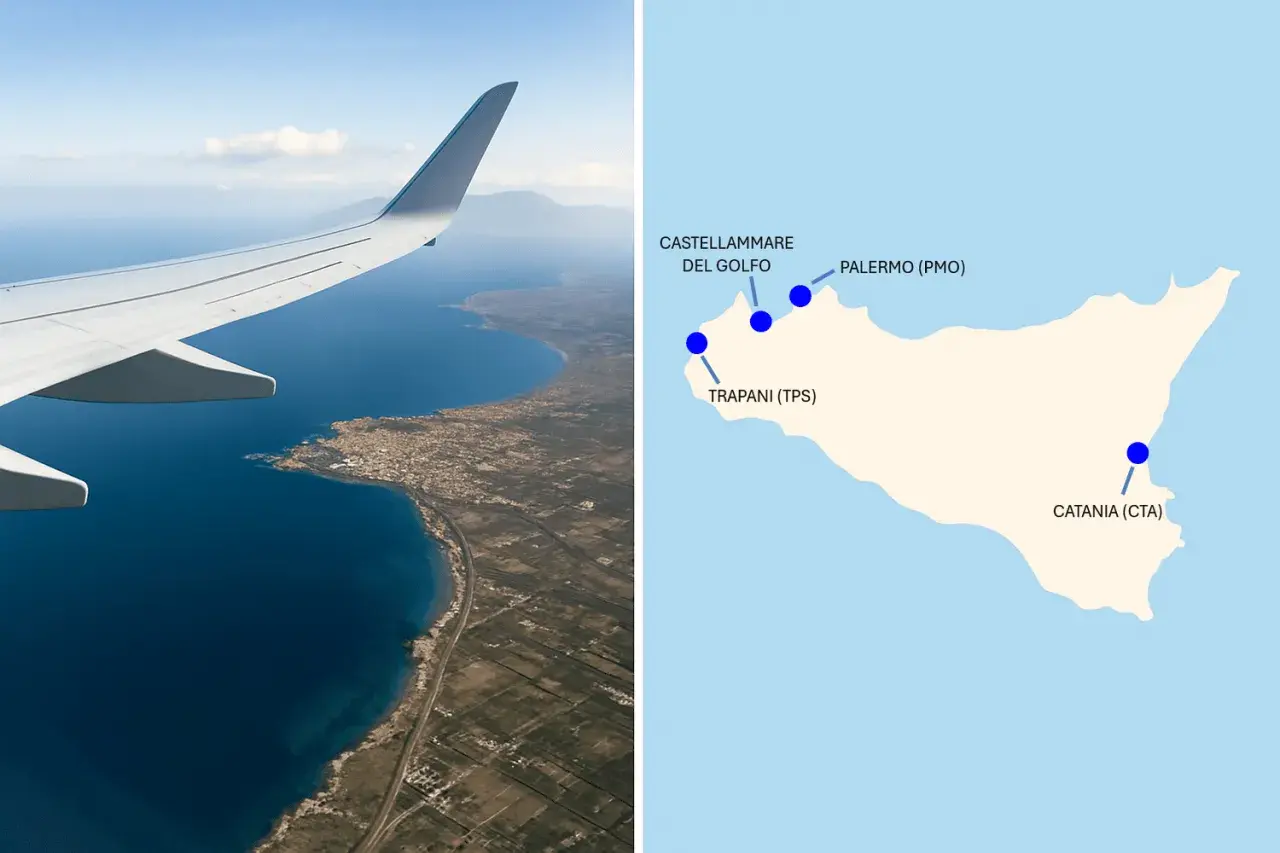
The answer to where to fly into Sicily is rarely one airport for every trip. The right choice depends on which coast you plan to explore first, how much driving you want to do, and whether you care more about flight selection or shaving time off the transfer. I usually start with the map of the island, not the airfare, because that one decision changes the shape of the whole itinerary.
The airport you choose should match the side of Sicily you want to see
- Catania is the best fit for the east coast, Mount Etna, Taormina, Syracuse, and the Val di Noto.
- Palermo is the smarter arrival point for Palermo, Cefalù, and most of western or northwestern Sicily.
- Trapani works well for the far west, but it usually has fewer flight options.
- Comiso is the most useful airport for Ragusa, Modica, Scicli, and the southeast.
- If your route covers both east and west, an open-jaw ticket often saves a full day of backtracking.
- For a first trip, the cheapest fare is not always the best deal once ground time is included.
The simplest rule for choosing an airport
If I had to reduce Sicily to one practical rule, it would be this: fly into the airport closest to your first two or three nights. Sicily is not tiny once you start crossing it by road. Palermo and Catania are the two big gateways, but they serve very different trip patterns, and choosing the wrong one can turn a smooth arrival into a long transfer day.
For a west-coast itinerary, Palermo usually wins. For the east coast, Catania is the cleaner choice. For the southwest or southeast, the smaller airports can be excellent if the flights line up. That is the decision tree I use when I want the trip to feel efficient instead of stitched together at the last minute.
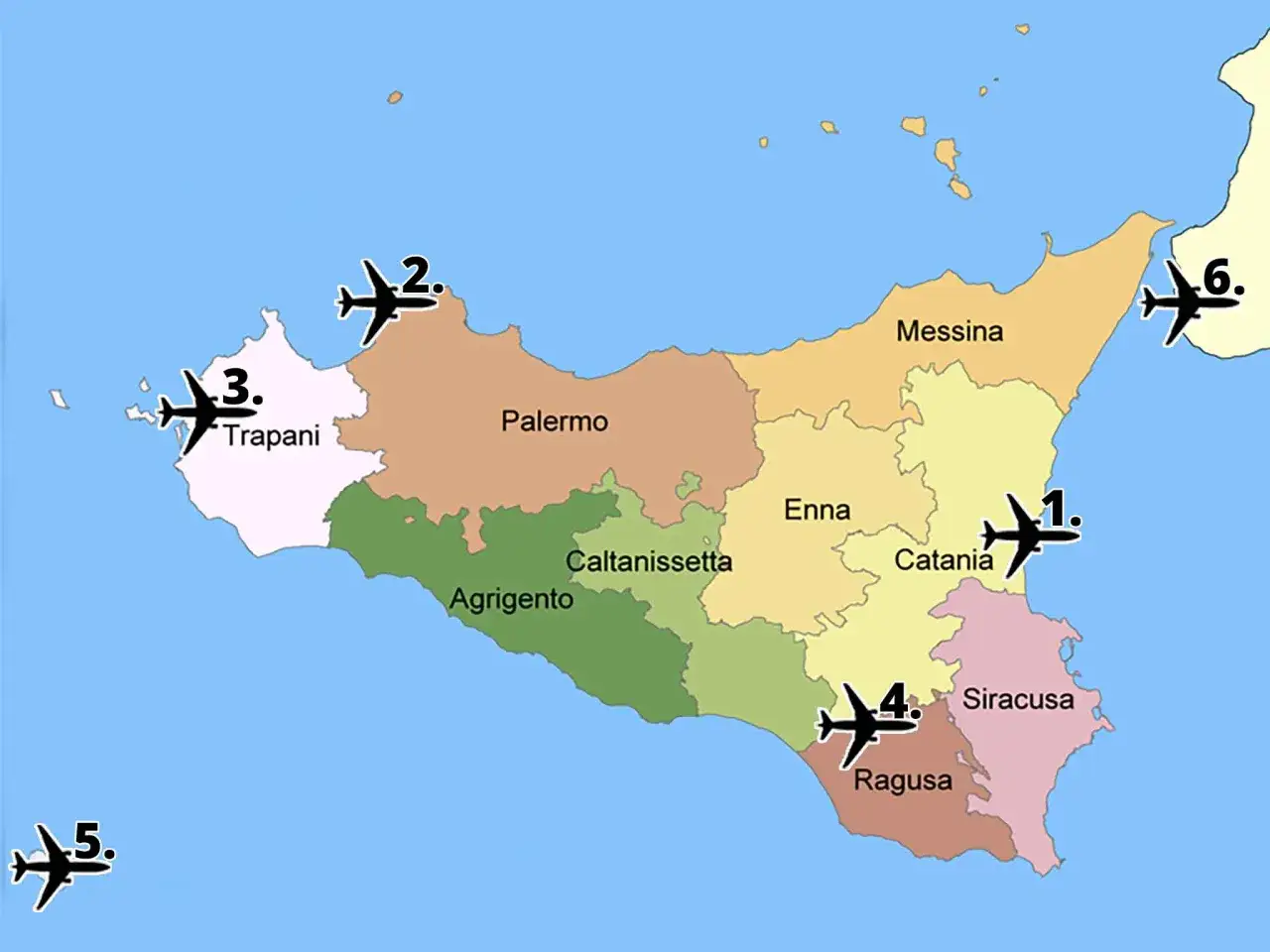
How the island breaks down by airport
This is the practical view I wish more travelers used before booking. The island looks compact on a map, but in real travel terms the airport you choose determines how much of your first day disappears into road time.
| Airport | Best for | Typical transfer time | Why I’d pick it |
|---|---|---|---|
| Palermo (PMO) | Palermo, Cefalù, Madonie, San Vito Lo Capo, western and northwestern Sicily | Palermo city about 45 minutes; Cefalù about 1 hour 15 minutes; San Vito Lo Capo about 2 hours or a bit more | Best all-around gateway for the west, with strong flight choice and a natural starting point for coastal and cultural trips |
| Catania (CTA) | Taormina, Mount Etna, Syracuse, Noto, the east and southeast | Taormina about 50 to 75 minutes; Syracuse about 50 to 80 minutes; Noto about 1 hour 20 minutes to 1 hour 45 minutes | Sicily’s busiest airport and the cleanest arrival point for an east-coast itinerary |
| Trapani (TPS) | Trapani, Erice, Marsala, the Egadi Islands, the far west | Trapani town about 20 to 30 minutes; Marsala about 25 to 40 minutes; Erice about 35 to 50 minutes | Excellent when your trip is concentrated in the far west and you want to land close to your base |
| Comiso (CIY) | Ragusa, Modica, Scicli, the southeast baroque towns, nearby beaches | Ragusa about 25 to 35 minutes; Modica about 45 to 60 minutes; Scicli about 45 to 60 minutes | Best for the southeast if your trip centers on the Val di Noto and you want to cut road time |
The big takeaway is simple: Palermo and Catania are the default choices, while Trapani and Comiso are specialist airports. That does not make the smaller ones less useful. It just means they are worth choosing when your trip truly matches their geography. From there, the question becomes which airport fits the style of trip you are building.
Palermo works best when the west side is the goal
I lean toward Palermo when the itinerary starts in the island’s northwest. It is the most comfortable entry point for Palermo itself, Cefalù, the Madonie, and much of the western coastline. If your plan includes historic streets, coastal drives, and day trips that stay on the west side, Palermo usually reduces friction right away.
Palermo also tends to be the more forgiving option for broader itineraries because it is a major gateway. That matters if you are flying in from the U.S. through a European hub and want the most flexible follow-on routing. Even when Trapani is geographically closer to a specific hotel, Palermo can still win if the flight schedule is better or if you need more rental-car or transfer options.The main trade-off is obvious: Palermo is not the best arrival airport for the east coast. If your first stop is Taormina or Syracuse, landing in Palermo means spending your first long drive crossing the island instead of beginning the trip where it actually matters. That is a fair compromise only when the fare or flight timing clearly justifies it.
Catania gives you the cleanest east-coast arrival
When I am planning an eastern Sicily route, Catania is usually the answer. It is the island’s busiest airport and the best base for Taormina, Mount Etna, Syracuse, and the Baroque towns of the southeast. If the trip is built around volcanic landscapes, sea views, and the historic coast east of the center of the island, Catania saves time from day one.
That convenience is not just about distance. It also gives the itinerary a more natural flow. You can land, collect the car, and be in the east-coast zone without wasting a full day on cross-island transfers. For a one-week trip, that difference is significant. Sicily rewards slow travel, but it does not reward unnecessary driving.
The downside is that Catania is a poor fit for a west-only trip. If you are headed straight to Palermo, Cefalù, Marsala, or San Vito Lo Capo, the transfer is long enough to feel wasteful. In that case, Catania only makes sense when the airfare is much better and your time on the ground is flexible.
Trapani and Comiso are excellent when your base is close enough
Trapani and Comiso are the airports I look at after the two main gateways. They are not the airports I default to, but they can be the smartest choice when the itinerary is narrow and location-specific. That is especially true if you are staying for several nights in one area and want the shortest possible transfer from the plane to the hotel.
Trapani for the far west
Trapani makes the most sense for the extreme west: Trapani town, Erice, Marsala, and the Egadi Islands. If that is your focus, landing there can feel wonderfully efficient. You are close to the coast almost immediately, which is exactly what many travelers want after a long-haul flight.
The limitation is flight volume. I would use Trapani when it is a clear geographic fit, not just because the fare looks attractive. If your schedule is broad or your dates are fixed, Palermo often gives you a better balance of convenience and choice.
Read Also: Matera Travel Guide - What to Do in Matera, Italy
Comiso for the southeast
Comiso is especially useful for Ragusa, Modica, Scicli, and the southeastern beaches. For a trip built around the late-Baroque towns, this airport can save a surprising amount of road time. That is one of those cases where a smaller airport delivers a better travel day than a bigger one.
Still, I treat Comiso as a destination airport, not a default airport. If your plans are still fluid, Catania usually gives you more flexibility. Comiso is the better pick when the southeast is already locked in and the flight schedule cooperates.
How to avoid the common mistakes
The biggest mistake I see is choosing the cheapest flight without checking where the hotel actually is. A fare that is $60 cheaper can become the expensive option once you add a long transfer, a full tank of fuel, and an extra half-day on the road. Sicily is one of those places where geography matters more than people expect.
- Match arrival airport to the first part of the itinerary. Don’t land on the opposite side of the island just to save a small amount on airfare.
- Consider an open-jaw ticket. If you want both east and west Sicily, flying into one airport and out of another often makes the trip cleaner.
- Build in arrival margin. After a long flight, car pickup, and airport formalities, a one-hour transfer can easily feel longer.
- Do not overvalue a tiny fare difference. On an island with real driving distances, time is part of the ticket price.
- Use the smaller airports only when they genuinely fit. Trapani and Comiso are great tools, but they are not automatically the best tools.
If you are flying from the U.S., I also think it helps to plan the arrival airport together with the European connection, not separately. A slightly less aggressive connection can be worth more than a cheaper fare if it lowers the chance of missed bags or late-night arrivals. That extra hour of patience usually pays off once you reach the island.
The arrival plan I would use for a first Sicily trip
For a classic first visit, I would keep it simple: fly into Palermo for the west, fly into Catania for the east, and use an open-jaw ticket if the itinerary crosses the island. That approach removes the most common source of wasted time, which is backtracking just to return to the same airport. It also gives the trip a more natural rhythm, especially if you want to mix cities, beaches, and countryside without rushing.
My rule of thumb is straightforward. If your first nights are in Palermo, Cefalù, or the western coast, choose Palermo. If they are in Taormina, Syracuse, Noto, or around Mount Etna, choose Catania. If you are staying deep in the far west or southeast and the flight schedule is good, Trapani or Comiso can be the better answer. That is the cleanest way I know to turn a flight decision into a better trip, not just a cheaper one.
For most travelers, the best airport is the one that protects the first full day of the holiday. On Sicily, that usually matters more than a small fare difference, and it is the single choice that most often separates a smooth arrival from a tiring one.