A good Sicily itinerary should feel like a sequence of distinct places, not a sprint between monuments. In this guide, I lay out a practical plan for two weeks in Sicily, show how I would split the island into bases, and explain when a car is worth the hassle. I also cover seasonality, budget, and the mistakes that usually make first-time trips feel tighter than they need to be.
The main decisions that shape the trip
- Plan for 3 to 4 bases, not a new hotel every night.
- A car helps most in western Sicily and for inland or beach stops; trains and buses work better on the east coast.
- The most balanced route usually runs Palermo, west Sicily, Agrigento, the southeast, and the Etna-Taormina area.
- May-June and September-October are the easiest months for a first trip.
- A comfortable mid-range trip often lands around €180-€320 per person per day, depending on season and hotel level.
How I would plan the route before I book anything
The real question is not how many places you can squeeze in. It is how much movement you can handle before Sicily starts feeling like a transfer problem instead of a trip. I usually build the island from west to east, because that cuts down on backtracking and lets each region have a clear purpose.
For the east coast, rail and coach links are good enough for many travelers. Trenitalia handles the main regional corridors, while Interbus is useful for east-coast hops such as Catania Airport, Taormina, Siracusa, and Noto. That means a car is helpful, but it is not mandatory if you are happy to stay on the well-connected spine of the island.
| Trip style | Best for | What it does well | What it does poorly |
|---|---|---|---|
| Car-based | First-time visitors who want beaches, hill towns, and flexibility | Easier access to smaller coastal stops, countryside drives, and rural food experiences | Parking stress, city traffic, and higher total cost |
| Mixed | Travelers who want a few easy city bases but still want freedom for one or two regions | Lets trains and buses handle the simple stretches while the car covers the awkward ones | More logistics and more handoffs between transport modes |
| No-car | City-focused travelers, solo travelers, and people who want a lighter plan | Works well for Palermo, the east coast, and major hubs with good bus links | Harder to reach some inland sights, salt pans, beaches, and archaeological sites on your own schedule |
If your flights allow it, I would strongly consider an open-jaw route: fly into Palermo and out of Catania, or the other way around. If you must do a round trip, keep one final buffer night near the airport you are using. That single choice removes a lot of pressure later in the trip, and it makes the rest of the itinerary much easier to follow.
Once that decision is made, the day-by-day route becomes much clearer.
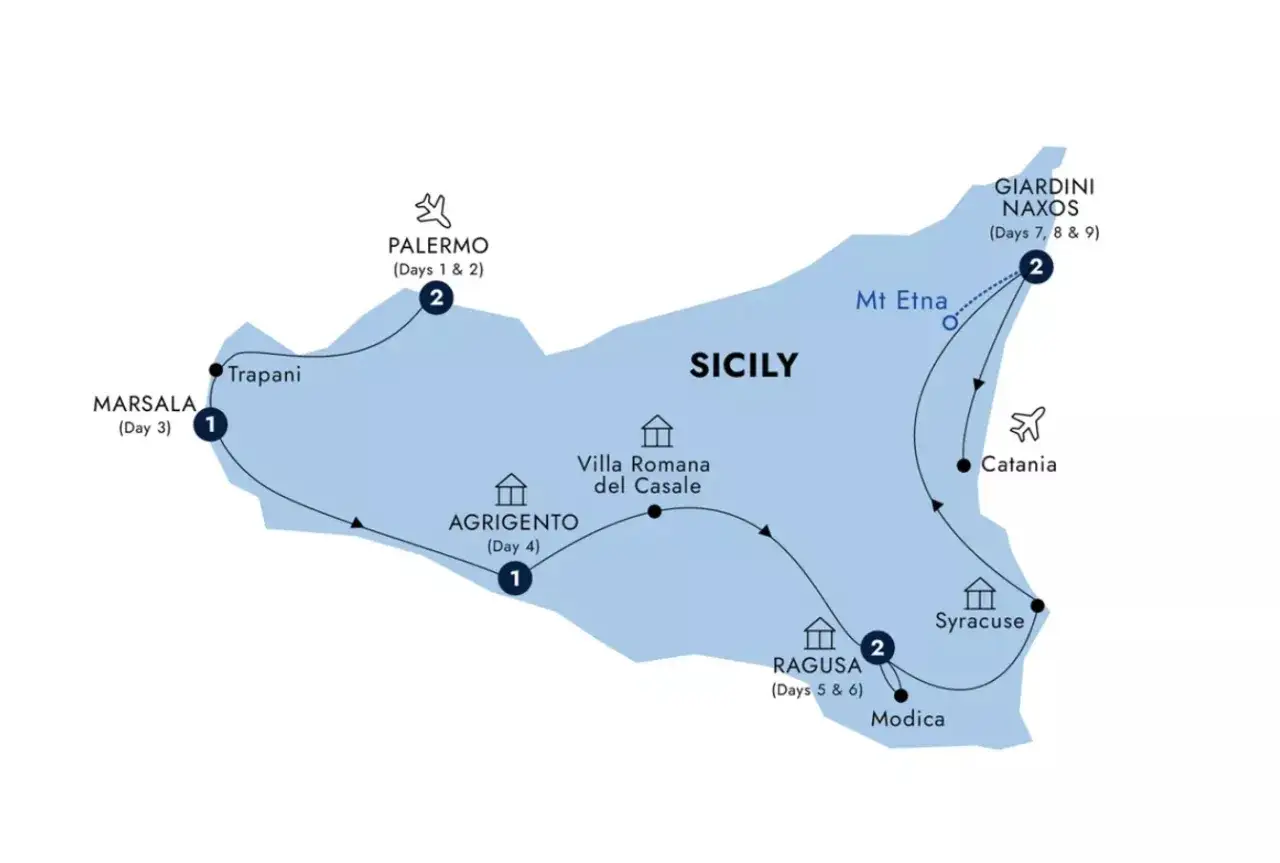
A fourteen-day route that feels full without becoming frantic
Here is the version I would send to a first-time visitor who wants city life, food, scenery, and a real sense of the island without turning the trip into a checklist.
Days 1 to 3 Palermo and Monreale
Start in Palermo because it tells you immediately what Sicily does best: layered history, loud markets, strong food, and a kind of lived-in energy that never feels polished in a boring way. I would use the first day to settle in, the second for the historic center and market streets, and the third for Monreale or a slower half-day along the waterfront and beach edge at Mondello.Palermo rewards curiosity more than speed. If you only treat it as a place to sleep, you miss the part that makes the rest of the island make sense.
Days 4 to 6 western Sicily and Agrigento
After Palermo, move west. Trapani works well as a base if you want the salt pans, Erice, and a clean route toward Segesta, while Marsala makes sense if you care more about wine and a gentler coastal pace. I would spend one day on Erice and the surrounding west coast, another on Segesta and the salt flats at sunset, and then continue south toward Agrigento.
Agrigento is worth a full stop, not a rushed drive-by. The Valley of the Temples is one of Sicily’s strongest archaeological landscapes, and it is far better when you arrive with enough time to walk it properly rather than trying to squeeze it between two long transfers. I would sleep near the site if possible and keep the evening simple.
Days 7 to 9 Ortigia, Noto, and the southeast coast
This is where the route becomes softer and more elegant. I like basing in Ortigia or central Siracusa because it gives you a walkable old town, easy access to the sea, and a good starting point for day trips into the Val di Noto. Spend one day on Ortigia and the Neapolis side of Siracusa, one day in Noto, and one day on the coast if you want something slower, such as Vendicari or Marzamemi.
Visit Sicily consistently highlights Ortigia, Siracusa, Noto, and the surrounding coastline as core southeastern stops, and I agree with that emphasis. This is the part of the island where the baroque architecture, the sea, and the pace all line up in a way that feels unusually coherent.
Read Also: Naples Itinerary - Plan Your Perfect Trip (3-Day Guide)
Days 10 to 14 Mount Etna, Taormina, and a flexible finish
Finish on the Ionian side, where the landscape gets more dramatic and the logistics get easier again. Taormina is busy, and I would not pretend otherwise, but it earns its place because the views are strong and the town is an efficient base for the east coast. Use one day for Taormina itself, one for Mount Etna, and one for a quieter reset such as the Alcantara Gorge or a beach day in Giardini Naxos.
Mount Etna should not be treated as a bonus stop. It is one of the experiences that gives the whole itinerary shape, especially if you like outdoor travel as much as historic towns. On a clear day, the contrast between lava landscapes, vineyards, and the coast is one of the island’s most memorable combinations.
If you are flying home from Catania, I would use the last night there as a buffer. If you are returning from Palermo, I would either reverse the route or swap this finish for one extra day in Cefalù and accept the longer final transfer. The best itinerary is the one that avoids a stressful last day.
That route works because it gives each region a distinct role instead of asking every stop to do everything.
Where I would stay and how many nights each base deserves
I rarely recommend more than four main bases in Sicily. Three is ideal if you travel slowly; five is the upper limit before the trip starts to feel like logistics. The point is to keep each region long enough to breathe, then move on before it gets repetitive.
| Base | Suggested nights | Why it works | Watch-out |
|---|---|---|---|
| Palermo | 3 | Best for arrival, food, history, and a strong first impression of the island | Traffic and parking can be frustrating if you bring a car too early |
| Trapani or Marsala | 2 | Good for western coast scenery, Erice, salt pans, and Segesta | More useful with a car than without one |
| Agrigento | 1 | Best if you want to see the Valley of the Temples at a calmer pace | One night is usually enough unless archaeology is your main focus |
| Ortigia or Siracusa | 3 | Walkable, atmospheric, and well placed for Noto and the southeast coast | Book early in peak season because the best stays go fast |
| Taormina or Giardini Naxos | 3 | Best base for Etna, the Ionian coast, and a scenic finish | Taormina gets expensive quickly in summer |
| Catania | 1 | Practical final night if you are flying out from Catania | More functional than atmospheric, so I treat it as a buffer rather than a highlight |
For a comfortable mid-range trip, I would budget roughly €1,800-€4,500 per person for 14 days before transatlantic flights, with the biggest swing coming from accommodation and whether you rent a car. For a couple sharing costs, the total often lands around €3,000-€6,500 if you stay in good but not luxurious hotels, eat well, and book a few paid experiences. In Palermo, Ortigia, and Taormina, July and August can push those numbers up fast.
That is why the base cities matter as much as the sights themselves: good routing saves money as well as time.
What I would budget for a comfortable trip
The fastest way to blow a Sicily budget is to underestimate lodging in the most desirable areas and to assume every transfer is cheap. Some of the island can still be done on a sensible budget, but the places people most want to stay are often the ones that cost the most.
| Category | Typical mid-range estimate | Notes |
|---|---|---|
| Hotel stays | €110-€220 per night in most bases, €150-€300 in Taormina or top-tier Ortigia | Shoulder season is noticeably better value than midsummer |
| Car rental | €45-€90 per day | Insurance, pickup point, and season change the price more than people expect |
| Fuel and parking | €120-€250 total for a two-week loop | More if you drive daily inside the larger cities |
| Food and drinks | €40-€80 per person per day for casual to comfortable dining | You can spend less at lunch and more at dinner, or the other way around |
| Entry fees and tours | €100-€300 per person | That usually covers temples, one guided Etna day, and a couple of smaller stops |
My rule is simple: if you care most about experience, spend more on the right bases and less on hopping around. The trip feels richer when you have a good room in the right place than when you save a small amount by sleeping somewhere inconvenient.
Once the budget is realistic, the timing question becomes the next big lever.
When I would go for the best balance of weather and crowds
Sicily works year-round, but it does not feel the same in every month. The island’s official tourism materials describe it as a destination with more than 2,500 hours of sunshine and a very long usable season, which is true enough in practice. For most travelers, though, the sweet spot is still the shoulder season.
- May to June gives you long days, manageable heat, and an easy mix of city time and coastal time.
- July and August are the hottest and busiest months, so I plan outdoor sightseeing early and keep midday for lunch, museums, or a long break.
- September and October are excellent if you want warm water, softer crowds, and better hotel value than peak summer.
- November to March is best if your priority is culture, food, and lower prices rather than beach time.
If I were planning a first trip, I would avoid building the whole itinerary around a midsummer beach fantasy. Sicily is more interesting than that. In warm months, the best strategy is to pair one strong outdoor day with one slower town day so the heat never controls the trip.
That seasonal balance also helps you decide which stops deserve real time and which ones can stay as day trips.
The mistakes I would avoid on a first trip
Most Sicily itineraries fail for the same reasons: too many hotel changes, too many long drives, and too little respect for the island’s heat and geography. I see these problems more often than I see bad taste or weak planning.
- Changing hotels too often. Four good bases usually beat seven rushed stops.
- Assuming the whole island is train-friendly. The main east-west corridors are manageable; the smaller scenic stops are not always easy without a car.
- Trying to do temples, beaches, and two towns in one day. That sounds efficient on paper and exhausting in reality.
- Visiting archaeological sites at noon in summer. Early mornings are much smarter, especially in Agrigento and inland areas.
- Leaving the departure city undecided. The route should serve your flight, not fight it.
- Underestimating parking and traffic in larger towns. Palermo, Catania, and Taormina all demand more patience than a map suggests.
The best fix is not more discipline. It is a lighter plan. When I strip out one unnecessary transfer, the rest of the trip usually becomes better almost immediately.
That is why the last booking decisions matter more than people think.
The small decisions that make the trip feel easy
If I were finalizing this itinerary today, I would lock in the accommodation in Palermo, Ortigia, and Taormina first, then build the rest around those anchor nights. Those three places sell quickly in peak months, and once they are set, the route usually falls into place without much friction.
I would also reserve a little flexibility. One unscheduled half-day is enough to absorb a late arrival, a long lunch, bad weather on Etna, or the simple temptation to stay on a beach longer than planned. Sicily is better when you leave room for that kind of drift.
- Book an open-jaw flight if the fare difference is reasonable.
- Pick one major outdoor day, usually Mount Etna, and protect it from overplanning.
- Pack walking shoes, a light layer for the volcano, and swimwear even if the trip is mostly cultural.
- Keep one easy meal or market lunch in each base so the food never becomes another task.
That is usually enough structure to make the trip feel expansive without becoming exhausting. If you keep the route simple, Sicily does the hard work for you.