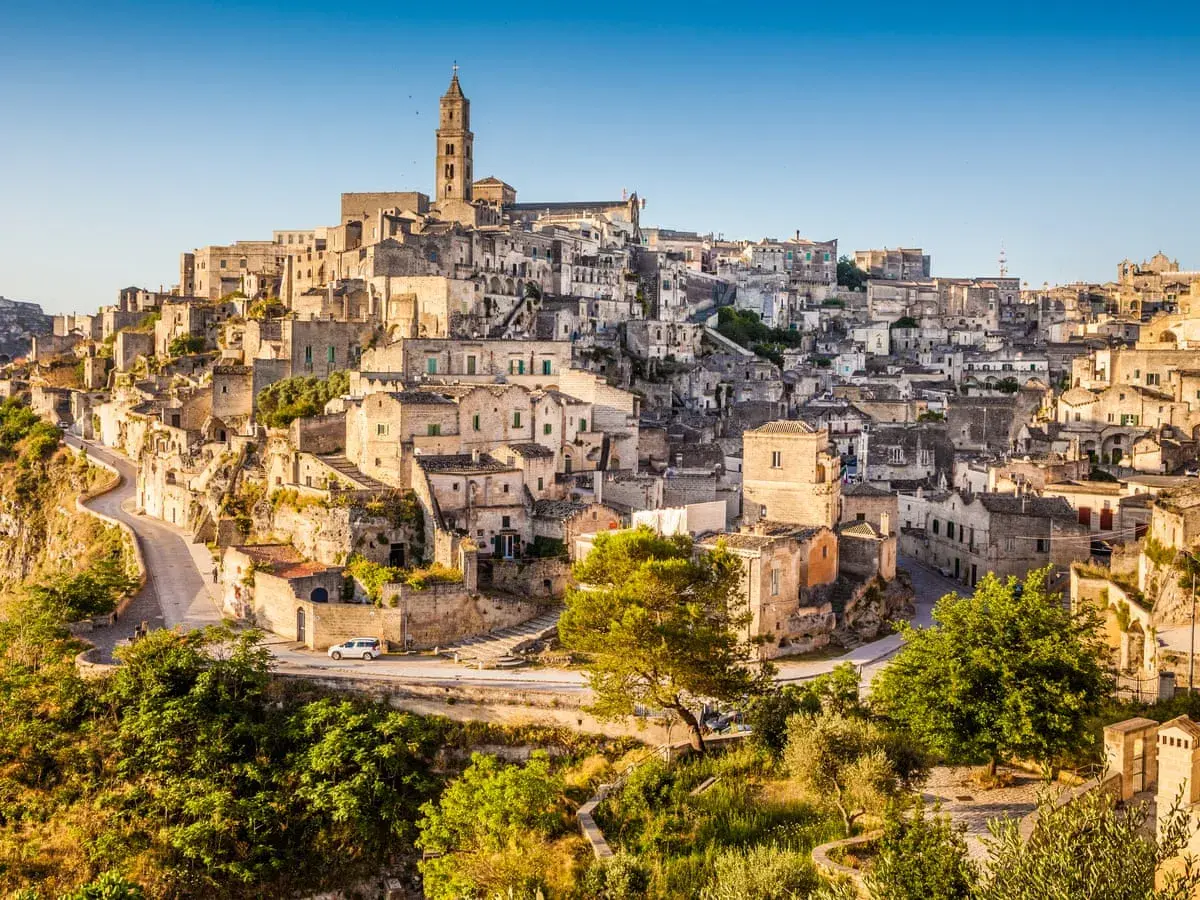
The easiest way to make Matera feel simple is to stop thinking of it as one compact old town and start reading it as a city built in layers. A clear Matera Italy map helps you understand where the Sassi sit, where to park, which viewpoints actually matter, and how to turn a steep, confusing place into a very manageable walking trip.
What matters most before you set out in Matera
- Matera is vertical, not flat, so the best map is a walking map with parking and viewpoints pinned.
- The city’s core heritage area is much larger than the postcard view: UNESCO lists the site at 1,016 hectares with a 4,365-hectare buffer zone.
- Sasso Barisano and Sasso Caveoso are the two historic districts you will keep coming back to.
- Parking outside the historic core is the smart move; once you park, plan to explore on foot.
- If you only have one big panorama, make it Murgia Timone or one of the central belvederes over the Sassi.
- For a first visit, a half-day works for the essentials, but a full day gives the city room to breathe.
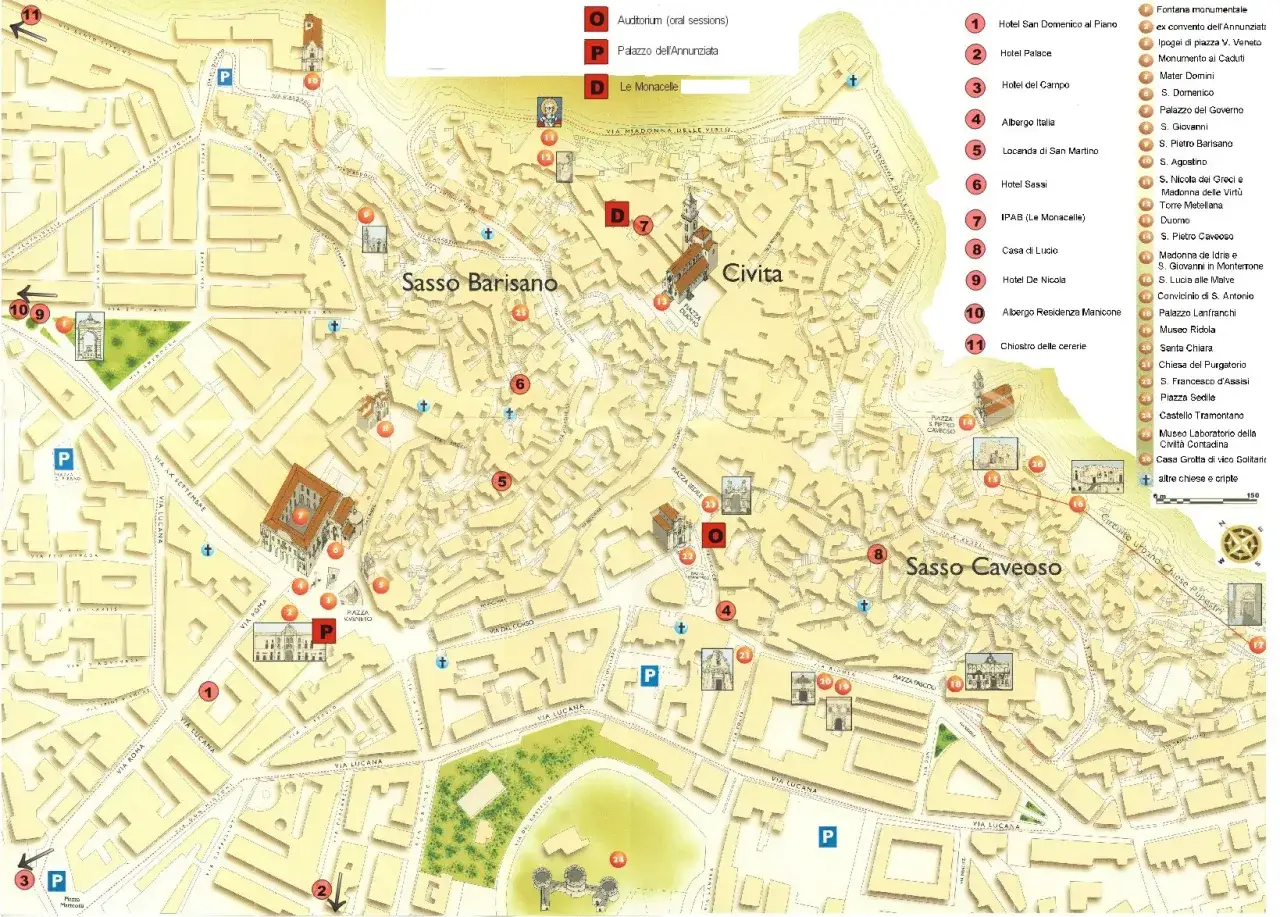
How Matera is laid out on the map
I like to picture Matera as three connected worlds: the upper modern town, the historic edge where life spills toward the ravine, and the carved stone districts below. The drama comes from the topography. You are not moving through a tidy grid; you are moving across ledges, steps, terraces, and paths that open and close your view every few minutes.
The key landforms are easy to remember once you see them on a map. The Civita is the historic ridge at the center, the Sassi are the two carved districts below and around it, and the Gravina ravine cuts the landscape on the opposite side. If you understand that relationship, the city stops feeling maze-like and starts feeling logical.
| Area | What you will find | How I use it on a trip |
|---|---|---|
| Civita and the upper center | Main squares, churches, hotels, and easier orientation points | My starting reference when I want to reset direction or meet someone |
| Sasso Barisano | A denser, more layered historic district with strong viewpoints toward the cathedral side | Best for first-time wandering and for understanding the city’s stone texture |
| Sasso Caveoso | Steeper lanes, cave houses, and dramatic edges near the ravine | Best when I want the most atmospheric, “old Matera” feel |
| Murgia Timone / opposite side of the ravine | The panoramic counterpoint to the city | Where I go when I want the full silhouette of Matera in one view |
That layout is why the city works best when you treat it as a sequence of walking zones, not as a place to drive from point to point. Once that clicks, parking strategy becomes the next thing that actually saves time.
Where to park if you want an easy start
If I am arriving by car, I do not aim for the deepest part of the old town. I park at the edge, then let the city unfold on foot. That approach cuts stress, avoids restricted traffic zones, and gives you a cleaner first impression than trying to wrestle a car through the historic core.
Matera Turismo notes that Via Vena has a monitored multi-story parking facility with capacity for up to 340 cars, which makes it one of the safest practical choices if you want a straightforward base. Other useful options include the areas around Via Ridola and Piazza Vittorio Veneto, where you are close to the main walking routes into the Sassi.- Via Ridola area - Good if you want a short walk into the most visited parts of town and do not mind checking a few streets first.
- Via Vena - My fallback when I want a more dependable monitored option with plenty of space.
- Sant’Isidoro parking - Useful if I want a covered 24-hour option close to the center.
- Piazza Cesare Firrao - Helpful when I want to stay close to Piazza Vittorio Veneto without driving deeper into the historic area.
- Via Carlo Levi - A practical choice for campers or for anyone who wants easy access to the Lanera side and the center on foot.
My main rule is simple: park where walking becomes pleasant instead of inevitable. That gives you more energy for the Sassi themselves, which is where the map starts to matter in a more interesting way.
How to read the Sassi without wasting time
The Sassi are the reason most people come to Matera, but they reward a little orientation before you descend into them. I separate them mentally like this: Sasso Barisano is often the better place to begin if you want an easier introduction, while Sasso Caveoso feels more raw, steep, and atmospheric. Between them sits the central ridge and square network that keeps everything connected.
| District | Best known for | What to prioritize |
|---|---|---|
| Sasso Barisano | Layered lanes, stone facades, and strong city views | Walk, look up, and follow the route toward the cathedral side |
| Sasso Caveoso | Steeper lanes and the most dramatic cave-house atmosphere | Leave time for slow wandering and for a few photo stops |
| Civita | The historic hinge between the two Sassi | Use it as your orientation point when the lanes start to blur together |
The viewpoints that make the city legible
Matera is one of those places where a viewpoint is not just a photo stop; it is a navigation tool. Once you have looked at the city from above, the tangle of lanes below starts to make sense. I would not plan a first visit without at least one strong panorama.
- Belvedere Luigi Guerricchio - A good first look at Sasso Barisano and the cathedral side of the city.
- Belvedere Giovanni Pascoli - One of the most useful places for reading Sasso Caveoso and the church cut into the rock face.
- Belvedere Emilio Colombo - A strong late-afternoon stop when the stone begins to warm in the light.
- Belvedere della Cattedrale - Useful if I want a clean central viewpoint after spending time around the main church area.
- Murgia Timone - The essential wider panorama, because it shows the whole city against the ravine and makes the geography click instantly.
If I had only one outside-the-center stop, I would choose Murgia Timone. It turns Matera from a beautiful maze into a readable landscape, and that is a much better way to understand what you are looking at before you go back down into the lanes.
A one-day route that actually works
The best first-day plan is the one that respects distance, stairs, and fatigue. Matera is compact enough for walking, but it is not casual walking. I would rather cover fewer blocks well than rush through the whole city and remember only the climbs.
- Start near Piazza Vittorio Veneto or Via Ridola so you can orient yourself quickly and drop into the historic center without a long approach.
- Walk the upper edge of the Sassi first to get your bearings before descending into the steeper lanes.
- Explore Sasso Barisano for the first hour or two, especially if you want the clearest introduction to the city’s layered structure.
- Cross toward the Civita and cathedral area for a natural reset point, lunch, or a coffee break.
- Continue into Sasso Caveoso once you are warmed up and comfortable with the terrain.
- Finish with one panorama, ideally Murgia Timone if you have the time and energy.
For a quick visit, I would budget about 2 to 3 hours for the essentials. For a satisfying first visit, 5 to 6 hours is the sweet spot. If you sleep in town, the city feels far less rushed and the evening light adds real value, especially around the viewpoints and the edges of the Sassi.
The mistakes that make Matera feel harder than it is
Most first-time frustrations in Matera are not about the city itself. They come from expecting it to behave like a normal flat historic center. I see the same mistakes repeatedly, and they are all avoidable.
- Driving too close to the core - The historic center is not the place to improvise a car route.
- Underestimating stairs - On the map, two streets may look short; in reality, one can be a serious climb.
- Skipping a panorama - Without a viewpoint, the city is harder to understand and easier to misread.
- Trying to see everything in one rush - Matera rewards pacing more than speed.
- Ignoring your hotel location - A property that looks central on a booking map can still sit awkwardly above or below your actual route.
When I plan carefully, these problems disappear. The city becomes less about navigation stress and more about rhythm, which is exactly what makes the experience memorable.
The setup I’d use for a first night in Matera
If I were planning this trip tomorrow, I would keep the setup simple: one parking choice, one walking loop, and one sunset viewpoint. I would also choose lodging close to Via Ridola or Piazza Vittorio Veneto if possible, because that gives me the easiest relationship with the historic center once I start and end the day.
- Before arrival - Save the parking point, hotel, and one viewpoint on an offline map.
- On arrival - Park once and leave the car alone for the rest of the main sightseeing block.
- During the day - Follow the upper edge first, then descend into the Sassi when I already know where I am.
- At sunset - Go to one belvedere rather than trying to chase every viewpoint.
For me, that is the smartest way to use a city map in Matera: not as a list of streets, but as a plan for movement, elevation, and light. If you treat the city that way, the historic center stops feeling complicated and starts feeling beautifully deliberate.