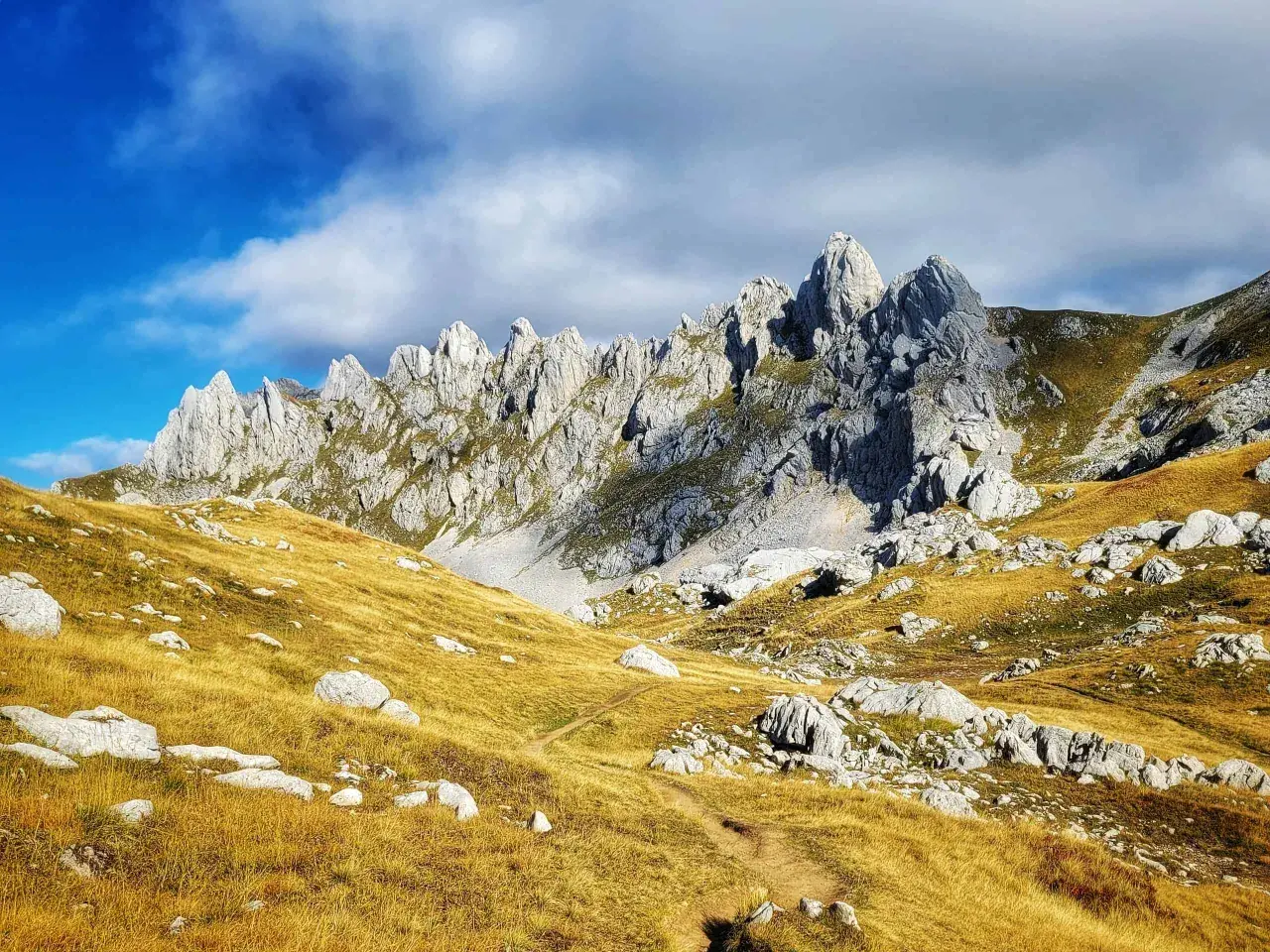
The Bobotov Kuk hike delivers the kind of alpine day that looks straightforward from a distance and then asks for real fitness, steady footing, and a bit of nerve once the limestone narrows. This guide breaks down the route options, difficulty, best season, gear, and the logistics of starting from Sedlo or Zabljak. If you want a practical read on whether the summit is worth the effort, and how to do it without underestimating the mountain, you will find the useful parts here fast.
The summit is best treated as a serious alpine day hike, not a casual walk
- The standard Sedlo route is about 10 to 12 km round trip, with roughly 940 to 950 m of climbing.
- Expect cable-protected rock steps, loose limestone, and exposed sections near the top.
- July, August, and September are the best trekking months for Durmitor, with September often feeling the most balanced.
- Bring sturdy boots, at least 2 liters of water per person, sun protection, and enough time for a careful descent.
- If you are uneasy on exposed rock, I would choose a guided day or a different Durmitor trail.
Which route to the summit fits your day
If you are planning a first attempt, I would start by choosing the route, because that decision changes everything else. Sedlo is the sensible default, while the longer point-to-point versions make the hike feel more like an endurance day than a clean summit outing.
| Route | Typical stats | What makes it different | My take |
|---|---|---|---|
| Sedlo out-and-back | About 10 to 12 km, 940 to 950 m of gain, 5.5 to 8 hours | Most direct line to the top, with the best balance of effort and scenery | The best choice for most hikers. |
| Sedlo to Zabljak | About 16 km point-to-point, 8 to 10 hours | Needs a shuttle or taxi pickup, and the descent is long and tiring | Strong long-day option if your logistics are sorted. |
| Zabljak out-and-back | About 22 km, 10 to 12 hours | Forest approach, less immediate payoff, and a lot more total effort | Only if you already know the mountain and want a very big day. |
The key point is simple: the Sedlo route gives you the best version of the mountain without turning the day into a logistics project. If you only have one chance, that is the version I would choose, because it starts high, reaches the summit efficiently, and keeps the focus on the terrain rather than the transport.
What the trail actually feels like
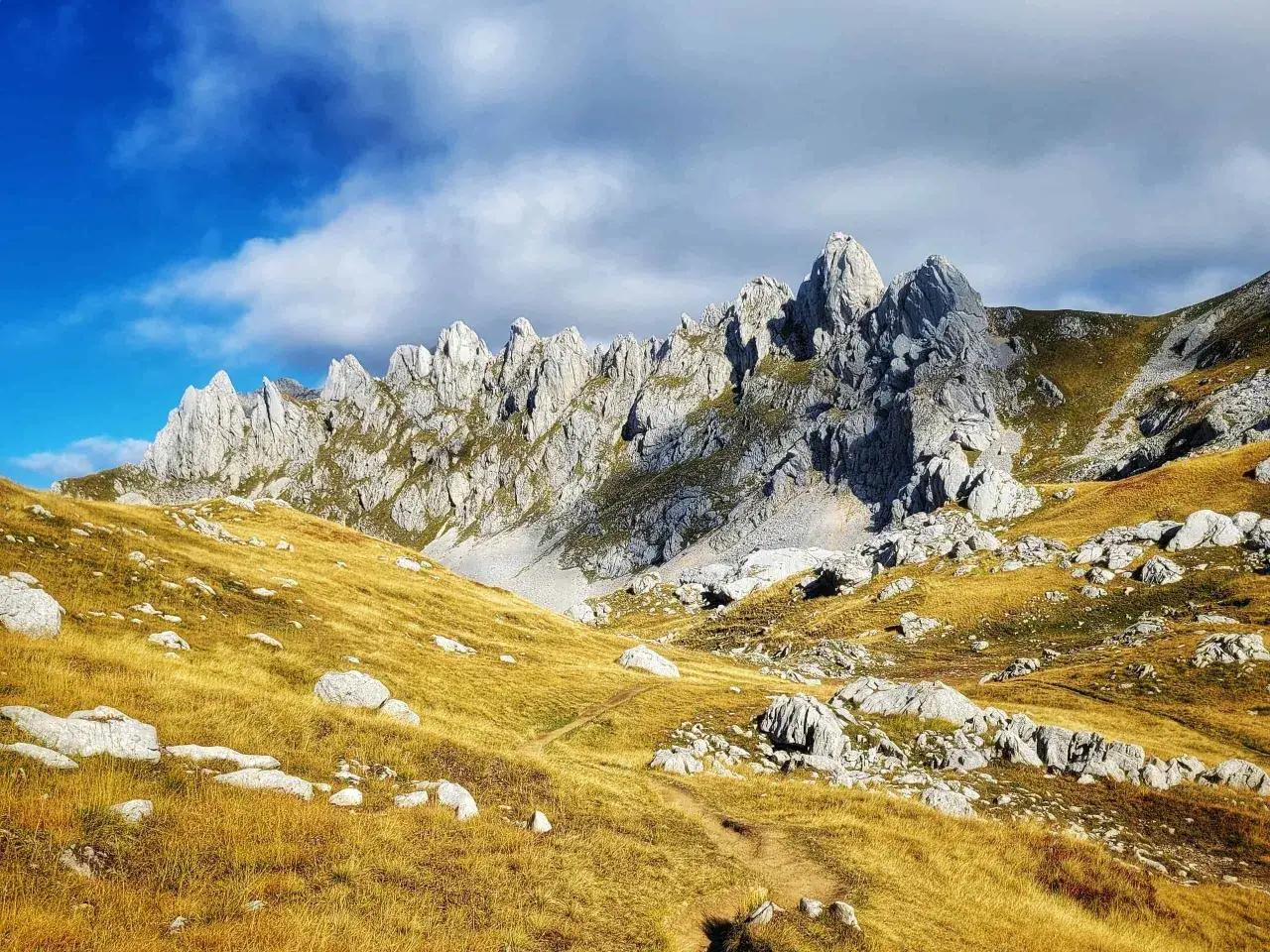
From Sedlo, the opening feels kinder than people expect. You move through grassy slopes and open limestone country before the route tips into its first hands-on rock step, where cables help on a short exposed section.
This is classic karst terrain, which means pale limestone, sharp edges, sinkholes, and footing that can change from firm to loose in a few steps. The red-and-white Knafelc waymarks are usually easy to follow, but the mountain still asks for attention because the line is obvious only when the weather is good and the rock is dry.
- The first section is a warm-up across open meadows and broad alpine ground.
- The middle section includes a cable-assisted step and a few places where you need your hands.
- The upper mountain becomes more exposed, with boulder fields and steeper limestone underfoot.
- The final push to the summit is short on paper, but it often feels slow in practice.
That last part matters more than many hikers expect. The summit may be only about 1 km from the final junction, but it is the slowest kilometer of the day because the terrain stays uneven and the exposure keeps your pace honest. That is exactly why timing and weather matter so much on this hike.
When to go and how weather changes the plan
Montenegro’s tourism board points to July, August, and September as the main Durmitor trekking months, and I would treat that as the right default for a first ascent. In that window, the trail is usually in its most straightforward condition, but the upper mountain can still change quickly if clouds build or the wind picks up.
| Season | What to expect | My take |
|---|---|---|
| July to August | Best access, longest daylight, warmest conditions, and the busiest trail traffic | Good choice if you start early and handle heat well. |
| September | Cooler air, often clearer views, and fewer hikers than peak summer | My favorite balance of conditions and comfort. |
| June and October | Possible snow patches, colder mornings, and shorter days | Only for hikers who are comfortable making conservative decisions. |
| Winter | Snow, ice, and a very different mountain | Not a normal hiking objective unless you have winter mountaineering experience. |
I would also start early, even in midsummer. On a mountain like this, the question is not only whether you can reach the summit, but whether you can get back down before weather and fatigue start working against you. If the forecast looks unstable, I would switch to a lower Durmitor walk rather than gamble on the ridge.
What to pack and how to pace the climb
The gear list is short, but the margin for error is not. This is not the place for worn-out shoes, a single bottle of water, or casual pacing on the upper rock steps.
- Sturdy hiking boots with real grip, not soft trail shoes with flat soles.
- At least 2 liters of water per person, and 2.5 liters if the day is hot.
- Sun protection, including hat, sunglasses, and sunscreen.
- A light wind shell or midlayer, because the temperature can drop fast above treeline.
- Snacks with real calories, ideally 400 to 600 calories beyond a small lunch.
- Trekking poles if you like them on descents, though they are optional rather than essential.
- Offline maps and a charged phone, even if the trail markings look clear.
My rule of thumb is to save energy for the summit ridge, not spend it early in the meadow sections. Keep the first cable-assisted step controlled, take the loose limestone slowly, and do not talk yourself into continuing if the rock is wet or thunder is building. A conservative decision on this mountain is usually the smart one, not the timid one.
How to get to Sedlo and where to base yourself
Sedlo Pass sits at about 1,907 m and is reached from Zabljak on the scenic P14 road in roughly 25 minutes by car. That high start is one reason the route works so well, because it gives you a lot of summit value without a long forest approach.
- Stay in Zabljak the night before if you can, because it puts you close to the trailhead and lets you start early.
- Use a taxi or private transfer if you do not have a car, since Sedlo is the practical trailhead for most hikers.
- Arrive early if you are driving, because the parking area is small and summer starts can get busy.
- If you plan a point-to-point finish in town, arrange pickup before you leave, not after you are already tired at the summit.
I would not build this into a coast-based day trip. The whole point of sleeping near the park is to protect your energy and your time window, so you can focus on the hike itself instead of rushing to beat the clock.
Why the summit feels worth the effort
The reward is not just a high point on a map. From the top, the landscape opens into a wide, austere panorama of limestone ridges, darker basins, and the hard-edged character that makes Durmitor feel different from softer alpine ranges. The view is dramatic because it is so raw.
I like mountains that make you earn the last few hundred meters, and this is one of them. The summit is compact rather than sprawling, which keeps the focus on the exposure, the surrounding peaks, and the sense that you are standing in the middle of a real high mountain system rather than at a casual viewpoint. That is why the climb stays memorable long after the legs recover.
The smartest way to plan the climb in 2026
If I were planning this ascent now, I would choose Sedlo, leave at dawn, carry more water than feels necessary, and keep a backup plan for a lower Durmitor trail if the upper rock is damp or the sky starts to close in. A guide is not mandatory in perfect summer conditions, but it becomes a smart option if you are new to exposed alpine terrain, traveling solo, or unsure about reading mountain weather.
For a first attempt, the best mindset is to treat Bobotov Kuk as a serious mountain day with a clear turn-around point, not a summit-at-any-cost challenge. If you respect that line, the hike becomes exactly what it should be, a demanding, beautiful day in one of the Balkans’ strongest mountain landscapes, and a much better memory than any rushed summit photo.