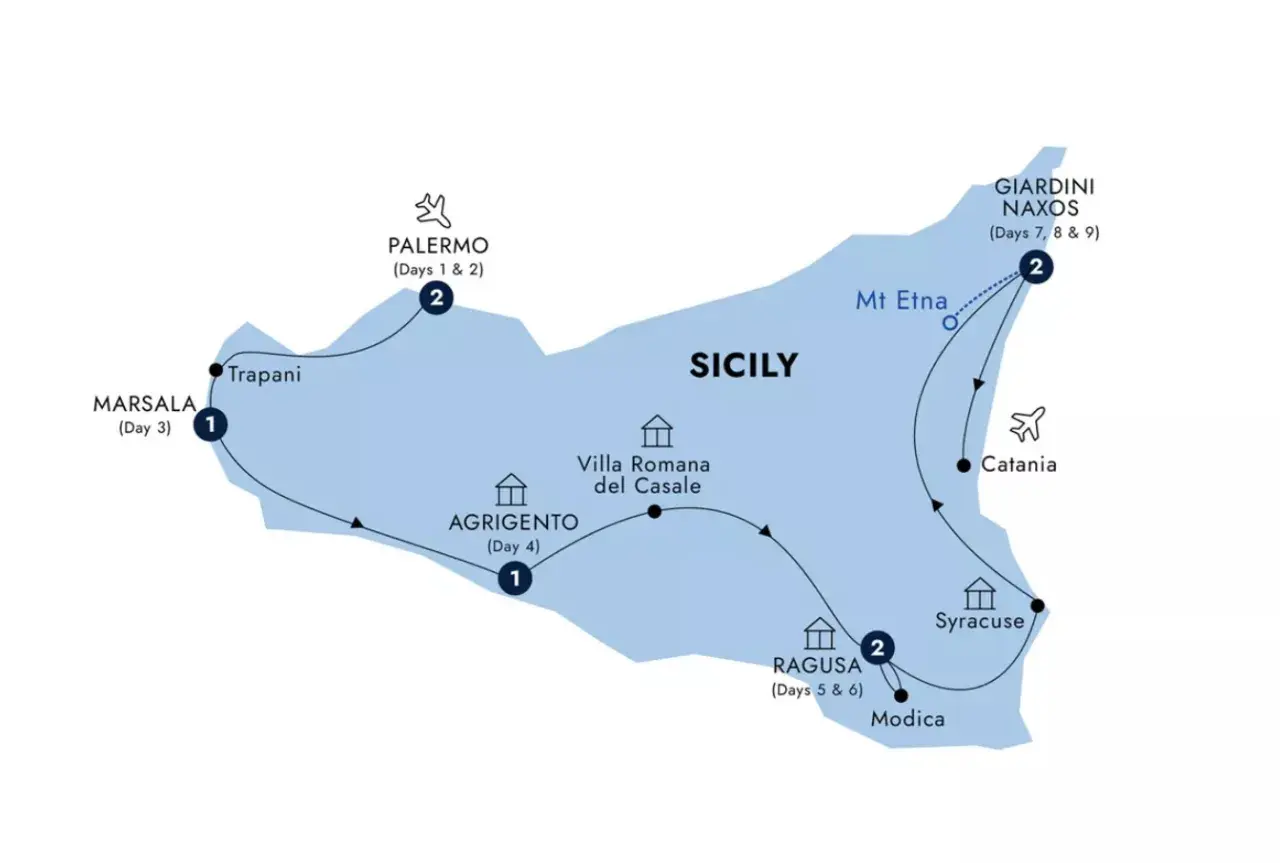
Sicily rewards travelers who plan the route with a little discipline. A well-built 2 week sicily itinerary is less about chasing every headline stop and more about balancing Palermo’s energy, the island’s western ruins and salt flats, the baroque southeast, and a few slower days for beaches, viewpoints, and volcanic scenery. In this guide, I focus on the route itself, how to pace it, what to budget, and which decisions make the trip feel smooth instead of rushed.
The essentials for planning two weeks in Sicily
- I would treat Sicily as a west-to-east loop, not a back-and-forth island hop.
- Four or five bases are usually enough for 14 days; more hotel changes start to eat into the trip.
- A car makes the scenic inland and coastal legs much easier, especially around Trapani, Agrigento, Ragusa, and Etna.
- Train and bus travel works best on the main Palermo, Syracuse, Taormina, Catania, and Cefalù corridor.
- For most travelers, April to June and September to October offer the best balance of weather, crowds, and sea conditions.
- For a comfortable midrange trip, I would budget roughly €130-220 per person per day, excluding long-haul flights.
The route that makes two weeks feel easy
The biggest mistake I see in Sicily planning is trying to cover the island in a zigzag. That looks efficient on a map and feels exhausting in real life. What works better is a single directional loop: start in Palermo, move west, cut across the south, then sweep up the east coast before finishing near your departure airport.
If I were building this trip from scratch, I would choose an open-jaw flight pattern if the fares cooperate, ideally Palermo in and Catania out. That avoids the least enjoyable part of the trip, which is ending with a long cross-island drive when you are already ready to fly home. If you must return to Palermo, I would simply leave one or two nights at the end as a buffer rather than forcing an overpacked final day.
| Route style | Best for | Trade-off |
|---|---|---|
| West-to-east loop | First-time visitors, scenic travelers, and anyone who wants the most balanced two-week trip | Needs a little more planning up front |
| Round trip via Palermo | Travelers who find better flights into one airport | Usually means more backtracking at the end |
| Train-and-bus focused | City-first trips and travelers who do not want to drive | Harder to include western and inland highlights comfortably |
My rule is simple: if the trip includes Segesta, Erice, Ragusa, Etna, and a few coastal detours, I want a car. If the trip is mostly Palermo, Syracuse, Taormina, and Cefalù, public transport becomes much more practical. That choice changes the whole shape of the itinerary, which is why I like to settle it before I lock the hotels.
A day-by-day Sicily plan that keeps the pace sane
This is the version I would recommend for most first-time visitors who want history, scenery, and enough breathing room to enjoy meals and beaches without feeling chained to a schedule. It follows the classic west-to-east logic, with Palermo at the start, Taormina and Cefalù near the end, and just enough time in each base to make the transfers worthwhile.
| Day | Overnight | Plan | Why it works |
|---|---|---|---|
| 1 | Palermo | Arrive, check in, and keep the first afternoon light with a walk through the historic center and a simple street-food dinner. | You land in a city that rewards wandering, not over-scheduling. |
| 2 | Palermo | See the city properly: markets, churches, backstreets, and Monreale if you want one major half-day side trip. | This gives you a full urban day before the road trip starts. |
| 3 | Trapani | Pick up the car and drive west with a stop at Segesta before continuing to Trapani. | Segesta breaks up the transfer and adds real archaeological value without stealing a full day. |
| 4 | Trapani | Use the day for Erice, the salt pans, Mozia, or a boat outing if you want time on the water. | This is one of the most scenic corners of the island, so I would not rush it. |
| 5 | Agrigento | Drive south and stop in Agrigento for the Valley of the Temples, ideally in the softer light later in the day. | It turns a transit day into one of the trip’s main highlights. |
| 6 | Ragusa | Continue east with a stop at Villa Romana del Casale if mosaics interest you, then settle in Ragusa. | This keeps the long southbound transfer from feeling like wasted time. |
| 7 | Ragusa | Spend the day in Ragusa, Modica, and Scicli, moving slowly through the baroque towns rather than trying to conquer all of them. | This is the island’s most satisfying “wander and linger” day. |
| 8 | Syracuse | Drive to Noto first, then continue to Syracuse and end the day in Ortigia. | Noto is an easy architectural detour that fits naturally into the drive. |
| 9 | Syracuse | Give Syracuse a full day for Ortigia, the waterfront, and one slower coastal walk or swim if the weather is warm. | You need a genuine pause after the string of transfers. |
| 10 | Taormina | Head north via Mount Etna or Catania, then arrive in Taormina for the evening. | This is the big contrast day: volcanic landscape, then a polished hill town. |
| 11 | Taormina | Stay local with the Greek theatre, viewpoints, and a long lunch; if you want movement, add Isola Bella or a beach stop. | Taormina works best when you let the setting do the work. |
| 12 | Cefalù | Drive north to Cefalù for a mix of old-town walking and a proper beach afternoon. | It gives the route a softer coastal finish before the final return north. |
| 13 | Palermo | Return to Palermo, drop the car if needed, and use the afternoon for anything you missed at the start. | This is the safest day to absorb delays without stress. |
| 14 | Palermo or departure | Keep the final morning flexible for a market visit, one last café stop, or the airport transfer. | A buffer day matters more than a forced extra sight. |
If you want a slightly lighter version, I would trim either Cefalù or the final Palermo return and use that time for a slower day in Taormina or an extra night near Etna. The route above is the version I think works best for most readers, but it is not rigid; Sicily rewards small adjustments.
Car or public transport is the decision that changes everything
I can make a Sicily trip work without a car, but I would not design the same route that way. The west coast, the baroque southeast, and Etna all become easier when you can stop where the view is good, not where the timetable is convenient. On the other hand, trains and buses are perfectly usable if you want to keep the trip tighter and stay on the main lines.
| Option | Best for | Upside | Downside | My take |
|---|---|---|---|---|
| Car | Scenic road trips, rural stops, and travelers who want flexibility | Easier access to Segesta, Erice, Ragusa, Etna, and beach detours | Parking, narrow streets, and occasional stress in historic centers | Best overall for this itinerary |
| Train and bus | City-focused itineraries | Less driving and less parking friction | Harder to stitch together the west and southeast efficiently | Good if you simplify the route and stay on the main corridor |
| Mixed approach | Travelers who want to avoid driving inside Palermo | Lets you enjoy the city without a car at the start | Can add friction if you keep too many rural stops | Workable if you pick up the car only after the Palermo nights |
If you do drive, I would pick up the car only after the Palermo city days and return it before the final night if your hotel is central. I would also add 15 to 30 minutes to many coastal transfer estimates in summer, because traffic, parking, and one wrong turn in a historic center can eat time fast. That extra margin is boring on paper and extremely useful in practice.
Where the trip earns its scenic days
Sicily is not just a list of monuments. The island is at its best when the trip includes a few places that let you breathe a little: a ridge town, a beach, a volcanic slope, a reserve with proper walking, or a coastline that looks better in person than in any photo. I would protect those days carefully, because they are what keep the itinerary from becoming museum fatigue with good food attached.
Best add-ons for beach and coast lovers
- Erice is worth it for the elevation and views alone; it feels like a natural pause above the coast rather than just another stop.
- The salt pans near Trapani are a strong fit if you like flat, open landscapes and late-day light.
- Cefalù makes sense as a softer landing near the end of the route because it combines a beach, a compact old town, and easy walking.
- Ortigia gives you waterfront atmosphere without forcing a formal beach day, which is useful if your schedule is already full.
Best add-ons for hikers and active travelers
- Mount Etna is the most distinctive outdoor day on the island, and I would make time for it if you want landscapes that feel unmistakably Sicilian.
- Zingaro Nature Reserve is ideal if you want a half-day walk with sea views rather than a packed cultural schedule.
- Isola Bella and the coastline around Taormina are useful when you want an active day without a major transfer.
- Villa Romana del Casale is not an outdoor site, but it works well as a break in the drive and gives the inland leg more meaning.
Read Also: Procida Travel Guide - Best Things to Do, Beaches and Boat Trips
What I would skip when the weather turns hot
- I would not cram two major museums and a long drive into the same afternoon.
- I would avoid over-planning beach days, because the best ones often come from staying flexible with weather and sea conditions.
- I would skip one optional stop before I would cut a proper lunch or an unhurried evening walk.
The real trick is pacing, not volume. Sicily gives you enough variety that you do not need to force every category of travel into one day, and that is exactly why the island feels so satisfying when the route is balanced well.
What this trip costs and what to book first
For planning purposes, I keep Sicily budgets in euros because that is how the island actually prices most things. The exact total depends on season, hotel level, and whether you share a car, but these are realistic midrange planning numbers for a two-week trip.
| Item | Typical planning range | Notes |
|---|---|---|
| Midrange room | €90-180 per night | Coastal towns and summer weekends push prices up quickly |
| Car rental | €35-80 per day | Automatic cars usually cost more and sell out sooner |
| Fuel and parking | €15-35 per day | Higher if you do a lot of short coastal hops |
| Meals | €30-60 per day | More if you lean into seafood, wine, and long dinners |
| Sightseeing tickets and local extras | €10-40 per day | Rises if you add boat trips, guides, or several paid sites in one day |
As a rough total, I would expect €80-130 per person per day for a budget-conscious trip, €130-220 per person per day for a comfortable midrange trip, and more if you want better hotels in peak summer or a stronger restaurant focus. I would not include transatlantic flights in that number, because they swing too widely to be useful as a Sicily-specific baseline.
When I book a trip like this, I lock three things first: the flight pattern, the Palermo and Taormina or Syracuse stays, and the car if I know I need one. After that, I add the slower choices. That order keeps the important logistics under control before I start obsessing over smaller side trips.
The last tweaks that make the loop feel effortless
If I were booking this trip for myself today, I would make just a few final adjustments. I would keep one afternoon open for weather, fatigue, or a spontaneous swim. I would not add more hotel changes unless they clearly improve the route. And I would treat Sicily as a place where the best days are often the ones with one anchor activity and enough unstructured time to enjoy the food, the views, and the streets between stops.
- Choose fewer bases if you value easy logistics more than maximum coverage.
- Use Palermo and Syracuse wisely if you are planning a train-heavy version of the trip.
- Protect one scenic day for Etna, Zingaro, or the coast rather than filling every day with ruins.
- Let Cefalù or an extra Palermo night act as a buffer if you need a gentler ending before departure.