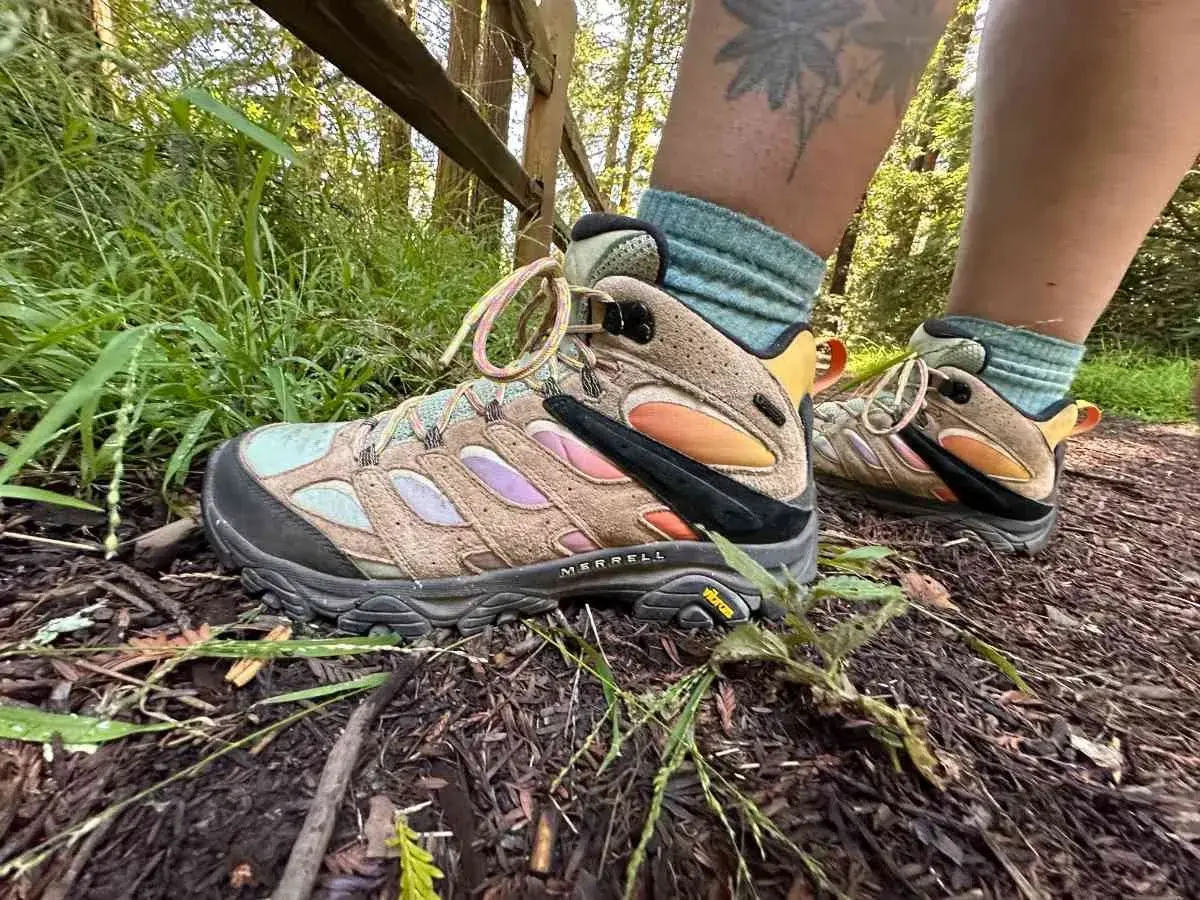
A good Merrell hiking boot should feel secure through the heel and midfoot, with enough room in the toe box for natural foot swelling and downhill movement. I do not want a boot that feels soft and sloppy; I want one that feels controlled, especially once the trail tilts, the pack gets heavier, and the miles start adding up. This article breaks down the fit signs that matter, how to test them properly, and when to choose a different size or a wide option.
The fit cues that matter most
- Your heel should stay planted with only minimal movement.
- Your longest toe should have about a thumb’s width of space from the front of the insole.
- The midfoot should feel secure, not squeezed.
- Try them on with the socks you will actually hike in, ideally later in the day.
- If you are between sizes or planning thick socks, a half-size up is often the first thing to test.
- Merrell wide-fit options exist, but only on a limited range of products.
What a correct Merrell fit feels like on the trail
I start with a simple rule: a hiking boot can feel firm, but it should never feel punishing. On level ground, the heel should stay planted, the midfoot should feel held without pressure, and the toes should still move freely enough that you can walk downhill without bracing for impact. In practical terms, the fit should feel secure in motion, not just comfortable when you are standing still.
That balance matters even more on steep descents, where a boot that is even slightly short can drive the toes forward. On rocky European trails, especially the kind with long, uneven drops underfoot, that extra room is not a luxury; it is what keeps the front of the boot from becoming the enemy.
| Area | What you want | What is wrong |
|---|---|---|
| Heel | Stays planted on step-downs | Obvious lift or rubbing |
| Toe box | Space to wiggle toes without curling them | Toes touch or brace against the front |
| Midfoot | Secure, even hold around the arch and laces | Numbness, hotspots, or lace bite |
| Forefoot width | Natural spread when you stand and walk | Pressure at the little toe or bunion area |
| Instep | Even tension across the top of the foot | Pinching or a hot spot under the laces |
If any of those cues are missing, the boot may still be the right brand, but it is not the right size or shape. That is why I always stress-test the pair before trusting the label, which is the next step.
How to test the fit before you leave the house
Try boots on later in the day, with the socks you will actually hike in. Feet change through the day, and a pair that feels neat in the morning can feel cramped after a few hours, especially on longer walks or in warmer weather. A boot that only feels good with thin socks and a loose lace job is not a good fit; it is a temporary illusion.
- Lace the boots the way you would on the trail, not loosely.
- Stand up, then walk on stairs, a slope, or a ramp to simulate descent.
- Check for about a thumb’s width of space in front of your longest toe.
- Feel for hotspots at the heel, little toe, and instep.
- Stand on one foot and bend your knee to see whether the heel shifts or the boot collapses awkwardly.
- If you are undecided, remove the insole and compare your foot to it for length and shape.
The goal is not to eliminate all sensation. A hiking boot should feel present, especially around the heel and midfoot. What you are avoiding is movement that keeps repeating itself, because repeated movement becomes rubbing, and rubbing becomes pain.
Once that basic test passes, the next question is whether you should actually change size or width, because fit problems are not always solved the same way.
When to size up, use wide, or stay with your regular size
Merrell’s size chart is the right starting point, but I would not treat it as a verdict. Merrell also notes that wide-fit options exist only on a small range of products, so if you need more room across the forefoot, you should look for that explicitly rather than hoping the standard version stretches enough. I would rather see a hiker stay in the correct length with the right width than jump a full size and create heel slip.
There is one more point I would not gloss over: Merrell does not promise a universal conversion between men’s and women’s footwear because foot shape and volume vary too much. That is sensible. Size numbers tell you something useful, but they do not tell you everything about how the boot wraps the foot.
| Situation | First thing I would try | Why it helps |
|---|---|---|
| You are between sizes | Try the half-size up first | It usually gives enough toe room for descents without making the boot sloppy |
| You wear thick winter socks | Test the half-size up with the socks on | Socks take up volume fast, especially in waterproof boots |
| Your forefoot feels squeezed but the heel is fine | Look for a wide-fit version | Width fixes side pressure better than extra length |
| Your toes touch the front on descents | Do not rely on break-in alone | Length problems usually get worse on trail days, not better |
| You use custom insoles | Test the boot with the insoles installed | Insoles reduce internal volume and can change heel hold |
I use the same logic for nearly every hiking boot: fix width with width, fix length with length, and only then use lacing as a fine-tuning tool. That matters because the shape of the boot itself can change the feel more than the size number does.
Why Merrell fit varies from model to model
Not every Merrell hiking boot fits the same way. A last is the 3D shape the boot is built around, and that shape can change the toe box, instep volume, and heel hold more than the size number does. A lighter, athletic hiker usually feels more flexible in motion than a stiffer backpacking boot, while waterproof versions can feel a touch less forgiving because the interior is built around extra protective layers.
I also pay attention to the midsole, the layer between the insole and outsole that cushions and stabilizes the foot. A softer midsole can feel comfortable right away, while a firmer one may feel more exacting but better under load. Neither is automatically better; the right choice depends on how you hike, how much you carry, and how sensitive your feet are.
- A roomier toe shape helps if your toes spread when you descend.
- A narrower heel cup helps if your heel lifts in loose boots.
- A stiffer upper can improve support, but it will not fix the wrong length.
- Waterproof membranes are useful in wet weather, but they can make the boot feel less airy and slightly more structured.
- Higher collars can help the ankle feel supported, but they do not solve a poor fit at the forefoot.
If you are used to urban walking shoes, a hiking boot should feel more structured, not more cramped. The right adjustment is usually a better-shaped model, not a bigger number on the box.
Once you accept that fit varies by model, the buying decision gets simpler and a lot less guessy, which is exactly what I want before placing an order.
What I would check before ordering a pair in 2026
If I were buying Merrell hiking boots today, I would make four checks before I kept a pair: the official US size chart, the width filter if I need one, the return window, and the boot’s shape relative to my feet. I would also keep the tags on until I had walked stairs, stood for a while, and tested a downhill step on a hard floor, because that is where a bad fit announces itself fastest.
- Use the brand’s own chart, not a generic conversion table from another retailer.
- Match the socks to the season and the route.
- Choose the smallest size that gives you real toe room.
- Fix width problems with width, not with extra length.
- Trust pressure points, because they usually get worse rather than better.
The best Merrell fit is the one you stop noticing once the trail starts working. If the boot feels stable, roomy in the toes, and quiet at the heel, you are probably in the right size; if not, the correction is usually a half-size, a different width, or a different model altogether.