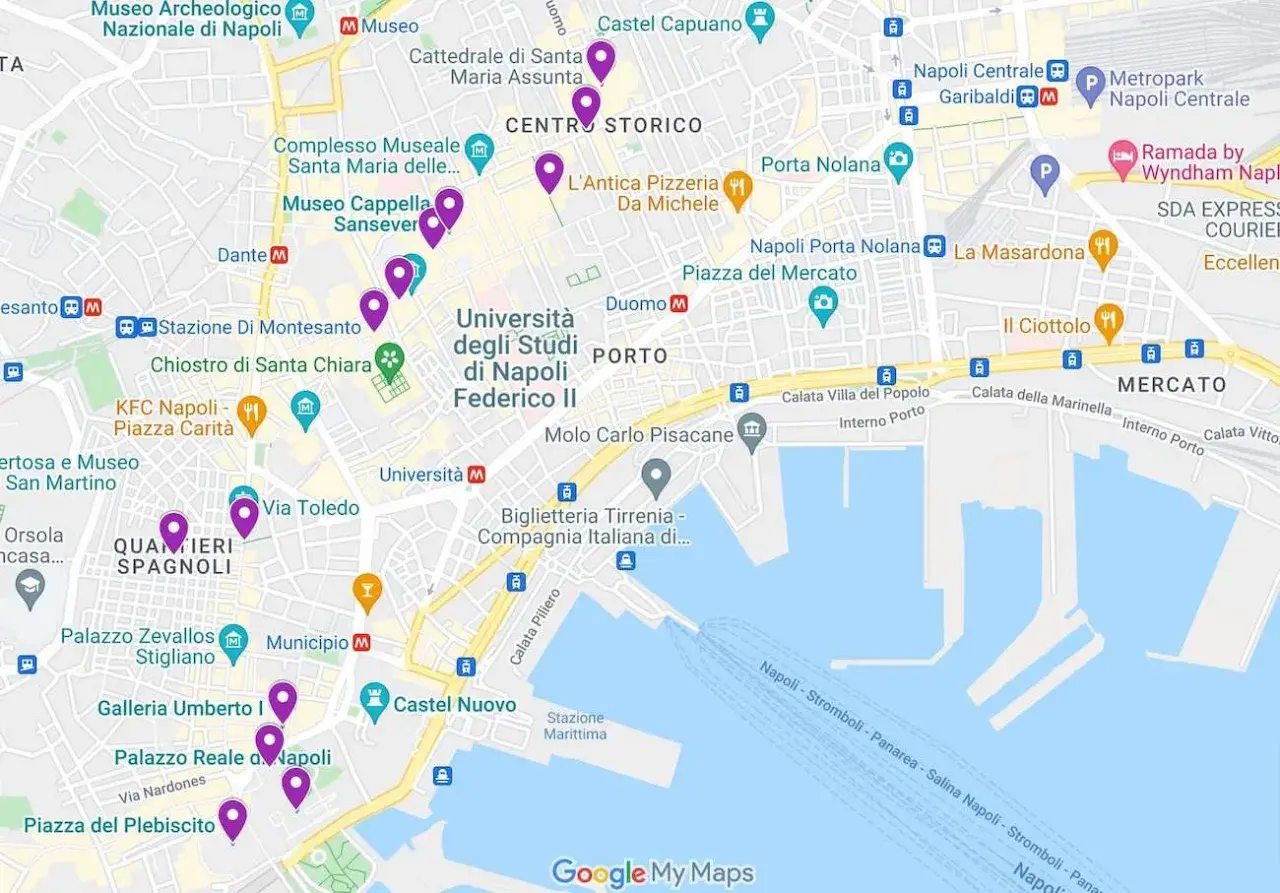
Naples rewards travelers who think in neighborhoods, not just landmarks. A good map makes it easier to decide where to stay, how to move between the historic center and the waterfront, and which parts of the city feel lively, quiet, or scenic at different times of day. I usually read the city as a set of connected zones: the old core, the sea-facing districts, the hill neighborhoods, and the transport hubs.
The quickest way to use a Naples neighborhood map
- For trip planning, the administrative frame matters less than the visitor clusters: historic center, waterfront, hills, and station area.
- Centro Storico, Chiaia, and Vomero are the safest all-round starting points for a first stay.
- Quartieri Spagnoli gives you atmosphere and energy, but it is not the quietest base.
- Piazza Garibaldi is practical for trains and transfers, yet it is usually a logistics choice rather than a charm choice.
- Hills, funiculars, and metro connections can change walking times more than the map suggests.
- Posillipo and Mergellina are the scenic picks when the view matters as much as the itinerary.
How I read the city before I book
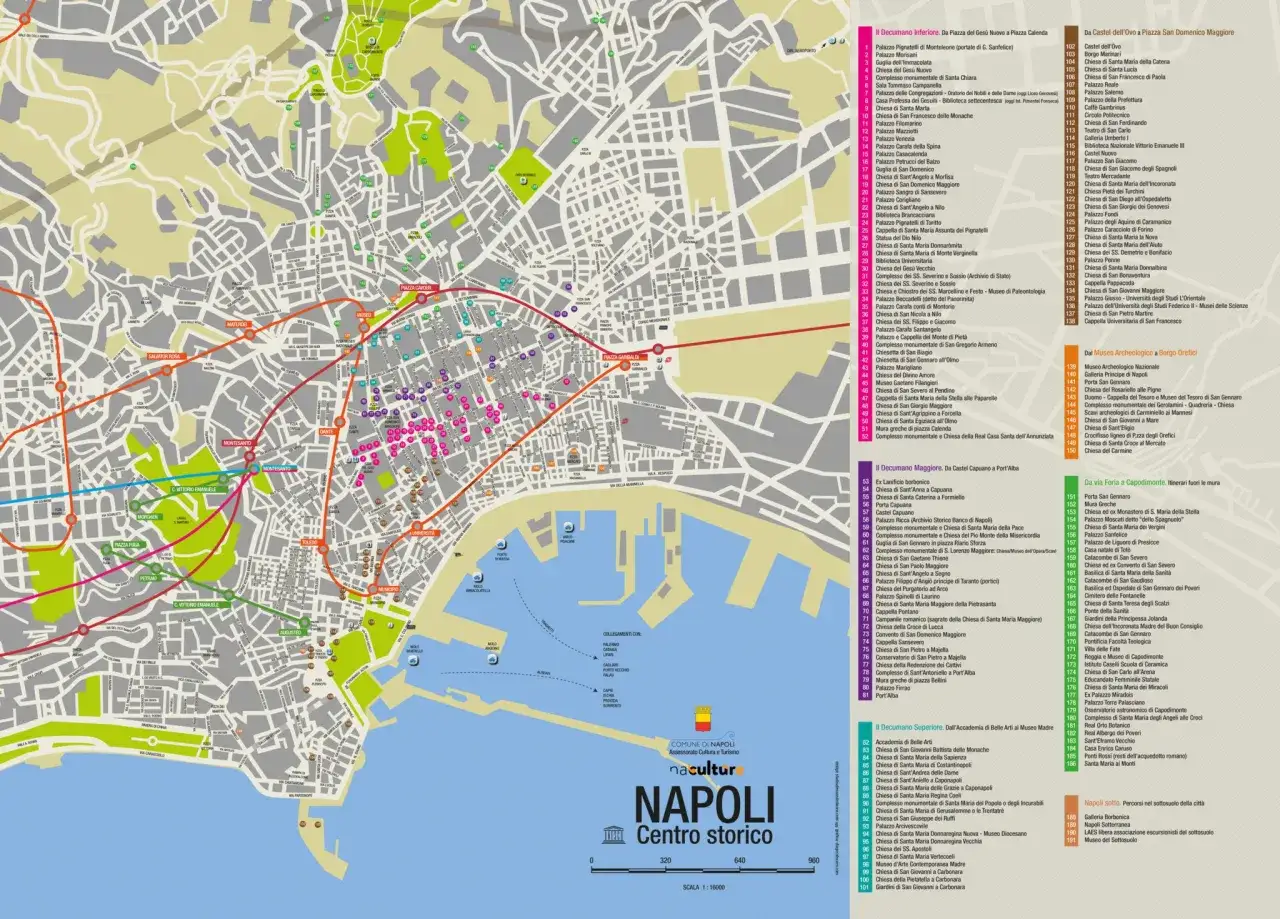
The first thing I do with a Naples map is ignore the instinct to treat the city like a flat grid. Naples is layered, steep in places, and often more connected by transit than by straight-line distance. The Comune di Napoli divides the city into 10 municipalità, but for a traveler that is mostly an administrative frame; the useful version is simpler: old center, waterfront, hill districts, and the rail-heavy eastern side.
That matters because the same walking distance can feel completely different once you add stairs, traffic, and elevation. A place that looks “close” on the map may be a surprisingly long climb at the end of the day, while a neighborhood that seems farther away can be easier if it sits near a metro or funicular stop. In Naples, the map is only half the story; the slope is the other half.
There is also a naming problem that catches a lot of visitors. Tourist labels, neighborhood names, and administrative borders do not always line up neatly. A district can appear under one name on one map and another name a few blocks away, so I always check the exact location of the hotel or apartment rather than relying on the broad neighborhood title alone. Once you think in those clusters, the neighborhood choices become much easier to compare.
The neighborhoods that matter most on a first visit
If you are trying to turn a Naples neighborhood map into a booking decision, these are the areas I would look at first. Italia.it consistently frames Chiaia, Vomero, and Posillipo as the city’s more elegant and scenic side, and that is a good mental shortcut for visitors. The rest of the city is more varied, more textured, and sometimes more practical than pretty, which is not a bad thing if you know what you are choosing.
| Neighborhood | What it feels like | Best for | Watch out for |
|---|---|---|---|
| Centro Storico | Dense, historic, lively, and packed with food, churches, and narrow streets | First-time visitors, walkers, food-focused trips | Noise, crowds, and the need to choose a quiet street carefully |
| Quartieri Spagnoli | Energetic, local, rough around the edges, full of street life and murals | Travelers who want character, nightlife, and a strong sense of place | It is not the calmest or easiest area for sleep or car access |
| Chiaia | Polished, waterfront-adjacent, stylish, and more upscale than the old center | Couples, comfort seekers, longer stays | Prices rise quickly, and some parts are more spread out than they look |
| San Ferdinando | Monumental and central, with a strong seafront identity | Landmark-hopping, promenade walks, easy access to major sights | It feels more ceremonial than neighborhood-like in some blocks |
| Vomero | Hilltop, residential, calmer, and often noticeably cooler in mood | Families, quieter nights, travelers who prefer a local base | Uphill walks and more dependence on funiculars or transit |
| Posillipo / Mergellina | Scenic, coastal, and defined by views more than density | Romantic stays, sea views, slower mornings | Less central for moving around on foot |
| Piazza Garibaldi | Functional, busy, and built around trains and transfers | Rail-heavy itineraries, short stopovers, budget logistics | It is convenient, but rarely the most atmospheric choice |
| Fuorigrotta | Western, event-friendly, and more practical than postcard-like | Stadium events, some budget stays, west-focused plans | Too far from the classic first-visit circuit for many travelers |
The part I always emphasize is that “best” does not mean the same thing in every trip. A first-time visitor usually wants easy sightseeing and strong atmosphere, while a repeat visitor may prefer a quieter base with faster access to the ferry port or the rail network. That is why the neighborhood map becomes useful only when it is tied to a real travel style, which is the next filter I use.
Which base fits the trip you actually want
Once the city is split into practical zones, the next question is not “which neighborhood is best?” but “best for what?” That sounds obvious, yet it is where many Naples bookings go wrong. A traveler who wants late dinners and dense street life will be happier in a very different place from someone who wants morning sea views and a calm night.
| Travel style | Best base | Why it works |
|---|---|---|
| First trip | Centro Storico or Chiaia | You get the strongest mix of sights, food, and orientation without needing to overthink every move |
| Quiet and polished | Vomero or Chiaia | Better sleep, a more residential feel, and less all-day street noise |
| Scenic break | Posillipo or Mergellina | The view is the point, so the neighborhood itself becomes part of the trip experience |
| Nightlife and urban texture | Quartieri Spagnoli or the edge of the historic center | You are close to the energy, the bars, and the late-evening city rhythm |
| Rail-first logistics | Piazza Garibaldi | Very efficient if you are arriving late, leaving early, or connecting to other cities |
| Family trip | Vomero | It is usually calmer, easier to rest in, and less intense than the city center |
My rule is simple: if your itinerary is mostly city walking, stay where the streets are worth walking. If your trip is more about day trips, ferries, or arriving and leaving at odd hours, prioritize a neighborhood that makes those transfers easier. The “perfect” base on a map is often the one that removes friction from your actual schedule, not the one that sits closest to a famous square.
How transport reshapes the map
Naples looks compact until you factor in the city’s hills, its traffic, and the way transit stitches the neighborhoods together. Metro Line 1 is especially useful because it connects the center with the hill districts and the northern side, while the funiculars make uphill areas far more practical than they look on a paper map. If you stay in Vomero, for example, the vertical city becomes much easier to live with.
That is also why a neighborhood near a transit node can be a smarter choice than a prettier area that is awkward to reach. A short ride on a line or funicular can save a lot of walking energy, especially after a long day of museums, coastal promenades, or food stops. I would rather stay one stop away from the action if that gives me a smoother morning and a less tiring return at night.
Waterfront movement matters too. The harbor, ferry connections, and the western side of the city make some bases better for island or coastal day trips than others. If you know you will spend time on ferries or changing between rail and boat, that should influence your map reading as much as the look of the neighborhood itself. In Naples, convenience and scenery are not always in the same place, but good planning helps you get both.
The last thing I check here is walking logic. Some streets are wonderful for strolling but slow for moving between districts, and a route that appears direct on the map can turn into a tiring zigzag. That does not make Naples hard to explore; it just means the best map is the one that respects elevation and transit instead of pretending the city is flat. Once you see that, the neighborhoods start making more sense.
The areas I would treat carefully
I do not think travelers need to be dramatic about Naples, but I do think they should be selective. Around the main station, the map is usually more useful for transport than for atmosphere. Public-facing travel guidance often treats station-adjacent pockets such as Vasto and Arenaccia as less appealing at night, and I would read that as a practical warning rather than a reason to avoid the whole city.
The same cautious logic applies to some peripheral districts. Soccavo, Fuorigrotta, and Mercato can make sense for very specific purposes, but they are rarely my first choice for a short visitor stay unless the trip is built around a stadium, a ferry connection, or another fixed reason to be there. A neighborhood can be perfectly valid and still not be the best fit for a tourist base.
One detail that a lot of visitors miss is how fuzzy neighborhood labels can be on the ground. Quartieri Spagnoli, for example, is not one neat postcard block; its edges blend into several nearby administrative areas, which means the feel of one street can be different from the next. That is why I always check the exact block, not just the neighborhood name on the booking page.
The bigger point is this: I would not make a decision from “safe” versus “unsafe” labels alone. I would ask whether the area is useful, lively, and well connected. That is the real trip-planning question, and it leads to better choices than any broad map label can provide.
The map rule I use before I book anything in Naples
If I am choosing one base for a short trip, I start with Centro Storico for immersion, Chiaia for comfort, and Vomero for quieter nights. Posillipo is the scenic upgrade, but I only choose it when the hotel itself is part of the experience. Piazza Garibaldi and the station area remain useful for one-night logistics, not for the whole trip.
The simplest test is this: pick the neighborhood that makes your first and last hour of the day easier, not the one that looks prettiest on a pin-drop map. In Naples, that choice usually saves more time and energy than chasing the absolute center of everything.
Once you plan the city this way, Naples stops feeling scattered and starts feeling like a set of memorable districts connected by a surprisingly workable transport network.