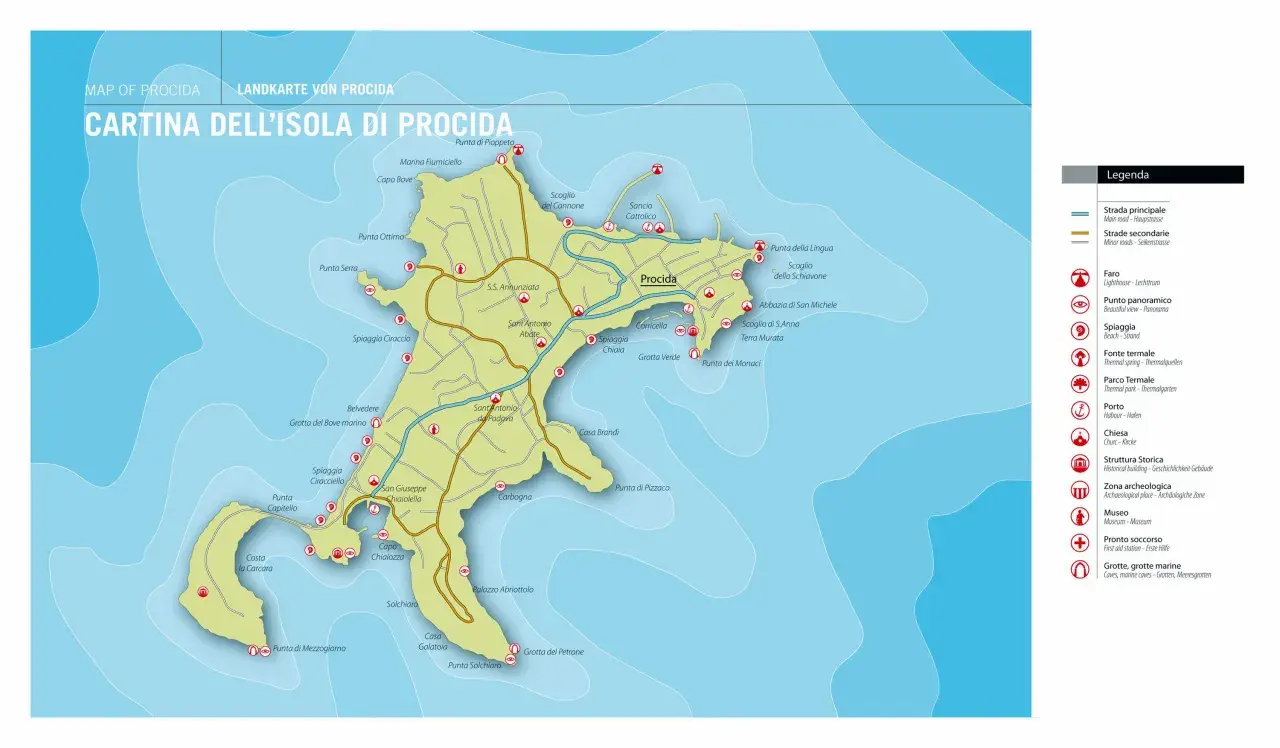
A good procida italy map is less about finding a dozen sights and more about understanding how the island works: where ferries land, which areas sit high above the sea, and where the easiest walking links actually are. That matters on Procida because the island is small, but the hills, stairways, and narrow lanes can make a short distance feel longer than you expect. In this guide I focus on the layout that helps with trip planning, the best route order, transport choices, and the beaches and viewpoints worth marking first.
The practical facts that shape a Procida day trip
- Procida is compact, so the map is really about sequencing hills, bays, and beaches, not covering long distances.
- Marina Grande is the main arrival point and the best place to orient yourself on the first hour of the trip.
- Terra Murata, Corricella, Chiaiolella, Lingua, and Pozzo Vecchio are the names I would mark first.
- Ferries connect the island with Naples and Pozzuoli, and Pozzuoli is usually the shortest crossing.
- Walking works well, but buses and micro-taxis matter once you start linking the higher and lower parts of the island.
How to read Procida before you start walking
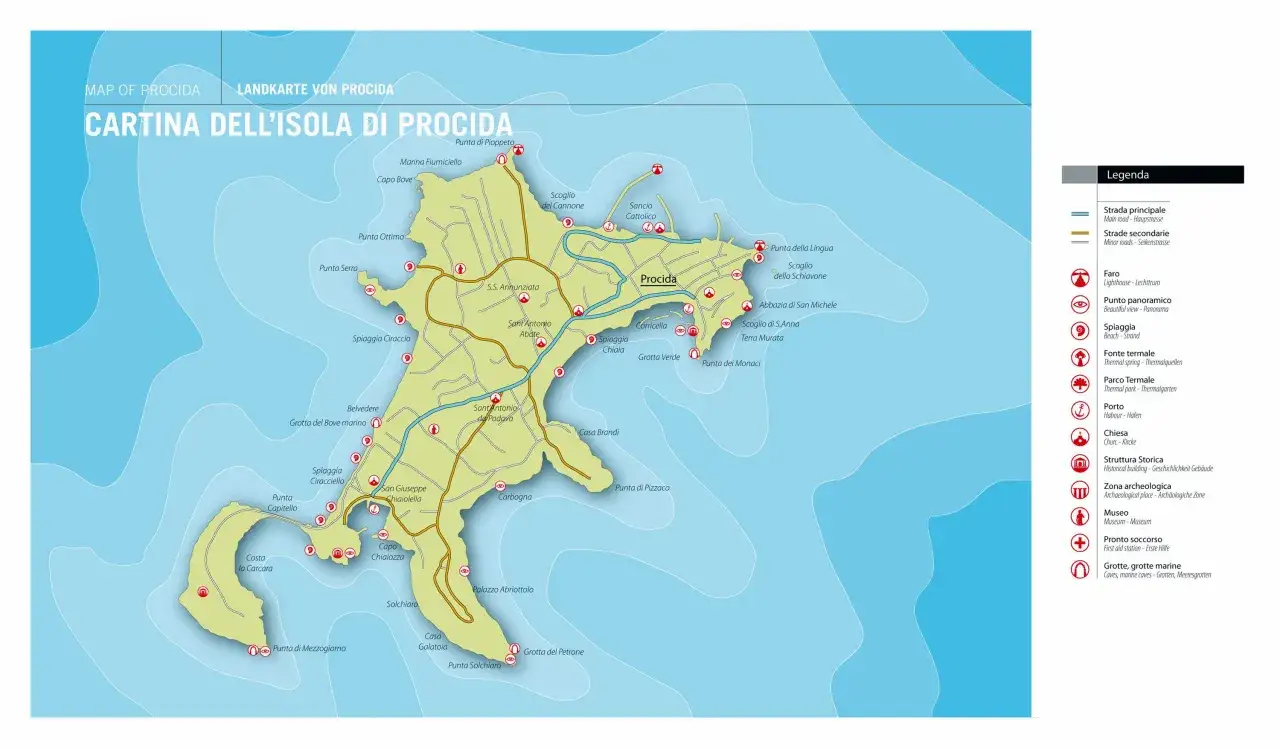
I like to think of Procida as four main reference points plus a few useful extras. Marina Grande is the arrival port and practical base, Terra Murata sits on the highest historic ground, Corricella drops down below it as the most photogenic old fishing village, and Chiaiolella anchors the southwest side of the island. Add Lingua near the port, Pozzo Vecchio on the western side, and Vivara just beyond Chiaiolella, and the whole map suddenly makes sense.
The island is tiny - just under 4 square kilometers - but the topography is the part people underestimate. On a map, two places can look close together; on foot, one of them may require a climb, a descent, and then another climb back out. That is why I never plan Procida by distance alone. I plan it by elevation, shade, and sequence.
| Area | What you will find | Why it matters on a map |
|---|---|---|
| Marina Grande | Ferry arrivals, shops, rentals, buses, and the first orientation stop | Best starting point and easiest place to reset your bearings |
| Terra Murata | The oldest historic center, steep lanes, and major viewpoints | Useful for understanding the island’s shape and the view down to Corricella |
| Corricella | Colorful fishing village with narrow lanes and no vehicle traffic | Looks close to Terra Murata on a map, but the descent and return matter |
| Chiaiolella | Harbor, beach access, and waterfront restaurants | Best for a slower afternoon and a more relaxed beach base |
| Pozzo Vecchio | Quiet western beach | Worth marking separately because it sits away from the port area |
| Vivara | Protected islet connected by a bridge | Important if you want a nature-focused map view, not just streets and harbors |
Visit Procida notes that the island is divided into nine local districts, or grancìe, but for trip planning I would keep the map simple: start with the port, one high point, one fishing village, and one beach area. That gives you a cleaner mental model and stops the island from feeling busier than it is. Once that structure is clear, it becomes much easier to choose the right walking order.
The best first-day route is a loop built around the hills
If I only had one day, I would not try to see Procida in a random order. I would start at Marina Grande, climb to Terra Murata, come down to Corricella, then move toward a beach or waterfront lunch before ending the day on the west side. That route follows the island's natural flow instead of fighting it.
From Marina Grande, Via Principe Umberto naturally pulls you upward to Piazza dei Martiri and the Belvedere dei Cannoni before you reach Terra Murata. I prefer to do that climb early, when the light is better and the heat is lower. Terra Murata and the viewpoint reward the effort with the kind of panorama that makes the whole island map click into place. After that, Corricella feels like a natural descent rather than a separate destination. If you reverse the order, you spend more energy on the return than on the view.
- Start at Marina Grande and orient yourself immediately on arrival.
- Go uphill once, not repeatedly, and use that climb for your main historic stop.
- Drop down to Corricella while you still have energy for steps and photos.
- Save the easiest beach or lunch stop for the middle or late afternoon.
- Finish on the Chiaiolella side if you want sunset light and a calmer pace.
Getting to Procida and moving around without friction
The ferry map is part of the island map. Procida is reached from Naples and Pozzuoli, and the arrival point that matters most is Marina Grande. From Naples, the fast hydrofoil from Molo Beverello is usually the quickest option, while traditional ferries from Calata Porta di Massa take longer but can accept vehicles. Pozzuoli is often the shortest and most economical crossing, which is why I tend to recommend it when the schedule works.
| Departure port | Typical crossing time | Best for |
|---|---|---|
| Naples Molo Beverello | About 40 to 45 minutes by hydrofoil | Foot passengers who want the fastest run |
| Naples Calata Porta di Massa | About 60 minutes by ferry | Travelers with vehicles or those who prefer a conventional ferry |
| Pozzuoli | About 30 to 35 minutes | The shortest and usually best-value crossing |
Once you land, Procida is small enough to walk, but that does not mean every route is flat. The island bus network is practical for linking the main areas, and the bus stop at Marina Grande is the easiest place to understand the system. The key lines are L1 for Porto-Chiaiolella, L2 for Porto-Chiaiolella-Solchiaro, C1 for Porto-Pozzo Vecchio, and C2 for Porto-Terra Murata-Corricella. A standard bus ticket costs €1.20 if you buy it in advance and €1.40 on board.
For comfort, micro-taxis are the best compromise. They can carry up to six people and work especially well in the narrow streets around the historic areas. I would also avoid planning around a private car unless you really need one. Procida restricts the landing of non-resident vehicles for much of the year, generally from March to October, so the easiest trip is usually the one where you leave the car behind. That makes the map simpler, and it keeps the island feeling like an island.
The beaches and viewpoints that deserve a place on your map
What makes Procida useful for trip planning is that the beaches are not interchangeable. Some sit close to the port, some are better for long swims, and some are mainly about the atmosphere. If you mark the right shoreline before you go, you will spend less time wandering and more time where the island actually rewards you.
| Beach or viewpoint | Where it sits | Best for | Practical note |
|---|---|---|---|
| Chiaia | Near the central village area, below steep steps | Classic scenery and a softer, quieter beach feel | Access is on foot or by sea, and the descent includes 186 steps from Piazza Olmo |
| Pozzo Vecchio | Western side of the island | Longer swimming stop and film-location appeal | Worth the detour if you want a slower beach day |
| Lingua | Right beside Marina Grande | Easy first swim after arrival | Very convenient, though it is pebbly rather than sandy |
| Chiaiolella and Ciraccio | Southwest side | Long shoreline, sunset light, and more relaxed beach time | Better when you want space and a slightly more open feel |
| Silurenza | Close to Marina Grande | Families and visitors who value convenience | One of the easiest beaches to fold into a short itinerary |
My practical rule is simple: choose one beach near the port and one farther away. That way, you are not spending your entire day crossing the island for every swim. Chiaia and Corricella give you the most iconic visual payoff, while Chiaiolella and Ciraccio are the better bet if you want a longer, more relaxed beach block. If the weather is clear and you want one extra panoramic stop beyond the beaches, I would add Punta Solchiaro for the widest island view. Once those places are on the map, the next decision is where to stay so you do not waste time moving luggage uphill.
Where to stay if you want the map to work for you
The best base depends on the kind of trip you are planning. For a first visit, I usually recommend staying near Marina Grande because it simplifies everything: arrival, buses, restaurants, luggage, and the first day of orientation. If you are on the island for only one night, proximity matters more than charm.
Corricella is the obvious choice if you want the most photogenic setting, but it comes with steps and a more complicated walk in and out. I would choose it when the stay itself is part of the experience, not when I need fast movement. Terra Murata is the strongest choice for history and views, but again, it is a hilltop area, so it suits travelers who do not mind climbing. Chiaiolella works well for slower stays because it gives you easier access to the southwest beaches and a calmer waterfront rhythm.
- Choose Marina Grande if you want the easiest logistics and the broadest mix of services.
- Choose Corricella if you want atmosphere and do not mind stairs.
- Choose Terra Murata if your trip is culture-first and you enjoy elevated views.
- Choose Chiaiolella if beach time and sunset walks matter most.
I have found that this choice matters more on Procida than on larger islands, because the island is compact enough that a poor base does not ruin the trip, but it can quietly add friction every time you move. A smarter base turns the map into a shortcut instead of a puzzle. Before booking, I also check a few small details that keep the day from getting fragmented.
The small details that save the most time on a Procida trip
Before I book anything, I check three things: the ferry schedule, the weather forecast, and whether I have planned too many uphill transitions in one day. That sounds basic, but on Procida those are the details that separate a smooth visit from a tiring one.
- Leave room for one long meal. Procida is best when the day has a slower center, not just a series of stops.
- Plan swims around the island’s shape, not just the weather. A beach that looks close on a map may be less convenient once you add stairs and heat.
- Use the port as your reset point. If you feel slightly lost, Marina Grande is where the island becomes readable again.
- Keep one flexible hour open. The best part of Procida is often the part you did not schedule.
If you use the island map this way, Procida stops being a cluster of pretty names and becomes a clear, manageable day or weekend plan. My version of the trip is simple: arrive light, climb once, swim once, eat well, and leave enough space to wander.